TTF Gas Jumps to €96/MWh as Brent Crude Falls Below $89 — NRG-IA
Piața de Energie Author: Ioana BuzoaicaAs winter starts, energy markets diverge: Brent crude fell below $89/bbl while TTF gas jumped 8.6% to €96/MWh, driving up Romanian power prices.
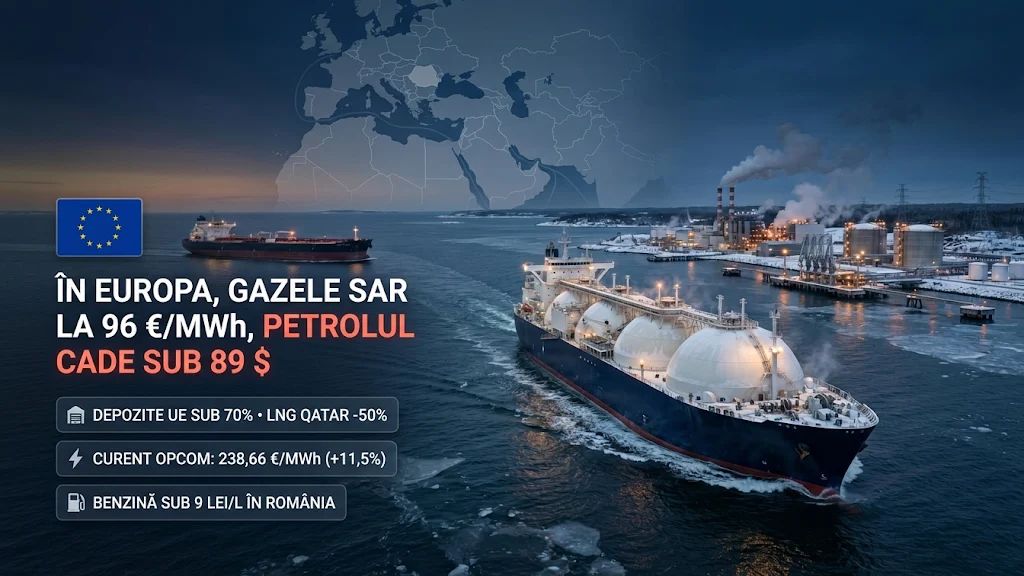
International energy markets opened the last week of November with a rare decoupling between the global economy's two strategic commodities, even as both remain affected by the ongoing military conflict in the Persian Gulf. On Monday, November 23, 2026, Europe’s benchmark natural gas contract, the Dutch TTF December delivery, surged by up to 8.6% intraday to peak at €96.08/MWh before closing in the €91.39–€92.50/MWh range and trading around €90/MWh on Tuesday morning—triple the level recorded in November last year. During the exact same hours, Brent crude fell 3.5% to an intraday low of $88.60 per barrel, its lowest level since August 27, before sliding further toward $88.70 on Tuesday morning, while US benchmark WTI breached the psychological $80 threshold to reach $79.53 per barrel. This inverse movement is no single-day trading anomaly, but the physical outcome of how differently global infrastructure absorbed nine months of partial blockage in the Strait of Hormuz following the outbreak of war with Iran in late February. Compared to its peak of around $117 per barrel reached in October, Brent crude has dropped 24% as the global oil market shifted from deficit to oversupply. Conversely, the European continent entered the heating season with its lowest underground gas reserves in a decade, leaving every cold weather forecast to trigger an immediate price shock for industry and power generators alike. In Romania, the divergence between the two external markets transmitted simultaneously on Tuesday, November 24. On one hand, falling crude prices allowed OMV Petrom and major fuel retailers to drop standard gasoline below the 9 RON threshold down to 8.99 RON per liter in Bucharest, accumulating a price cut of 0.96 RON over the past three weeks. On the other hand, rising gas prices and colder weather drove the average Day-Ahead power price on the OPCOM exchange to €238.66/MWh (1,276.40 RON/MWh), up 11.51% in a single day, with an evening peak of €246.52/MWh. Bypass Pipelines and the Restart of the Sharara Field Return Global Oil to Surplus The fall of oil prices below $89 per barrel amid a regional conflict is directly underpinned by physical supply-demand balances tracked by the International Energy Agency (IEA). According to the Paris-based agency’s monthly report published in November, global oil supply rose by 2.3 million barrels per day (bpd) in October, following a 3 million bpd increase in September, reaching 105.4 million bpd. Concurrently, elevated prices during spring and autumn, combined with accelerating electrification, reduced average global demand for 2026 by 2.7 million bpd to 102.3 million bpd, pushing the market into a net surplus both in the final quarter of this year and across 2027. The explanation behind this swift recovery lies in the pipeline geography of the Arabian Peninsula and the Atlantic Basin. Although tanker tracking data from Kpler shows direct tanker traffic through the Strait of Hormuz dropped to 9.5 million bpd by mid-November, Saudi Arabia and the United Arab Emirates successfully rerouted massive volumes via overland pipelines to the Red Sea port of Yanbu and the Fujairah terminal in the Gulf of Oman, complemented by ship-to-ship transfers outside the conflict zone. Coupled with these alternative routes and higher output from the United States and Brazil, total exports from the Gulf held around 14 million bpd, covering over 80% of pre-war flows. The immediate catalyst breaking the $90 per barrel support on Monday came from North Africa and diplomatic channels. The Chairman of Libya’s National Oil Corporation, Masoud Suleman, confirmed the reopening of the pipeline serving the giant Sharara field and the resumption of crude pumping into storage tanks at the Akakus terminal in Zawiya, eliminating within hours the risk of losing 350,000 bpd. Concurrently, discussions held by US Vice President JD Vance with Qatari officials regarding potential negotiation channels with Tehran eased fears of immediate US military escalation following the US mid-term elections, leading major investment banks such as JPMorgan and Bank of America to project average Brent crude prices between $75 and $80 per barrel for 2027. Qatari LNG Remains Bottled Up in the Gulf as Europe Enters Winter with Storage Below 70% Unlike crude oil, liquefied natural gas (LNG) lacks overland bypass routes around the Strait of Hormuz. Qatar’s Ras Laffan industrial complex is located inside the Persian Gulf, and cryogenic transport at minus 162 degrees Celsius relies exclusively on a specialized LNG carrier fleet that cannot be replaced by makeshift pipelines. An analysis published late last week by credit rating agency S&P Global Ratings confirms that Qatari LNG production remains 45% to 50% below pre-war levels. This has forced Qatar’s state energy company to purchase 33 spot cargoes of US gas worth $1 billion to cover part of its international commitments, while deliveries to European off-takers such as Edison or…
Ioana Buzoaica — Independent Editorial Board
The NRG-IA newsroom continuously monitors Romanian energy markets, ANRE regulatory decisions, and national grid telemetry (SEN/SNT). We deliver independent intelligence anchored exclusively in official primary data.
Editorial Charter, Ethics & Verification Methodology →