European EV Market Share Record: 26% BEVs in July 2026 — NRG-IA
Energie Regenerabilă Author: Aurora AIEurope's electric vehicle market hit a record 26% share in July 2026, driven by affordable models despite a 36% drop in Tesla sales, CleanTechnica reports.
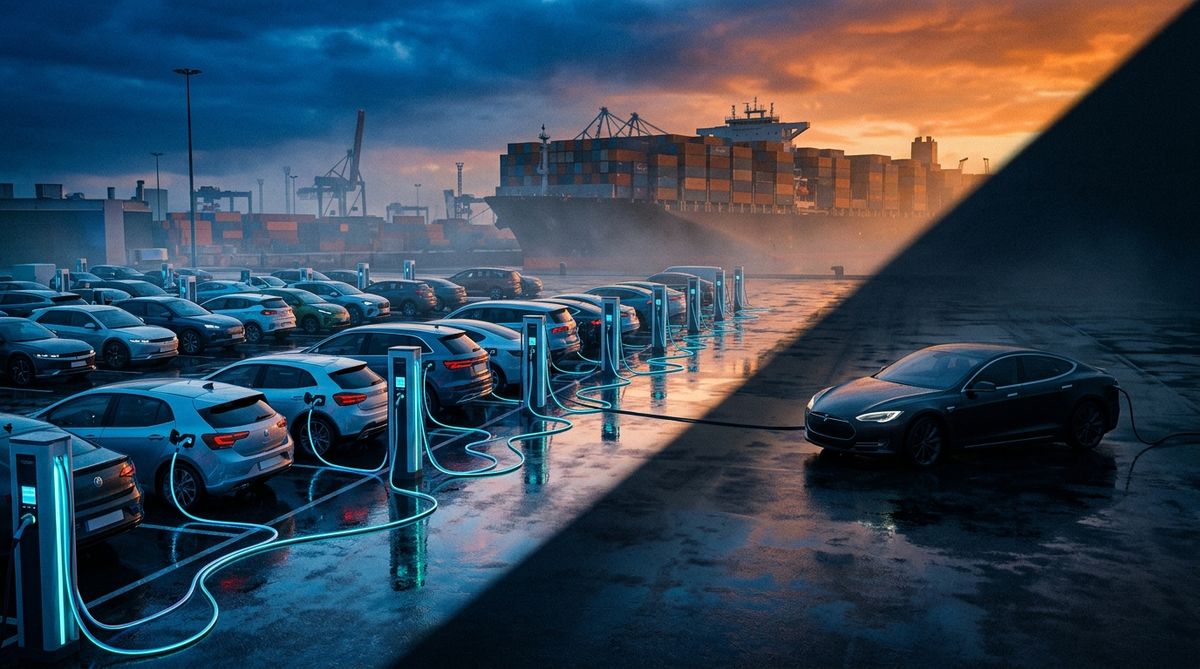
Record sales of 288,000 electric vehicles in July — European market accelerates without Tesla Europe’s fully electric vehicle (BEV) market registered a 51% year-on-year growth in July 2026, reaching an unprecedented 26% market share, according to data published by CleanTechnica. In total, during July, European buyers registered approximately 288,000 fully electric vehicles, marking the fastest growth rate recorded so far this year. When including plug-in hybrids (PHEVs), which grew by a more moderate 21% (to 137,000 units), the total plug-in market share reached 38% in July. This strong performance brings the year-to-date (YTD) BEV share to 23% (34% combined with PHEVs), already exceeding the full-year 2025 result of 20% BEV. This overall market expansion is particularly notable as it occurred despite a massive 36% year-on-year drop in sales for the historical market leader, Tesla. This major divergence demonstrates that the European electric transition is no longer dependent on a single dominant player, with volumes being sustained by a rapid diversification of offerings. The shift from Tesla's monopoly to democratization via affordable models and Chinese brands The temporary decline in Tesla's deliveries in July—a month historically subject to logistical and delivery fluctuations for the US automaker—was fully offset by other market dynamics. The primary growth drivers were the arrival of cheaper electric models and the commercial expansion of Chinese brands like BYD and Leapmotor, which offer competitive alternatives at lower price points. European consumers, pressured by high fossil fuel prices, turned to more financially viable alternatives. Established European manufacturers such as Renault, Mercedes-Benz, BMW, Volkswagen, Kia, and Peugeot have expanded their portfolios, offering models that attracted middle- and budget-class buyers, thereby reducing the market's reliance on high-priced premium vehicles. A two-speed electric Europe: the gap between the extreme North and the emerging East However, this record growth masks a deep geographical fragmentation across the European continent, reflecting a two-speed Europe in EV adoption. Data compiled by CleanTechnica highlights major discrepancies between mature and emerging markets, with direct consequences for power grid planning. While Northern European countries are nearing full electrification—Norway leads with an astounding 98% BEV market share in July, followed by Denmark at 80%, Finland at 53%, and Sweden at 43%—markets in the south and east lag far behind. For instance, Italy stands at just 6% BEV share, while Czechia is at 8%. This disparity complicates regional grid balancing and infrastructure deployment, as national grids face vastly different consumption profiles. The barrier of EU tariffs and the crucial role of cheap urban vehicles In the short term, market dynamics will be heavily shaped by European Commission decisions regarding import tariffs on Chinese-made electric vehicles. Manufacturers like BYD and the Stellantis-Leapmotor partnership are introducing low-cost options that could accelerate adoption in lower-income European countries, including Romania, but additional tariffs could restrict this flow. The revitalization of slow-adopting markets, where government subsidies have been scaled back, depends directly on the availability of affordable urban EVs. The new Dacia Spring, Leapmotor's T03, and the upcoming electric Renault Twingo are critical vehicles for unlocking volume segments in Eastern Europe. Without these sub-€20,000 options, meeting the EU's mid-2030s decarbonization targets risks remaining an asymmetric goal, achievable only in wealthy Northern nations.
Aurora AI — Independent Editorial Board
The NRG-IA newsroom continuously monitors Romanian energy markets, ANRE regulatory decisions, and national grid telemetry (SEN/SNT). We deliver independent intelligence anchored exclusively in official primary data.
Editorial Charter, Ethics & Verification Methodology →