California & Germany Shift EV Focus to Grid Capacity — NRG-IA
Tehnologie & Inovație Author: Ioana BuzoaicaCalifornia and Germany passed the 200k EV charger milestone, shifting funding from network size to fast charging, grid connections, and e-truck power.
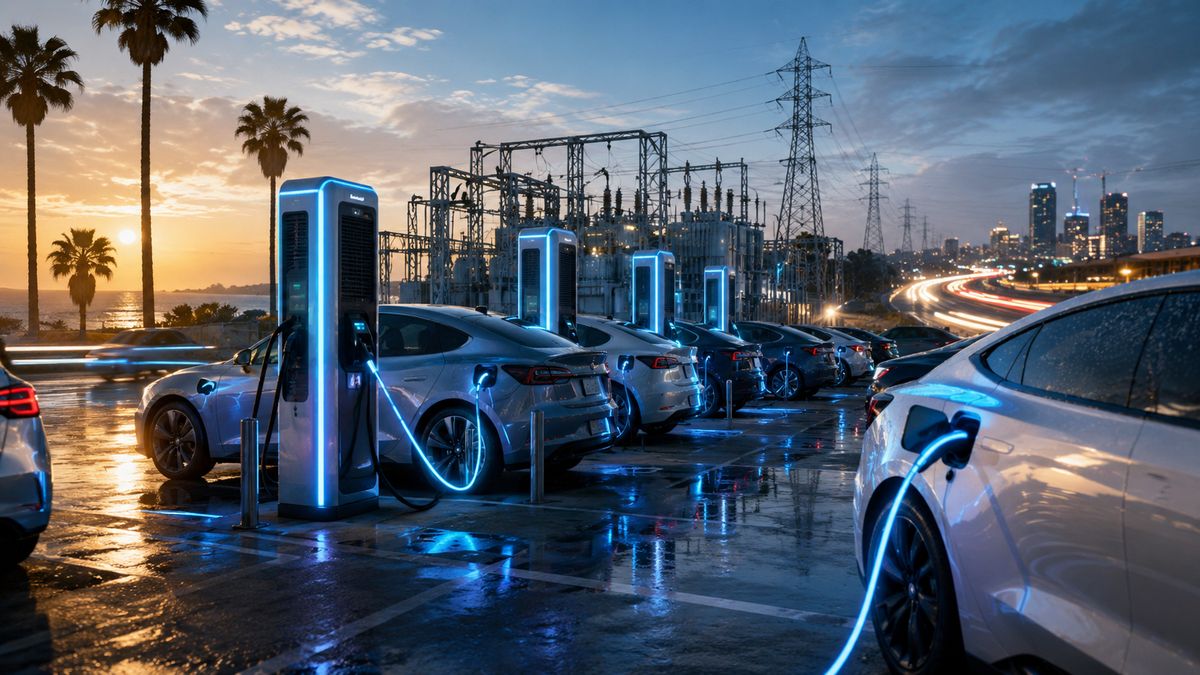
California and Germany are showcasing the next phase of electric vehicle infrastructure: the 200,000 charging point milestone is no longer the finish line, but the start of a more challenging race. Now that networks have reached critical mass, the question is shifting from "how many plugs are there" to "how fast, where, and with what power can you charge." California announced as early as September 2025 that it had surpassed 200,000 public and shared electric vehicle ports, reaching 201,180—an increase of 22,631 from the previous update in March 2025. According to the California Energy Commission, the number of EV ports was 68% higher than the state's gasoline nozzles, with the public and shared network complementing approximately 800,000 chargers installed in private homes. Germany has also crossed the 200,000 public charging point threshold. As of April 1, 2026, the Bundesnetzagentur registry reported 149,002 standard charging points and 51,253 fast-charging points, with a total simultaneous capacity of 8.50 GW available across the reported infrastructure. The 200,000 threshold changes the equation: the network exists, but not all locations matter equally For the general public, the 200,000 figure conveys the idea of a mature network. For the energy market, however, it opens up a more complex challenge. EV infrastructure is not just about the number of reported points. What matters is the power output of each point, real-time availability, location, charging times, interoperability, public access, and the local grid's capacity to handle peak demand. California has surpassed the numerical threshold, but the direction of funding shows that the state does not consider the infrastructure challenge solved. On May 28, 2026, the California Energy Commission announced $55.2 million in new funding through CALeVIP to accelerate the installation of public fast chargers. The funds are targeted at site hosts and developers who can move shovel-ready projects from the planning phase to installation. This is the real shift: funding is no longer just chasing "more chargers," but rather fast, public, and shovel-ready projects. In the first window, from October 7, 2026, to January 14, 2027, California will cover up to 100% of eligible costs for DC fast chargers, up to $100,000 per port. In the second window, from February 24 to May 27, 2027, the cap will be $55,000 per port, with a minimum power output of 150 kW. California pays for speed, not just presence on the map In the EV market, the difference between a slow charger and a DC fast port is the difference between being stationary and true mobility. For a driver who charges at home, the public network may be a backup. For a driver without a garage, for fleets, ridesharing, regional transport, or long-haul corridors, fast charging becomes critical infrastructure. The Fast Charge California Project confirms this logic. CALeVIP specifies that eligible projects must be publicly available DC fast chargers, and funding can cover up to 100% of approved costs—including equipment, installation, planning, and engineering—with tiered caps based on guaranteed power output per port: $55,000 for 150–274.99 kW and $100,000 for 275 kW or more. California is thus introducing an energy infrastructure logic, not just a mobility one. A fast EV charging point is not just an outlet in a parking lot. It is a high-power consumer connected to the grid, impacting grid connections, transformers, local load management, and, in some cases, requiring energy storage or grid upgrades. Germany shifts funding toward electric trucks and installed capacity Germany is entering the same stage, but with a strong focus on heavy-duty transport. The Federal Ministry of Transport announced a four-year, €1 billion program for charging infrastructure dedicated to battery-electric heavy-duty vehicles. The program targets both companies building depot charging and operators of public charging points for electric trucks. The key element is that Germany is not just funding the charger. Grid connections, stationary batteries, and charging and load management systems are also eligible. This structure shows that authorities are treating e-truck (e-LKW) charging as a power, flexibility, and grid issue, rather than just parking lot equipment. The German program starts with €200 million in the initial calls, and the central criterion in the competitive bidding process will be the funding amount requested per kW of installed capacity. This changes the subsidy logic: projects are evaluated not just by the number of points, but by the efficiency of public capital relative to the actual power added to the grid. For public infrastructure dedicated to electric trucks, the German call requires charging points with a minimum of 100 kW, located in traffic-relevant areas such as rest stops, charging hubs, or transshipment points. Each site must have a total nominal capacity of at least 1,500 kW, with at least one point of 350 kW or…
Ioana Buzoaica — Independent Editorial Board
The NRG-IA newsroom continuously monitors Romanian energy markets, ANRE regulatory decisions, and national grid telemetry (SEN/SNT). We deliver independent intelligence anchored exclusively in official primary data.
Editorial Charter, Ethics & Verification Methodology →