Berkeley: How metals amplify low-energy nuclear fusion — NRG-IA
Tehnologie & Inovație Author: Ioana BuzoaicaBerkeley Lab and UC Davis found that metallic hosts can boost low-energy fusion by 10¹⁸, paving the way for compact, efficient reactors.
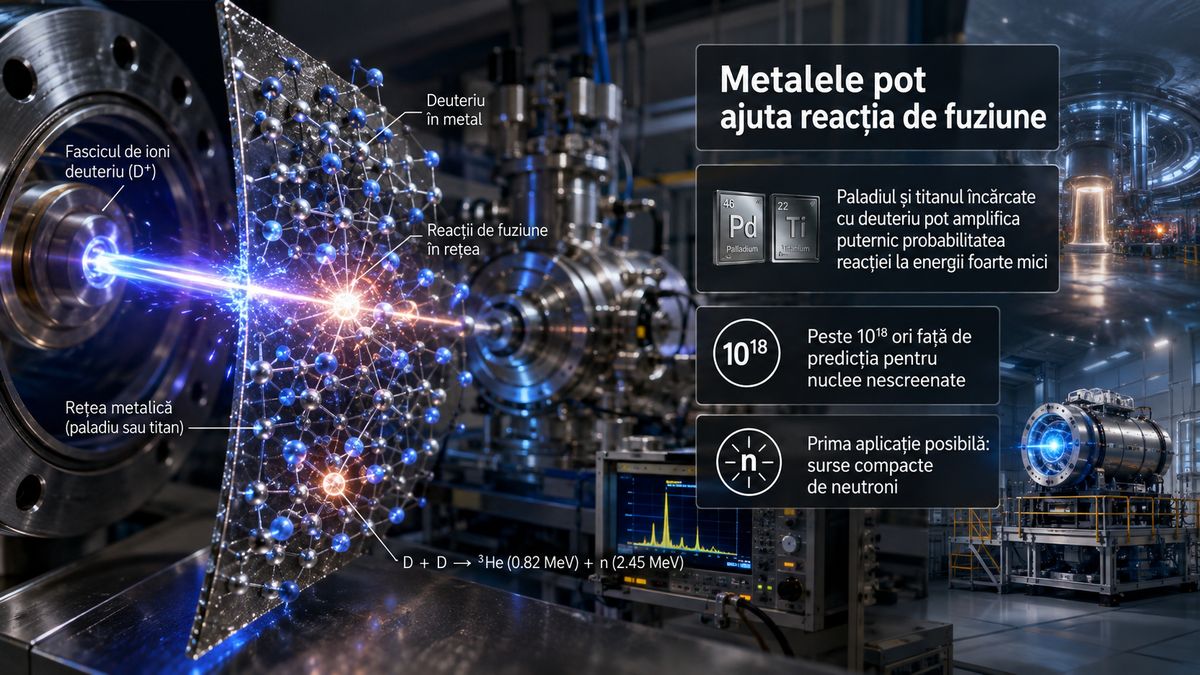
Researchers at Lawrence Berkeley National Laboratory and the University of California, Davis have opened a new frontier in the fusion race: instead of controlling the reaction solely through extreme temperatures, pressure, or magnetic fields, they have demonstrated that the host material in which the fuel is embedded can directly alter the probability of nuclei fusing . The study, published on July 18, 2026, in Nature Communications , utilized deuterium-loaded palladium and titanium. At very low energies, where the fusion probability between two isolated nuclei should drop nearly to zero, the researchers observed a persistent level of reactions. At the lower limit of the experiment, the measured yield exceeded the prediction for unscreened nuclei by more than 10¹⁸ times . This figure describes the amplification of the reaction probability , not the electrical energy produced. For the technology, the decisive question now becomes: how much can the absolute fusion rate be increased if materials are engineered specifically for this purpose? If the answer is high enough, fusion could gain a control mechanism that current major reactor concepts exploit far less: the atomic engineering of the host material containing the fuel . Until now, we heated the fuel. Berkeley shows we can start designing the nuclear environment as well Fusion produces energy when two light atomic nuclei combine into a heavier nucleus. The fundamental problem is that nuclei carry a positive electrical charge and repel each other. The dominant solution in fusion physics has been to supply them with enough energy to overcome this repulsion and draw close. ITER, the largest international magnetic confinement experiment, is designed for a deuterium-tritium plasma of approximately 150 million degrees Celsius . Its goal is a Q-factor of at least 10: roughly 500 MW of fusion power for 50 MW of heating power injected into the plasma. The US National Ignition Facility tackles the problem through compression: 192 lasers focus energy onto a tiny fuel capsule. In an experiment on April 7, 2025, NIF achieved 8.6 MJ of fusion energy from 2.08 MJ of laser energy delivered to the target, representing a target gain of 4.13. Berkeley introduces a third variable. Within a metal, electrons and the atomic structure modify the environment through which the nuclei must approach each other. Electrons can partially screen the electrical repulsion, while lattice defects and deuterium distribution can create regions where fusion becomes more probable. Berkeley Lab describes this direction as "materials-driven fusion" : the material becomes an active participant in the reaction, rather than just the container or wall that must withstand it. This perspective fundamentally expands the role of materials in fusion technologies. Until now, research has focused primarily on developing materials capable of withstanding extreme temperatures, neutron bombardment, and mechanical stresses inside the reactor. Berkeley's results suggest that the material could also play an active role: its electronic properties and crystal structure can influence the probability of the fusion reaction. If this effect can be controlled and optimized, the design of future reactors will no longer focus solely on material durability, but also on their capacity to create an environment favorable to the nuclear reaction. How the experiment works The team loaded deuterium—a heavy isotope of hydrogen—into thin foils of palladium and titanium and then bombarded the material with a beam of deuterium ions. When a deuteron from the beam gets close enough to one embedded in the metal, a deuterium-deuterium fusion reaction can occur. The researchers tracked the characteristic nuclear products of the reaction and varied the beam energy to observe how rapidly the fusion probability decreased. The surprising result occurs below approximately 2–2.5 keV . Instead of the yield continuing to drop exponentially, the experiments reveal a "plateau": reactions persist at a level far higher than anticipated for isolated nuclei. This phenomenon was observed in both palladium and titanium hydrides. The complete microscopic mechanism is the next puzzle to solve. The team is investigating the role of electronic structure, crystal defects, composition, and how deuterium is distributed within the material. The first application could be much closer than a power plant: compact neutron generators Berkeley is already pointing to a very concrete practical direction: more compact and efficient neutron sources . Neutron generators are essentially electrically controllable devices that produce small-scale fusion reactions. The International Atomic Energy Agency operates such equipment using deuterium-deuterium and deuterium-tritium reactions. The facility's compact generators can reach up to approximately 4×10⁸ neutrons per second and can be switched off electrically, unlike isotopic sources that emit continuously. Neutrons are…
Ioana Buzoaica — Independent Editorial Board
The NRG-IA newsroom continuously monitors Romanian energy markets, ANRE regulatory decisions, and national grid telemetry (SEN/SNT). We deliver independent intelligence anchored exclusively in official primary data.
Editorial Charter, Ethics & Verification Methodology →