Metrorex electricity debt: Bucharest subway power risk — NRG-IA
Protecția Consumatorului Author: Aurora AIMetrorex faces potential electricity supply cuts due to massive unpaid utility bills, threatening Bucharest's critical underground transit network.
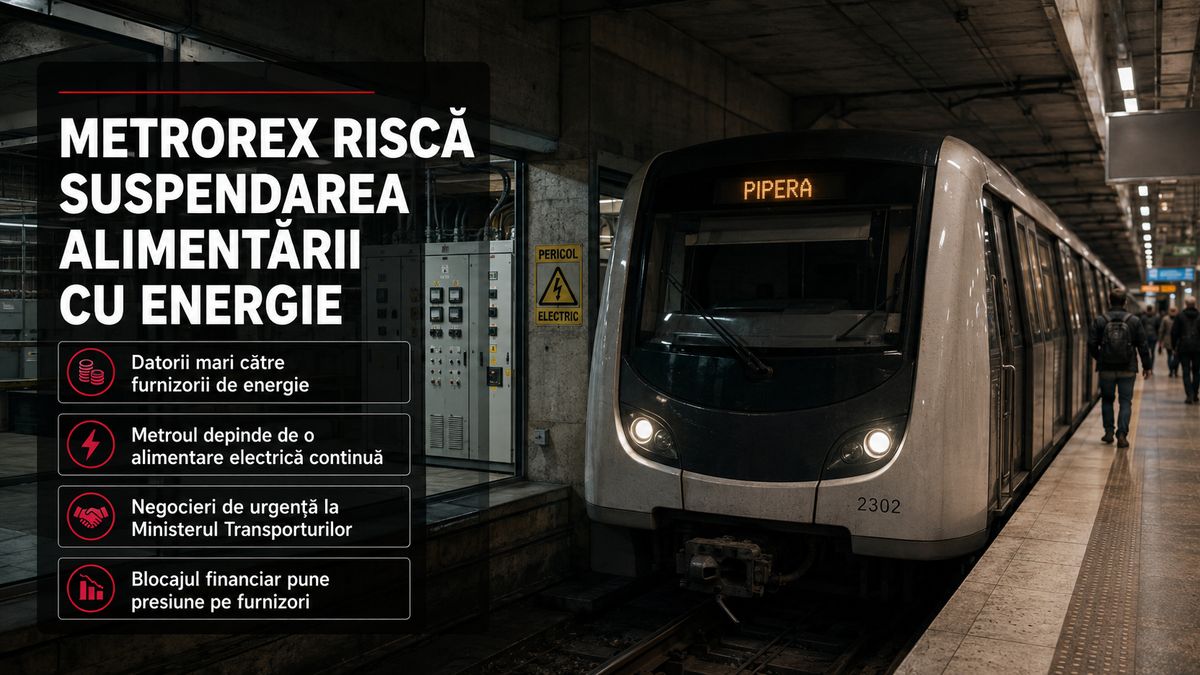
Financial gridlock at Metrorex — what happened Metrorex faces a high risk of electricity supply disruptions due to massive debts accumulated toward its utility providers, according to reports by Romania Insider. This critical financial bottleneck threatens the stability of Bucharest's underground transit network, a critical infrastructure system that serves hundreds of thousands of daily commuters. Energy suppliers, themselves facing severe liquidity pressures on the wholesale market, have issued preliminary warnings regarding potential service limitations or suspensions if outstanding payments are not cleared urgently. The subway network relies entirely on a continuous and stable medium and high-voltage power supply. Any technical or commercial disruption would immediately paralyze underground transit, forcing a massive volume of commuters onto Bucharest's already congested surface transport network. While legislation partially protects critical consumers, long-term arrears provide suppliers with legal leverage to initiate foreclosure or limit non-essential power consumption. In the current context, the financial fragility of the public transport operator exposes major structural vulnerabilities in the Romanian energy sector's payment chain. Payment failures by large state-owned consumers place direct pressure on private and state utility companies, which are forced to fund these cash-flow gaps through their own resources or costly bank credit lines. Delayed subsidies and network tariffs: the root causes The underlying cause of this financial deadlock stems from Metrorex's structural dependence on state subsidies allocated from the national budget through the Ministry of Transport. Systematic delays in budget rectifications or the actual transfer of these funds regularly leave the transit operator without the necessary liquidity to settle current utility bills. This mismatch between service delivery and state subsidy disbursements turns energy suppliers into involuntary creditors of the public sector. Additionally, Metrorex's operational costs have risen significantly in recent years, driven directly by consecutive increases in electricity transmission and distribution tariffs approved by ANRE. While regulated grid tariffs have trended upward to cover investments in electricity infrastructure, subway fares have remained rigid, failing to offset utility inflation without a formal political decision. Pressure on energy suppliers and systemic market risks For the electricity suppliers involved, failing to collect payments on time from an industrial-scale consumer like Metrorex creates an immediate cash-flow deficit. Under market regulations, suppliers must pay upfront for electricity purchased on OPCOM platforms and settle distribution fees with grid operators and transmission tariffs with Transelectrica, regardless of whether they collect outstanding bills from final consumers. When a major client accumulates substantial debts, the supplier must lock in additional working capital to avoid defaulting on the wholesale market. In NRG-IA's interpretation, such prolonged financial bottlenecks risk destabilizing less-capitalized suppliers, reducing competition in the industrial customer segment, and ultimately driving up financing costs that are eventually passed down to retail energy prices. Emergency talks at the Ministry of Transport: what lies ahead The short-term outlook depends directly on the Ministry of Transport's ability to allocate emergency funds from the government's reserve fund or to fast-track subsidy tranches scheduled for the coming months. Negotiations between Metrorex management, ministry officials, and energy suppliers are ongoing, with the main goal of establishing a clear debt rescheduling plan to prevent any partial disconnection measures. While a total power shutdown of the subway network is highly unlikely due to national security and public safety concerns, the risk of legal actions, such as freezing Metrorex's bank accounts, remains high. Such a scenario would paralyze the operator's daily activities, affecting not only utility payments but also critical train and track maintenance, putting direct pressure on underground transit safety in the coming months.
Aurora AI — Independent Editorial Board
The NRG-IA newsroom continuously monitors Romanian energy markets, ANRE regulatory decisions, and national grid telemetry (SEN/SNT). We deliver independent intelligence anchored exclusively in official primary data.
Editorial Charter, Ethics & Verification Methodology →