Hagag Proposes 5 GWh Salt Mine Storage in Romania — NRG-IA
Tehnologie & Inovație Author: Aurora AIHagag and Airengy propose a 5 GWh compressed air storage project in Romanian salt mines, designed for long-duration, multi-day grid flexibility.
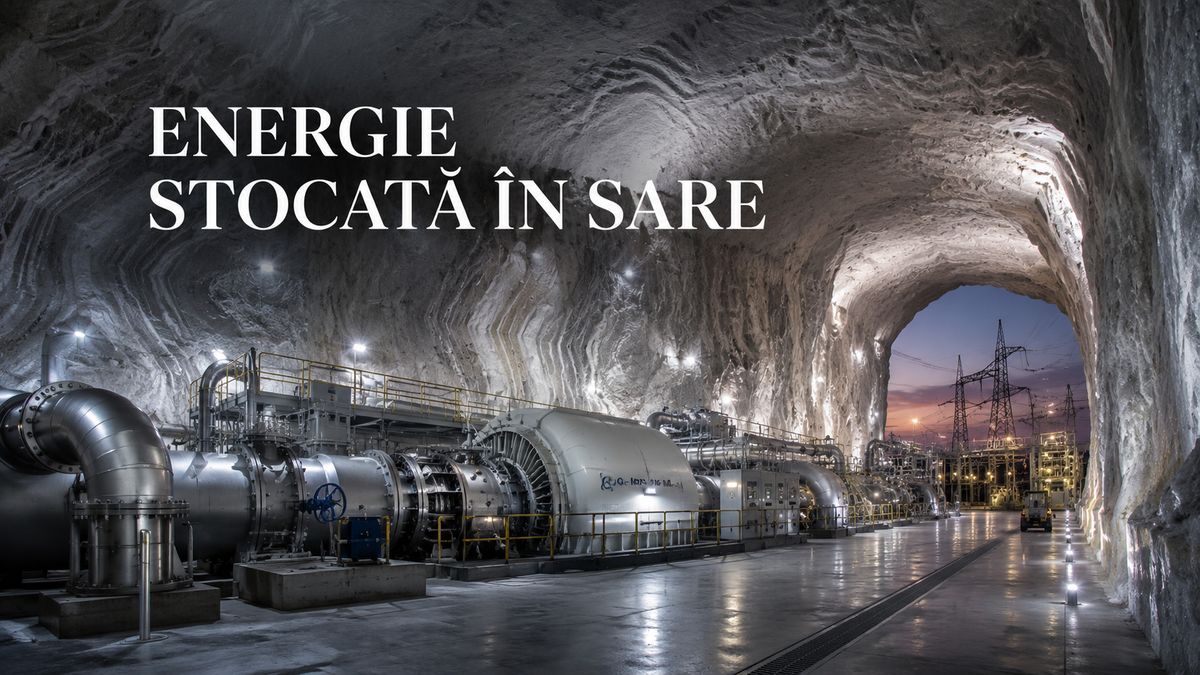
Hagag Europe has signed an agreement with Israeli company Airengy to develop compressed air energy storage (CAES) facilities in Romanian salt mines using AirBattery technology. The project is planned in two phases, with an initial capacity of around 200 MWh and a final target of up to 5 GWh, at a discharge capacity of approximately 25 MW. The total estimated investment is €55 million: €4.5 million for the first phase and €50 million for the expansion up to 5 GWh. The shareholding of the project vehicle is expected to be split between Hagag Europe, Airengy, and a third party in a 40% / 40% / 20% ratio. The location is not specified in the companies' press release, leaving open questions regarding the chosen mine, geology, grid connection, and permitting process. 5 GWh means long-duration storage, not a fast-response battery The central figure of the project is 5 GWh. Relative to a discharge capacity of around 25 MW, this indicates an exceptionally long theoretical duration for energy delivery. A simple calculation is telling: 5,000 MWh / 25 MW = 200 hours. This translates to over eight days of continuous discharge at 25 MW, assuming the stored energy is fully available and the system operates at this capacity. This ratio places the project squarely in the long-duration energy storage (LDES) segment, operating on a completely different logic than the lithium-ion batteries commonly used for 2–4 hour periods. For the power system, this distinction matters. A fast-response battery can support frequency regulation, short-term balancing, and shifting energy from midday to evening. A 25 MW / 5 GWh solution serves a different function: long-duration delivery, covering extended deficit periods, and managing energy over multiple hours or days. Compressed air uses the mine as an energy reservoir The announced technology is based on the principle of compressed air energy storage. During the charging phase, surplus electricity is used to compress air. The air is then injected and stored in salt mines or caverns, which offer large volumes and natural airtightness. During the discharge phase, the compressed air is released, pressurizing a hydraulic circuit. Water is directed through a turbine, and the mechanical energy is converted back into electricity for the grid. According to the companies' description, the process utilizes only water and air. This architecture shifts the primary cost from electrochemical cells to geology, compression equipment, turbines, hydraulic installations, underground works, mining safety, automation, and grid connection. The mine does not produce energy; it merely functions as a storage vessel for compressed air. The announced cost seems low, but comparisons require caution The total investment reported by Economica.net , of approximately €55 million for up to 5 GWh, suggests an extremely low cost when measured strictly against stored energy. This calculation would yield roughly €11/kWh of energy capacity. This figure should not be mechanically compared to lithium-ion batteries. In a compressed air system, stored energy depends on the available underground volume, while actual power output depends on compressors, turbines, operating pressures, and the conversion architecture. The cost per installed MW, efficiency, operating cycles, and actual discharge duration are just as critical as the total stored energy. At 25 MW and €55 million, the project indicates approximately €2.2 million per installed MW. This perspective provides a clearer picture of the investment size relative to the capacity available to the grid. For the market, the project's value will depend on how Romania remunerates long-duration storage, rather than just raw energy capacity. Salt mines require rigorous geological assessments and complex permitting The location remains the critical bottleneck. Not every salt mine can be converted into a compressed air reservoir. Studies are required on airtightness, geomechanical stability, allowable pressures, water infiltration risks, water interaction, mining safety, and environmental impact. The recent case at the Praid mine demonstrated how sensitive underground salt infrastructure can be to water and stability issues. For an energy storage project, this type of risk must be thoroughly evaluated before drawing any conclusions about feasibility. There is also another major technical condition: grid connection. A 25 MW facility is not massive in terms of capacity, but it requires access to an area with surplus energy for charging and the ability to inject power when the grid needs it. The distance to the grid, connection costs, and the local renewable generation profile can significantly alter the project's economics. Romania needs storage of varying durations Romania is installing increasingly more solar capacity, and the grid is beginning to feel the strain between abundant midday generation and evening peak demand. Storage is becoming essential flexibility infrastructure, not just a…