Finland Tests LDR-50 SMR for Nuclear District Heating — NRG-IA
Tehnologie & Inovație Author: Aurora AIFinland is testing a new path for SMRs: urban heat. Steady Energy's Helsinki pilot uses a fuel-free LDR-50 replica to validate the technology.
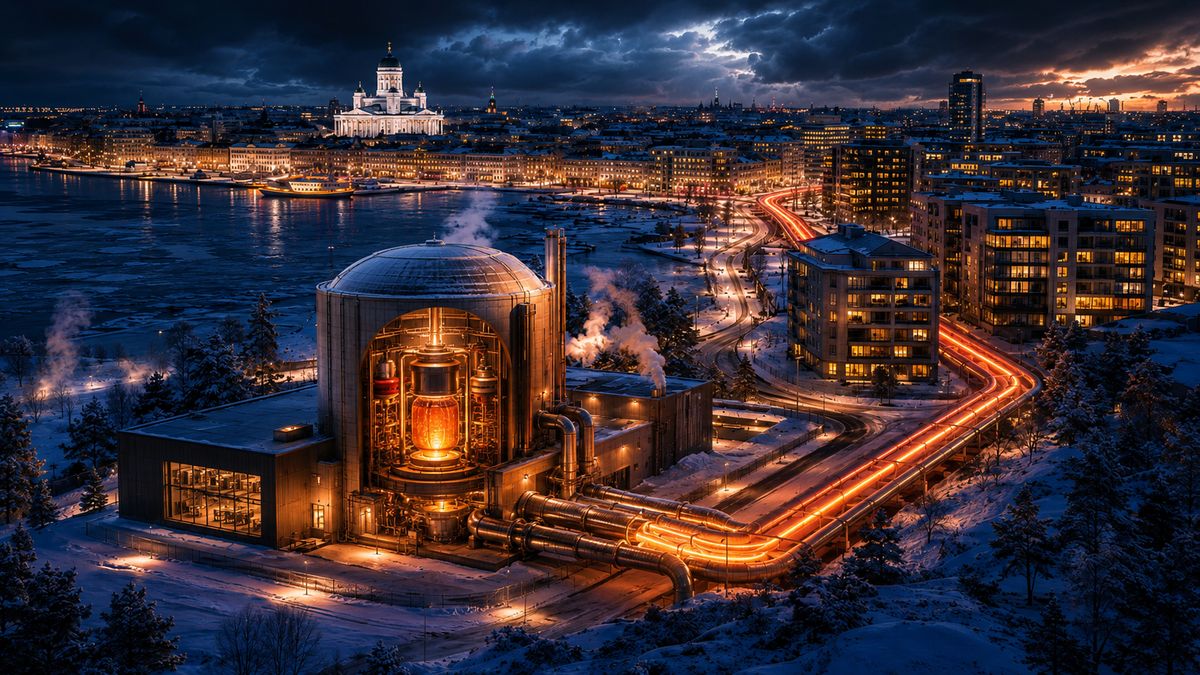
Finland is carving out a new path for small-scale nuclear power: reactors dedicated to district heating. Finnish company Steady Energy has begun constructing a full-scale pilot in Helsinki for the LDR-50, a small modular reactor designed for urban district heating with a capacity of 50 MW thermal . The project is located at the former Salmisaari B coal-fired power plant, decommissioned by energy utility Helen, with the first concrete pour taking place in February 2026. The Helsinki pilot uses a full-scale replica of the LDR-50 technology, but testing is conducted without nuclear fuel . Instead of a reactor core, the facility utilizes an electric resistor to simulate the heat produced by the reactor. The heat generated during the testing phase will be delivered to Helen's district heating network, according to Steady Energy. Nuclear power enters the logic of district heating The LDR-50 is designed to address a concrete problem: cities need stable, clean, and winter-ready heat when thermal demand spikes. In Steady Energy's model, the reactor directly produces heat for the municipal network, bypassing the traditional electricity generation phase. This represents a major shift in terms of cost and complexity. A conventional nuclear power plant heats a coolant, produces steam, spins a turbine, and generates electricity. The LDR-50 simplifies this chain: the reactor produces heat, which is directly transferred to the district heating network. Steady Energy claims that the absence of turbines and generators allows nearly all of the generated energy to be distributed directly to the heating grid. For the general public, the concept is simple: a mini-reactor powers radiators rather than lightbulbs. For cities, the goal is to gradually replace coal, gas, or other combustion-based sources with a constant, low-emission heat source. LDR-50: 50 MW thermal, low temperature, and low pressure The LDR-50 unit is designed for 50 MW of thermal capacity . The reactor operates at approximately 150°C and under 10 bar —temperatures and pressures significantly lower than those of conventional nuclear reactors used for power generation. These conditions reduce technical stress on the facility and allow for a simpler architecture tailored for district heating applications. The reactor's size is another key factor. Steady Energy describes the LDR-50 as comparable to a shipping container, and World Nuclear News notes that future commercial units are designed for underground construction. This footprint reshapes the public perception of nuclear energy. Instead of a massive plant located far from urban centers, Steady Energy's model envisions modular heating plants built close to existing district heating networks—potentially underground—with minimal visual impact. Salmisaari: former coal plant becomes a laboratory for nuclear heat The choice of location carries symbolic weight. The pilot is being built in the turbine hall of Salmisaari B, a coal-fired plant decommissioned by Helen. The closure of Salmisaari marked the end of coal use in Helen's generation portfolio, as the company aims for climate neutrality by 2030 and entirely combustion-free energy production by 2040. Transforming a former coal plant into a testing ground for nuclear heat highlights the energy transition pressures facing Nordic cities. District heating cannot be decarbonized simply by shutting down old sources. Cities require new, dispatchable sources capable of delivering heat during the cold season. For Helsinki, small-scale nuclear is part of a broader portfolio of solutions. Helen is evaluating investments of €1–5 billion in SMR capacity over the coming years, and the company has launched a planning process to select a site by the end of 2027. The investment would be on the lower end if the chosen solution produces only heat, and higher if the project involves combined heat and power (CHP) generation. Why district heating changes the SMR equation Small modular reactors are typically associated with electricity generation. In Finland, Steady Energy is championing a narrower but potentially more easily integrated model: heat production for urban grids. This approach matters because district heating operates under a different logic than the electricity market. Power prices are highly volatile, driven by wind, solar, hourly demand, and balancing costs. In contrast, urban heating experiences strong, predictable seasonal demand, particularly in winter. A dedicated heat reactor can serve as a baseload source for the thermal grid, complemented by other technologies during peak demand. For cities with mature district heating networks, this model could prove highly attractive. The reactor does not need to compete hourly with wholesale electricity prices. Instead, it delivers heat directly into a local system where demand is concentrated and distribution infrastructure is already in place. Fortum joins the project with nuclear expertise Steady Energy is not developing this…
Aurora AI — Independent Editorial Board
The NRG-IA newsroom continuously monitors Romanian energy markets, ANRE regulatory decisions, and national grid telemetry (SEN/SNT). We deliver independent intelligence anchored exclusively in official primary data.
Editorial Charter, Ethics & Verification Methodology →