Mintia Plant: 575 MW Turbine Nears Commercial Operation — NRG-IA
Piața de Energie Author: Ioana BuzoaicaMintia's first 575 MW gas turbine will enter commercial operation on Nov 17-18. The €1.4B investment will boost domestic generation and cut imports.
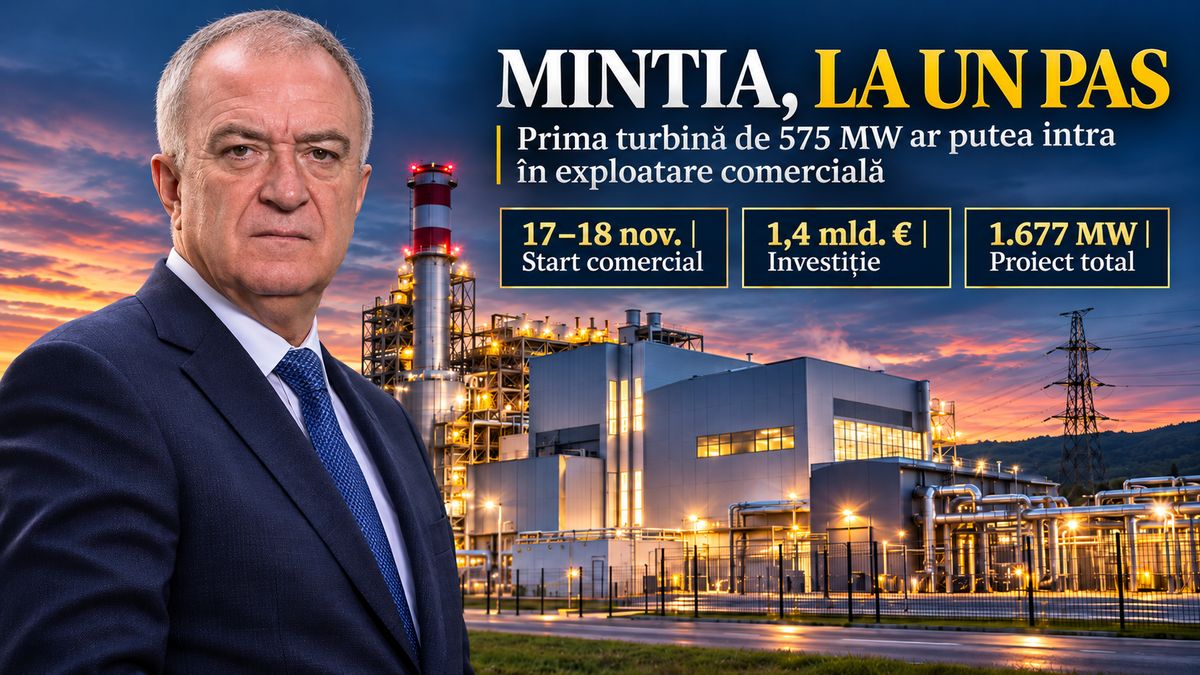
Romania is preparing to bring a major new power generation capacity into commercial operation. The first turbine at the Mintia natural gas power plant, with an installed capacity of 575 MW, is scheduled to start commercial production on November 17 or 18, 2026, according to an announcement made on Monday, November 16, by Ion Sterian, CEO of Transgaz. The milestone marks the approach of the first commercial phase of a private energy investment estimated at approximately €1.4 billion. Developed by Mass Global Energy Rom on the site of a former coal-fired power plant in Hunedoara County, the new facility is designed for a total installed capacity of 1,677.12 MW. Once completed, it will become the largest single-site combined-cycle gas turbine (CCGT) power plant in the European Union. Its phased commissioning represents a key development for Romania at a time when domestic generation adequacy and import dependency have become central energy security concerns. "I have good news here: starting tomorrow or the day after, the team at the Mintia plant will begin commercial production with the first turbine and will enter production testing with the second turbine," Ion Sterian announced at the "Energy for Romania – Transatlantic Edition" conference. The statement sets an imminent timeline for commercial operations, the actual execution of which remains to be confirmed by the plant operator and relevant regulatory authorities. From initial testing to commercial operations: Mintia enters a decisive phase The first turbine at the Mintia plant was synchronized with the National Power System on October 15, 2026. According to the quarterly report published by TSO Transelectrica on November 13, the equipment was connected to the grid across two intervals during its first test day, reaching a peak gross output of 135 MW at the generator terminals. A period of technical fine-tuning and testing followed to optimize operating parameters. Transelectrica and Mass Global agreed to align testing schedules with grid demand, including scheduling generation during evening peak hours when electricity demand is high. As a result, the plant's initial test deliveries contributed to supplying the system even during the commissioning phase. However, transitioning to commercial operation fundamentally changes the framework under which the plant monetizes its output. During testing, output follows a technical schedule agreed upon with the system operator and is subject to a provisional commercial mechanism. According to project documentation, remuneration for electricity injected during testing—under positive pricing conditions—is capped at the lower of the day-ahead market clearing price or 400 RON/MWh. The completion of commissioning tests and compliance with technical and regulatory requirements enable the shift to commercial operation, allowing market participation under standard rules for licensed power generators. This transition is significant both for the project's commercial revenues and for securing a major new source of dispatchable capacity for the national grid. What 575 MW means for Romania's power generation and electricity imports Mintia's first turbine accounts for approximately one-third of the plant's total designed capacity. Operating hypothetically for 24 hours at its rated capacity of 575 MW, it could generate 13.8 GWh of electricity before auxiliary consumption and operational constraints. Actual production will depend on available capacity, running hours, dispatch schedules, and market conditions. For the Romanian power system, the primary advantage lies in adding flexible, dispatchable capacity. Unlike solar and wind assets, whose output fluctuates with weather conditions, gas turbines can be dispatched based on fuel availability, power demand, and grid requirements. This flexibility is particularly valuable during evening peak hours, when solar generation drops off while demand remains high. Competitive incremental output from Mintia can curb import requirements during specific time blocks, meeting demand through domestic generation. However, the net effect on wholesale electricity prices will depend on natural gas prices, carbon allowance costs (EU ETS), thermal plant availability, and market conditions across coupled regional bidding zones. Output from Mintia will compete economically against net imports and other dispatchable assets, leveraging cost competitiveness wherever market dynamics permit. The facility's contribution is also critical for integrating renewable energy. As Romania expands its solar and wind capacity, the grid increasingly requires dispatchable resources to bridge periods of low renewable output and high demand. Mintia can provide a portion of this needed flexibility alongside hydro assets, battery storage, and other dispatchable plants. The €1.4 billion investment: Two gas turbines and a combined-cycle layout The Mintia project utilizes Siemens Energy technology, featuring two SGT5-9000HL…
Ioana Buzoaica — Independent Editorial Board
The NRG-IA newsroom continuously monitors Romanian energy markets, ANRE regulatory decisions, and national grid telemetry (SEN/SNT). We deliver independent intelligence anchored exclusively in official primary data.
Editorial Charter, Ethics & Verification Methodology →