Romanian diesel above RON 10: Refining pressures persist — NRG-IA
Piața de Energie Author: Ioana BuzoaicaDespite a 20% excise cut, Romanian diesel is back above RON 10/l. Tight refining capacity and low EU stocks keep diesel-to-Brent spreads near record highs.
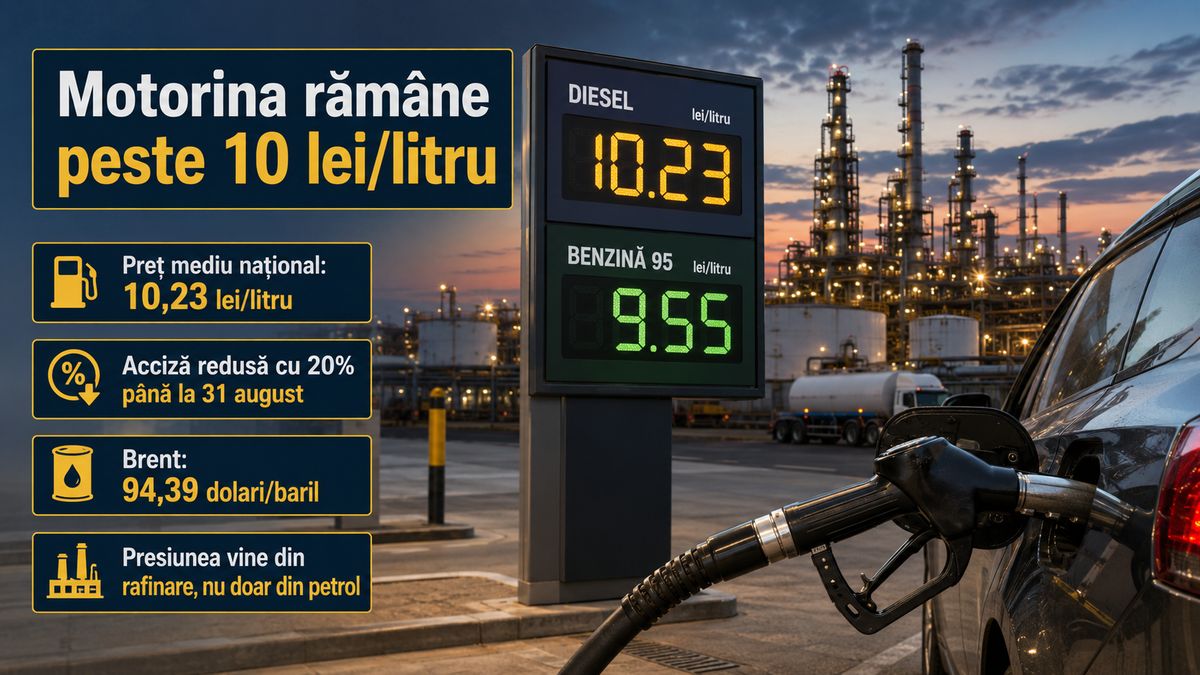
Standard diesel averaged RON 10.23/liter in Romania on the morning of August 23 , despite a temporary 20% excise duty reduction applied by the government between August 16 and 31. Standard gasoline stood at RON 9.55/liter. For a 50-liter tank, the average price of diesel already translates to approximately RON 512. The trend at the pump shows that current pressures cannot be explained by crude oil prices alone. Brent closed on Friday, August 21, at $94.39/barrel, following a weekly gain of 6.39%. However, the refined products market is far more strained: the spread between European diesel and crude oil has surged toward historic highs, driven by reduced refining capacity in the Middle East and Russia, low European inventories, and disrupted maritime flows. For Romania, this spread has a direct impact. While the country possesses significant refining capacity, approximately 77% of its processed crude is imported. Consequently, even if crude oil prices stabilize, the cost of the finished product can continue to rise, driven by dynamics occurring between the barrel and the pump. Diesel climbs back above RON 10 across all major retail networks Data available on August 23 at 06:27 AM indicated a national average price of RON 10.23/liter for standard diesel, with prices ranging between approximately RON 10.02 and RON 10.40/liter. Premium diesel averaged RON 10.96/liter. Price variations among major retail networks remain visible. Petrom averaged approximately RON 10.14/liter , Socar RON 10.15, Rompetrol RON 10.19, while OMV and MOL stood at around RON 10.20. In the aggregated morning data, Lukoil was positioned at approximately RON 10.40/liter. Regional differences also remain relatively narrow. The lowest prices identified in Bucharest and Iași hovered around RON 10.14/liter, while in Cluj-Napoca they dipped to RON 10.09, and in Timișoara to RON 10.10. Nationwide, the lowest available quotes reached approximately RON 10.02/liter. Prices fluctuate throughout the day, and discrepancies may occur between online aggregators and actual station displays, but the overall picture is clear: standard diesel has widely returned above the RON 10/liter threshold . Excise duty cut quickly followed by fresh price hikes Starting August 16, the excise duty on standard diesel was temporarily reduced by 20%, equivalent to RON 560.86 per 1,000 liters. The Ministry of Finance estimated a total net effect, including VAT, of approximately RON 0.68 per liter . On the first day of implementation, the impact was clear. Petrom had lowered standard diesel to RON 9.99/liter, and several other networks hovered around the RON 10 mark. However, the market quickly began clawing back some of these savings. Approximately 48 hours after the tax cut, several networks raised prices by about RON 0.15 per liter. By the morning of August 23, Petrom had reached RON 10.14/liter, OMV and MOL were at roughly RON 10.20, and the national average had climbed to RON 10.23. The excise cut continues to keep prices lower than they would have been under the same market conditions without fiscal intervention. However, the recent price hikes demonstrate that external supply costs and refined product dynamics are simultaneously driving retail prices. Diesel decouples sharply from crude oil prices The spread between crude oil and diesel has emerged as one of the market's most critical variables. At the beginning of the year, the premium of European diesel over Brent crude was around $25 per barrel. By August 21, this spread had surged to approximately $76.52 per barrel , nearly tripling. This indicator measures, in market terms, the difference between the value of the refined product and the raw material from which it is derived. It does not represent the refinery's net profit: processing costs, energy, logistics, maintenance, and other overheads must be covered from this spread. However, its expansion highlights just how much more expensive the finished product has become relative to crude oil. This mechanism explains why a stabilization in Brent prices does not automatically guarantee cheaper diesel. Crude oil may be available, but it must be processed into fuel at an operational refinery, and the product must then be transported to deficit markets. Currently, this specific link in the supply chain is under severe strain. Refineries emerge as the market's primary vulnerability Middle Eastern refinery output was approximately 2.9 million barrels per day below pre-conflict levels in the second quarter , according to Reuters data. For the third quarter, the deficit was estimated at around 2.2 million barrels per day. Simultaneous pressure is coming from Russia, where attacks on energy infrastructure have dragged refinery runs down to very low levels. The impact is directly visible in refined product trade. In July, diesel exports from Russia, the Middle East, and major Asian producers were approximately 1.3 million barrels per day lower than a year earlier . This…
Ioana Buzoaica — Independent Editorial Board
The NRG-IA newsroom continuously monitors Romanian energy markets, ANRE regulatory decisions, and national grid telemetry (SEN/SNT). We deliver independent intelligence anchored exclusively in official primary data.
Editorial Charter, Ethics & Verification Methodology →