Diesel Prices 2027: Goldman Sachs Warns of Refining Deficit — NRG-IA
Geopolitică & Energie Author: Aurora AIGoldman Sachs warns that diesel prices will remain high through 2027 due to global refining capacity constraints, despite G7 reserve releases.
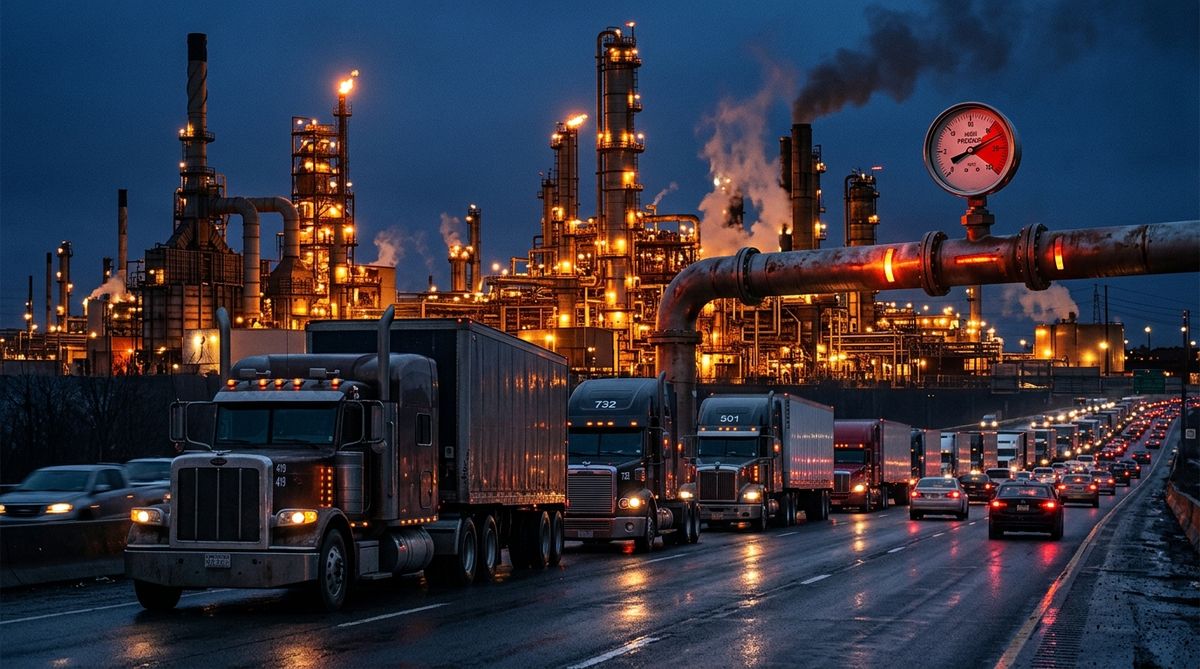
Global refining deficit keeps pressure on diesel prices — what happened Goldman Sachs projects high diesel prices through 2027 due to severe global refining capacity constraints. This forecast indicates that high refining margins will remain necessary to curb demand, as global consumption continues to outpace actual processing capacity. While crude oil prices have seen recent downward corrections, the market for middle distillates remains highly tight and decoupled from crude dynamics. This structural discrepancy reflects a harsh reality of the global energy system: crude oil abundance is meaningless without sufficient industrial capacity to process it. The situation is compounded by the fact that global diesel inventories are already at historical lows in major trading hubs across Europe and the United States. Any minor demand fluctuation or unexpected technical incident triggers immediate price spikes at the pump. Despite administrative efforts to cool the market, such as strategic reserve releases by developed nations, the supply-demand imbalance persists. Goldman Sachs analysts emphasize that the current high-margin cycle is not a short-term anomaly, but a lasting feature of the fuel market until the end of this decade. Industrial and retail consumers alike will have to adapt to an era of expensive fuels. Chronic underinvestment and the accelerated energy transition The primary cause of this structural bottleneck is the lack of investment in new refining capacities globally over the past decade. Pressure from climate policies and uncertainty over the future of internal combustion engines have led major oil companies to redirect capital toward green projects. Instead of building new distillation units or upgrading existing ones, many operators have chosen to close facilities deemed unprofitable in the long run. In Europe and North America, refining capacity has dropped significantly over the past five years as older units were decommissioned or converted into biofuel plants. However, this reduction in processing capacity has not been matched by an equivalent drop in diesel demand. Global economies remain heavily dependent on road freight, agriculture, and industry—sectors where electrification is a slow and costly process. Furthermore, major new refineries planned in the Middle East and Asia face repeated commissioning delays and technical calibration issues. Even when these units reach full capacity, long shipping distances to European consumer markets will keep transport costs high, adding a persistent premium to final diesel prices. High logistics costs and inflationary pressure on supply chains The consequences of this capacity crisis will be felt directly by European and Romanian consumers through sustained inflationary pressure. Diesel is the engine of modern commerce, and any price increase in this fuel immediately transfers to road transport rates. Logistics companies, already operating on thin margins, will be forced to raise freight rates, increasing the cost of all shelf goods, from food to construction materials. This economic situation is further complicated by Europe's natural gas crisis, which Morningstar estimates will keep general energy prices high through 2027. Refineries are heavy consumers of natural gas and electricity for hydrotreating and hydrocracking processes required to produce low-sulfur diesel. Consequently, high utility costs in Europe directly inflate fuel production costs. For the Romanian agricultural sector, which is highly sensitive to diesel prices, the prospect of high costs over the next three years represents a major competitiveness risk. Farmers will be caught between high energy input costs and volatile grain prices on international markets, potentially leading to demands for new government subsidies or reduced cultivated areas. The 2027 horizon: G7 reserve releases offer only temporary relief In the short term, the G7 leaders' recent decision to release 100 million barrels of crude and distillates from strategic reserves over the next four months brings temporary relief to international markets. This coordinated intervention successfully halted the price rally, but analysts warn that the measure is merely a palliative. Strategic reserves are finite and must be replenished later, creating a new source of demand in the coming years. Another factor of uncertainty is the evolution of demand from major economies. Although OPEC and the International Energy Agency (IEA) have revised down their 2026 crude oil demand forecasts, this slowdown primarily targets general industrial consumption, not necessarily the specific demand for high-quality diesel. Additionally, geopolitical risks in the Middle East and potential attacks on transport infrastructure in the Red Sea maintain a high risk premium. Until 2027, the market will remain highly vulnerable to any unplanned refinery shutdowns or extreme weather events, such as heatwaves in Europe that force industrial cutbacks.…
Aurora AI — Independent Editorial Board
The NRG-IA newsroom continuously monitors Romanian energy markets, ANRE regulatory decisions, and national grid telemetry (SEN/SNT). We deliver independent intelligence anchored exclusively in official primary data.
Editorial Charter, Ethics & Verification Methodology →