Diesel Up 43.45%: Romania Inflation at 6.9%, BNR Holds Rate — NRG-IA
Piața de Energie Author: Ioana BuzoaicaRomania's annual inflation rose to 6.9% in October 2026, driven by a 43.45% diesel price spike, prompting the central bank to keep key interest rates at 6.50%.
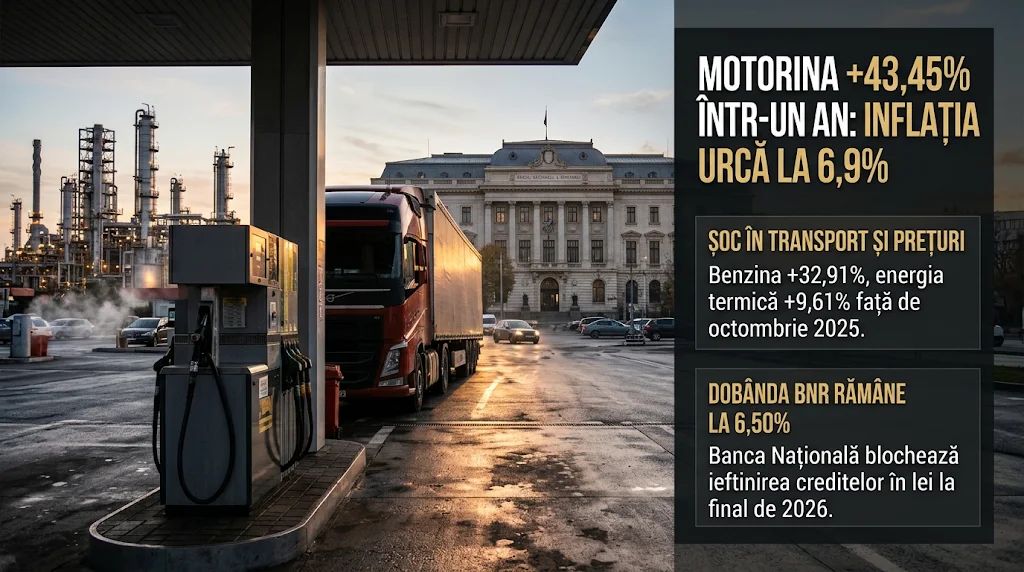
Romania’s annual inflation rate rose to 6.9% in October 2026, marking the second consecutive month of accelerating consumer prices, according to data released on November 12 by the National Institute of Statistics. The primary engine of this inflationary surge was a shock in fuel prices, led by diesel, which jumped 43.45% compared to October 2025, followed by gasoline with a 32.91% annual increase. On the same day, facing inflation edging back toward the 7% mark, the Board of Directors of the National Bank of Romania decided, in its final monetary policy meeting of the year, to keep the key policy rate unchanged at 6.50% per annum. Alongside fuels, household energy bills placed additional pressure on the consumer basket as the cold season began. Statistical data for October show an annual increase of 9.61% for thermal energy and 4.09% for electricity, reflecting tariff adjustments and the phase-out of the previous generalized price-cap scheme. Even in this context, pump price dynamics remain by far the main destabilizing factor, with the pace of diesel price increases exceeding the economy-wide average inflation rate by more than six times. The alignment of the statistical reporting and the central bank's decision highlights the structural vulnerability of the Romanian economy to external oil shocks. Unlike gasoline, which is mainly used in personal transportation, diesel is the core fuel for road freight transport, food distribution, agriculture, and construction sites, turning its price hike into a multiplied cost across the entire economic supply chain. Regional Refining Deficit Decouples Diesel Prices from Gasoline The 10.54 percentage point gap between annual diesel and gasoline price increases stems not from crude oil price movements alone, but from the architecture of the European and regional refining markets. Both the European Union and the Black Sea basin face a structural surplus of gasoline and a pronounced deficit of middle distillates, a category that includes diesel and aviation kerosene. Although Romania operates three refineries — Petrobrazi, Petromidia, and Petrotel — high domestic consumption and steady demand from neighboring countries, including Ukraine, leave the local market reliant on imports of finished diesel, whose benchmark prices fully reflect risk premiums and international logistics costs. Throughout 2026, the Middle East conflict and shipping disruptions in the Strait of Hormuz and the Red Sea hit one of the key global sources of diesel exports to the European market — major refining complexes in the Persian Gulf. Concurrently, tighter Western sanctions on the Russian oil sector and vessels in the so-called shadow fleet — expanded on November 12 by the UK through sanctions against Slavneft — further constrained middle distillate availability and inflated international diesel refining margins well above those for gasoline. Compounding these supply constraints was the autumn seasonal demand peak. September and October simultaneously bring harvesting and sowing in agriculture, winter stock accumulation, and increased commercial freight ahead of the fourth quarter, whereas gasoline consumption naturally tapers off after the summer season ends. Why Declining Crude Prices Lag at the Pump International benchmark price trends in early November also explain the gap between commodity exchanges and prices paid by drivers at gas stations. Following a sharp drop of around 21% in the first ten days of November from previous peaks, Brent crude rose again by over 3.3% on November 12, returning to the $93.5–$94 per barrel range amid claimed drone attacks on Saudi Arabian oil infrastructure and renewed tensions in the Persian Gulf. These developments offset an OPEC+ production increase of 2.04 million barrels per day in October, which brought total output to 41.23 million barrels per day. First, the statistical snapshot published by INS measures the average for October 2026 — a period preceding the Brent benchmark correction seen in early November. Second, the physical supply and refining chain operates with a commercial lag of three to six weeks, during which refiners and distributors market fuels processed from crude purchased and shipped at the higher prices of previous months, settled in US dollars. The fiscal structure of retail pump prices further buffers any external price declines. In Romania, fixed per-liter excise duties and value-added tax (applied on top of the excise tax) account for roughly half of the end-consumer price. When crude market benchmarks drop, price relief applies solely to the product and refining cost component, while the fixed tax burden remains unchanged, mathematically dampening the percentage drop visible at service stations. Freight Costs Block Monetary Easing and Keep Borrowing High For the National Bank of Romania, the 43.45% surge in diesel prices represents more than just a volatile component of the consumer basket, as it generates second-round…
Ioana Buzoaica — Independent Editorial Board
The NRG-IA newsroom continuously monitors Romanian energy markets, ANRE regulatory decisions, and national grid telemetry (SEN/SNT). We deliver independent intelligence anchored exclusively in official primary data.
Editorial Charter, Ethics & Verification Methodology →