Motorina trece din nou de 9 lei/litru în România, în timp ce criza GNL din Qatar apasă pe piața gazelor din Europa — NRG-IA
Piața de Energie Author: Aurora AIThe Middle East crisis pushes diesel to 8.72 lei in Romania, while Qatar disruptions force the Ministry of Energy to warn of an expensive winter ahead.
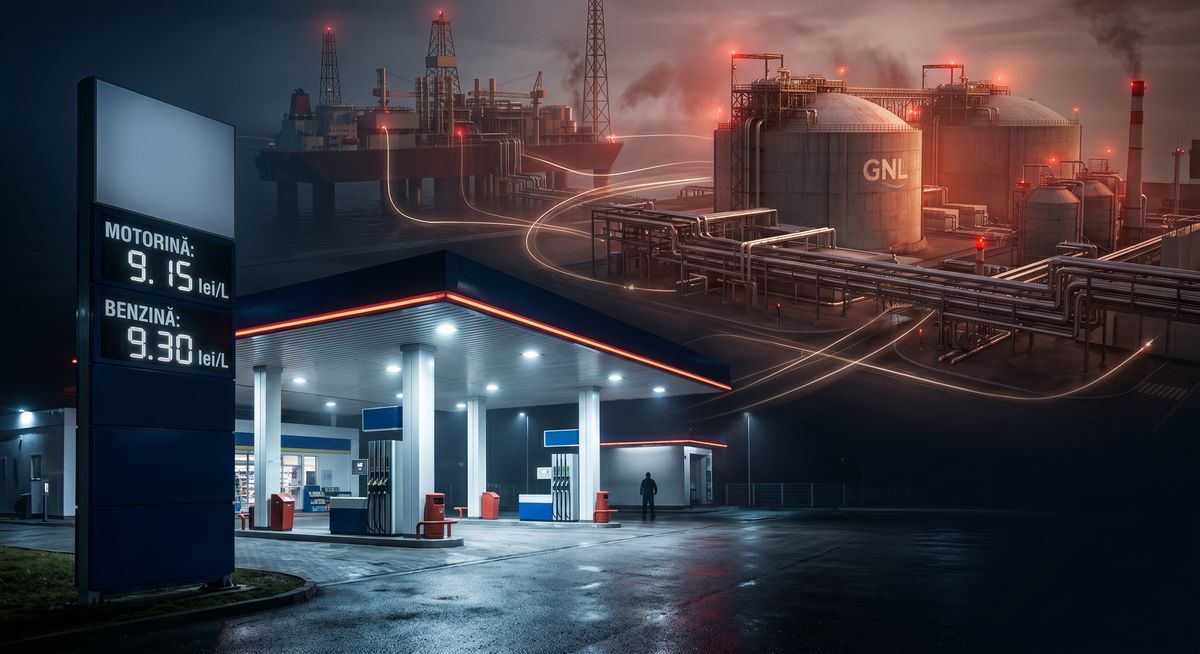
Global Context: The Strait of Hormuz and Supply Chain Vulnerability The closure or severe restriction of traffic through the Strait of Hormuz represents one of the most severe asymmetric shocks to the global economy. Transiting approximately one-fifth of global oil consumption and a significant proportion of liquefied natural gas (LNG), this critical chokepoint directly dictates imported inflation in European economies. In Romania, the effects of this geopolitical crisis are no longer theoretical projections, but daily realities visible at the fuel pumps and in forecasts for the coming winter. Tensions in the Middle East have generated a substantial risk premium in commodity markets. Maritime insurance costs have skyrocketed, and alternative routes add weeks to delivery times, limiting the available supply on the European spot market. Immediate Impact on Consumption: Fuels Hit New Highs The most visible and immediate effect of external bottlenecks is recorded in the transport and logistics sector. According to data published by e-nergia on April 28, fuel prices have seen another major increase across the main distribution chains in Romania. Diesel price: Reached the threshold of 8.72 lei/liter at Petrom stations in western Bucharest. Cascade effect: Being the primary fuel for freight transport and agriculture, this price level will inevitably translate into inflationary pressure on consumer goods in the coming quarter. [Chart 1 Description: A line chart illustrating the direct correlation between announcements regarding maritime traffic restrictions in the Middle East and the upward curve of standard diesel prices in Romania in April 2026, highlighting the steep jump towards the 8.72 lei mark.] Gas Market Analysis: Severe Warnings for Winter 2026-2027 While the oil market reacts immediately, the natural gas market faces a structural medium-term problem. The Ministry of Energy has issued a clear warning regarding the major difficulties anticipated for the next cold season. "Things are quite unpredictable because we are in an international crisis, and through the destruction of some production capacities, especially in the Qatar area, the price of gas will continue to be high, and we face a rather difficult winter and spring 2027 from a tariff perspective" — Ministry of Energy (source: e-nergia). This situation complicates market liberalization efforts. Claudia Griech, CEO of E.ON Energie, recently emphasized that the remaining 11 months of state-administered prices must be used to prepare a predictable transition. In an international environment where LNG volumes from Qatar are compromised, the concept of "low prices" becomes relative, with predictability being the main achievable goal to protect household and industrial consumers. Affected Sectors and Regional Energy Market Reconfiguration The fossil fuel crisis overlaps with an accelerated restructuring of production capacities in the region. Recently, the most modern coal-fired power plant in Bulgaria, AES Galabovo (600 MW), suspended operations indefinitely, entering a conservation regime. Removing 600 MW of baseload energy at the regional level increases the pressure on the Romanian energy system to ensure its own balance. In this context of extreme price volatility, Romania's balancing market is hitting record levels. Suppliers are looking for stability solutions, an example being the contract through which Getica 95 provides energy for STS, navigating a competitive market where managing imbalances has become vital (source: Energy-Center). Perspectives: The Renewables Paradox and the Storage Solution While gas and oil prices rise due to geopolitical factors, Romania is experiencing the paradox of intermittent overproduction. On April 27, the system recorded a new absolute record for instantaneous production from photovoltaic sources at midday, leading to massive exports. However, the lack of flexibility generated negative prices on the spot market, forcing solar parks to abruptly reduce their output. The only viable solution for partial decoupling from the global hydrocarbon crisis is storage. Official Transelectrica data indicates historic progress: Installed capacity: Romania has surpassed the 1,000 MWh threshold. Operational figures: Currently, installations with 600 MW of power and 1,130 MWh of storage capacity are functioning. [Chart 2 Description: A stacked bar chart contrasting the decline in regional coal capacities (e.g., AES Galabovo -600 MW) with the exponential growth of battery storage capacities in Romania (reaching the 1,130 MWh threshold), demonstrating the paradigm shift in energy security.] Conclusions The closure of trade routes in the Middle East and the destruction of capacities in Qatar are not just foreign news; they dictate the price of diesel at 8.72 lei in Romania and foreshadow an expensive winter. While nuclear energy remains a stable pillar of security—with experts recently reiterating, 40 years after Chernobyl, that the…