Diesel Prices Rise: 15 Bani of 68-Bani Tax Cut Rebounds — NRG-IA
Piața de Energie Author: Ioana BuzoaicaA temporary 20% excise cut slashed diesel by 68 bani/liter, but major networks raised prices by 15 bani within 48 hours amid tight European supply.
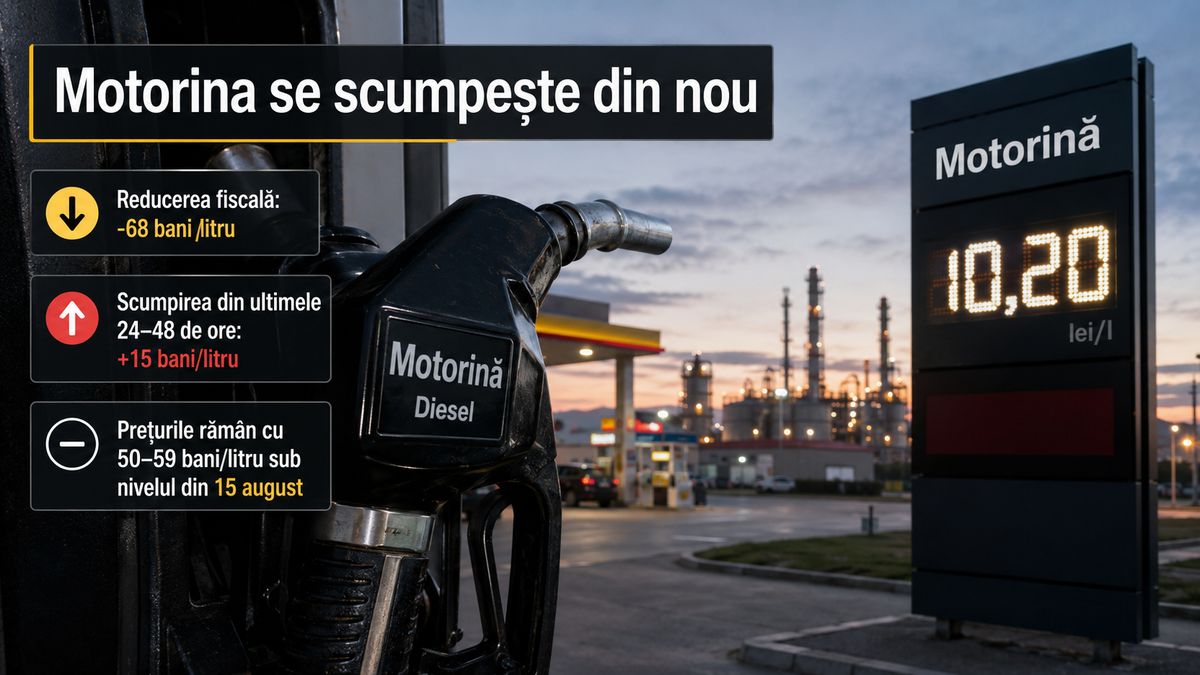
Just two days after the excise duty cut lowered diesel prices by approximately 68 bani per liter , prices have begun rising again across major filling station networks. Petrom and OMV initiated the upward trend on August 17 with an increase of about 15 bani/liter, followed on August 18 by MOL, Rompetrol, and SOCAR. This move clawed back approximately 15 bani of the 68 bani/liter tax-driven price drop , representing nearly 22% of the initial tax cut's impact. However, the remainder is still visible at the pump: across the main networks analyzed, diesel on August 18 was approximately 50–59 bani/liter cheaper than on August 15 , before the new excise duty took effect. This development provides a quick test for the state-introduced mechanism: taxation can instantly lower prices, but it cannot freeze diesel rates as long as the refined product continues to grow more expensive on the European market. Petrom dipped below 10 lei, then rebounded to 10.14 lei/liter The temporary 20% reduction in the excise duty on standard diesel applies to the period of August 16–31, 2026 . The excise duty was reduced by 560.86 lei per 1,000 liters, and the fiscal impact on the final price, including VAT, is approximately 68 bani/liter when the cut is fully passed on to the consumer. On August 16, this effect was immediately visible at filling stations. In Bucharest, Petrom reduced diesel from 10.67 to 9.99 lei/liter , and OMV from 10.73 to 10.05 lei/liter. MOL also hovered around 10.05 lei/liter, while Rompetrol implemented an even larger price cut than the fiscal impact at monitored stations, dropping to approximately 10.05 lei/liter from 10.79. However, the sub-10 lei threshold did not last long. On August 17, Petrom raised its price to 10.14 lei/liter , and OMV to approximately 10.20 lei/liter . A day later, MOL and Rompetrol had reached approximately 10.19–10.20 lei/liter at monitored Bucharest stations, while SOCAR displayed values of around 10.14–10.19 lei/liter. The price hike is thus almost universal among the major networks, but the tax cut has not been wiped out. Petrom remained 53 bani/liter below its August 15 level, OMV and MOL showed roughly the same difference, and Rompetrol was nearly 59 bani/liter below its pre-intervention price. For a 50-liter tank, the 15 bani rebound translates to an extra 7.5 lei per fill-up compared to the low point reached after the excise cut. With a remaining difference of 53 bani/liter compared to August 15, the combined tax and market benefit is still around 26.5 lei for the same fill-up . Excise duty cuts do not freeze pump prices The mechanism introduced by Law no. 162/2026 does not set a fixed price for diesel. The state intervenes in the fiscal component, while the cost of the petroleum product continues to fluctuate based on market dynamics. The law allows for a temporary reduction of the excise duty by values between 5% and 25% , depending on the evolution of the Platts diesel benchmark and the average pump price. The Ministry of Finance reassesses these indicators twice a month. For the August 16–31 period, a 20% reduction was activated. The calculation was made in a context where the relevant Platts diesel benchmark had risen by 34.13% compared to the reference period, and the average pump price by 23.01% . This discrepancy explains the very existence of the fiscal intervention: the state is attempting to cushion a sharp price increase stemming from the petroleum product market, rather than replacing commercial price formation. The law also introduces limits on commercial markups and the frequency of price adjustments. Under the terms of the legislation, the average commercial markup applied by operators cannot exceed the average 2025 level, adjusted according to applicable rules, and price increases can be made at most once a day, up until 12:00 PM. These restrictions limit commercial behavior but do not cap the total cost of a liter of diesel . If the product purchased or produced by the operator becomes more expensive, the final price can rise even if the commercial markup remains within legal limits. Europe has a specific diesel problem, not just an oil problem The pressure on diesel cannot be explained solely by Brent crude prices. This summer, the European issue is increasingly one of available refined product . Reuters reports that European diesel imports fell to approximately 1.56 million barrels per day in July , down from around 1.97 million barrels per day in January. Restrictions and refinery issues in Russia and the Middle East have reduced supply precisely at a time when Europe remains heavily dependent on imports for a significant portion of its diesel requirements. The tightness has become severe enough that cargo diesel in Europe has become more expensive than jet fuel, an unusual situation for the oil products market. At the same time, oil product exports from Russia, the Middle East, and major Asian hubs in July were approximately 1.3 million barrels per day…
Ioana Buzoaica — Independent Editorial Board
The NRG-IA newsroom continuously monitors Romanian energy markets, ANRE regulatory decisions, and national grid telemetry (SEN/SNT). We deliver independent intelligence anchored exclusively in official primary data.
Editorial Charter, Ethics & Verification Methodology →