Bogdan Ivan Demands Diesel Price Audits in Romania — NRG-IA
Piața de Energie Author: Ioana BuzoaicaFormer Energy Minister Bogdan Ivan calls for audits on rapid diesel price hikes after tax cuts, amid tight European markets and new markup cap laws.
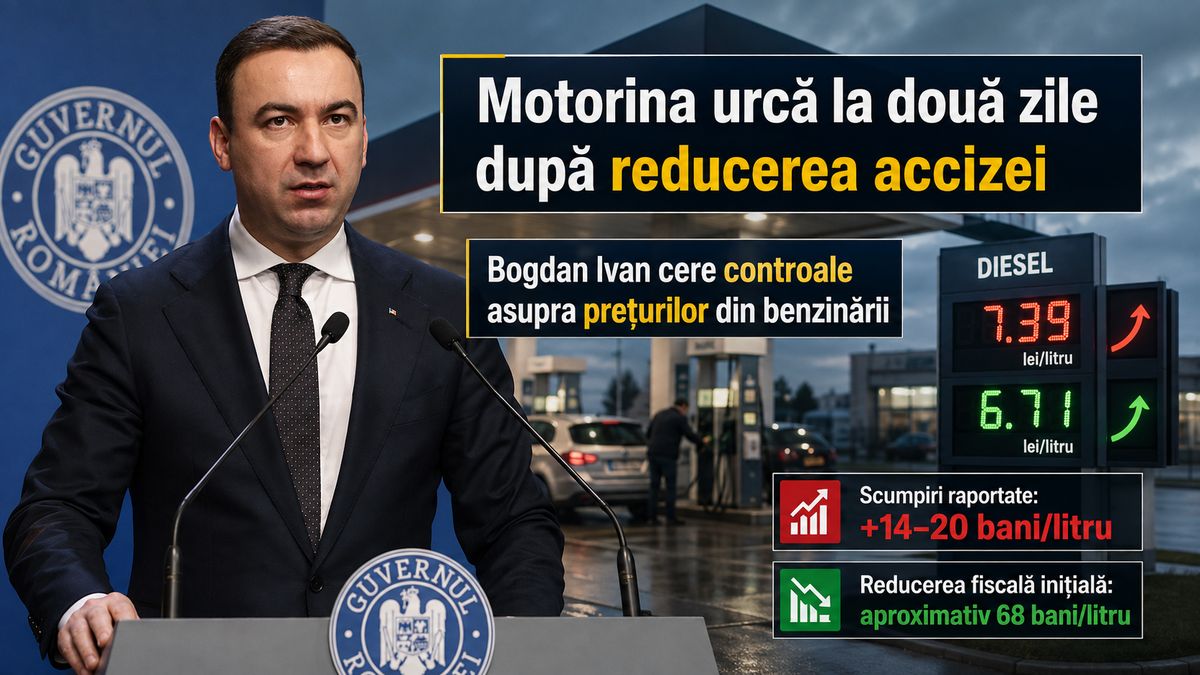
Bogdan Ivan is calling for an investigation into how diesel prices are formed after major gas station networks raised rates by approximately 14–20 bani/liter , just 24–48 hours after a tax cut had lowered prices by about 68 bani/liter . The former Minister of Energy is requesting the intervention of the Ministry of Finance, ANAF (the tax authority), and the Competition Council to determine whether the recent price hikes have an economic basis or include a speculative component. The timing is significant because Romania now has a legal framework that allows for such an audit. Law No. 162/2026 caps commercial markups on fuel relative to the levels practiced by each operator in 2025 and obliges companies to provide the data necessary for inspections. For the first time in the current wave of price increases, the dispute between international costs and commercial margins can be verified using operators' actual data, rather than just comparing prices displayed at the pump. Ivan cited the case of a station where diesel had dropped to 9.99 lei/liter after the excise duty cut and subsequently reached 10.14 lei/liter . This trend corresponds to the movement observed in the Petrom network: the price fell below the 10 lei threshold on August 16 and rose by approximately 15 bani a day later. On August 18, the price hikes spread to other major networks. Depending on the station and the timing, the reported increases were approximately 14–20 bani/liter at MOL, Rompetrol, and SOCAR, after Petrom and OMV had already raised their prices. The tax cut remains visible even after the price hike The increases over the last two days have not eliminated the effect of the excise duty reduction. Before the fiscal intervention, on August 15, diesel in the analyzed Bucharest stations was around 10.67 lei/liter at Petrom, 10.73 lei at OMV and MOL, 10.79 lei at Rompetrol, and 10.69 lei at SOCAR . Following the price hikes on August 17–18, Petrom stood at around 10.14 lei/liter, while major competing networks were generally in the 10.14–10.20 lei/liter range, with variations between stations. Thus, diesel continued to be approximately 50–59 bani/liter cheaper than before the excise duty cut . This difference is essential for market evaluation. Operators did not claw back the entire 68-bani tax cut, but rather about 14–20 bani in the first two days. In the case of a 15-bani increase, approximately 22% of the initial fiscal relief returned to the price. The open question is what economic component explains this rebound and whether commercial markups remained within the limits established by law. The law allows for margin verification, not just tracking prices on the board Law No. 162/2026 reinstated the crisis state in the crude oil and petroleum products market and introduced an intervention mechanism combining a dynamic excise duty reduction with a cap on commercial markups. For gasoline and diesel, the average commercial markup applied by each operator cannot exceed, under the conditions provided by law, their own annual average from 2025. Companies must declare their reference level and how it was calculated to the Ministry of Finance. This mechanism allows authorities to compare current margins with the legal baseline established for each operator. There is also a limit on the frequency of price increases: operators can raise prices only once a day and only until 12:00 PM, whereas price reductions can be implemented at any time. However, these rules do not fix the absolute price of diesel. The cost of the purchased product, transport, logistics, and other commercial components can continue to fluctuate. A higher price at the pump does not, on its own, prove that the markup cap has been exceeded. Legal verification is conducted on the relevant margin and the average established for the application period, not through a simple comparison between yesterday's and today's prices. ANPC and the Competition Council have direct authority over the market Control of this market does not belong to a single institution. For compliance with the commercial markup cap in relation to the final consumer, ANPC (the National Authority for Consumer Protection) has direct powers of investigation and sanctioning . For operators importing, producing, or distributing fuel, and for potential competition issues, the central role belongs to the Competition Council . The Ministry of Finance and tax authorities manage the reporting and taxation components and can provide or verify the data necessary to apply the mechanism. The law provides for significant sanctions for exceeding commercial limits, including turnover-based fines for violations established according to the methodology. Authorities thus have the opportunity to reconstruct price formation using data that is not visible to the consumer: acquisition or production costs, transport, handling, commissions, other directly attributable expenses, and the actual commercial markup. This analysis can separate a…
Ioana Buzoaica — Independent Editorial Board
The NRG-IA newsroom continuously monitors Romanian energy markets, ANRE regulatory decisions, and national grid telemetry (SEN/SNT). We deliver independent intelligence anchored exclusively in official primary data.
Editorial Charter, Ethics & Verification Methodology →