NASA plans lunar nuclear reactor by 2030 for stable energy — NRG-IA
Tehnologie & Inovație Author: Ioana BuzoaicaThe lunar race enters an energy phase. Solar can power short missions, but permanent bases need continuous power during the lunar night and in shadows.
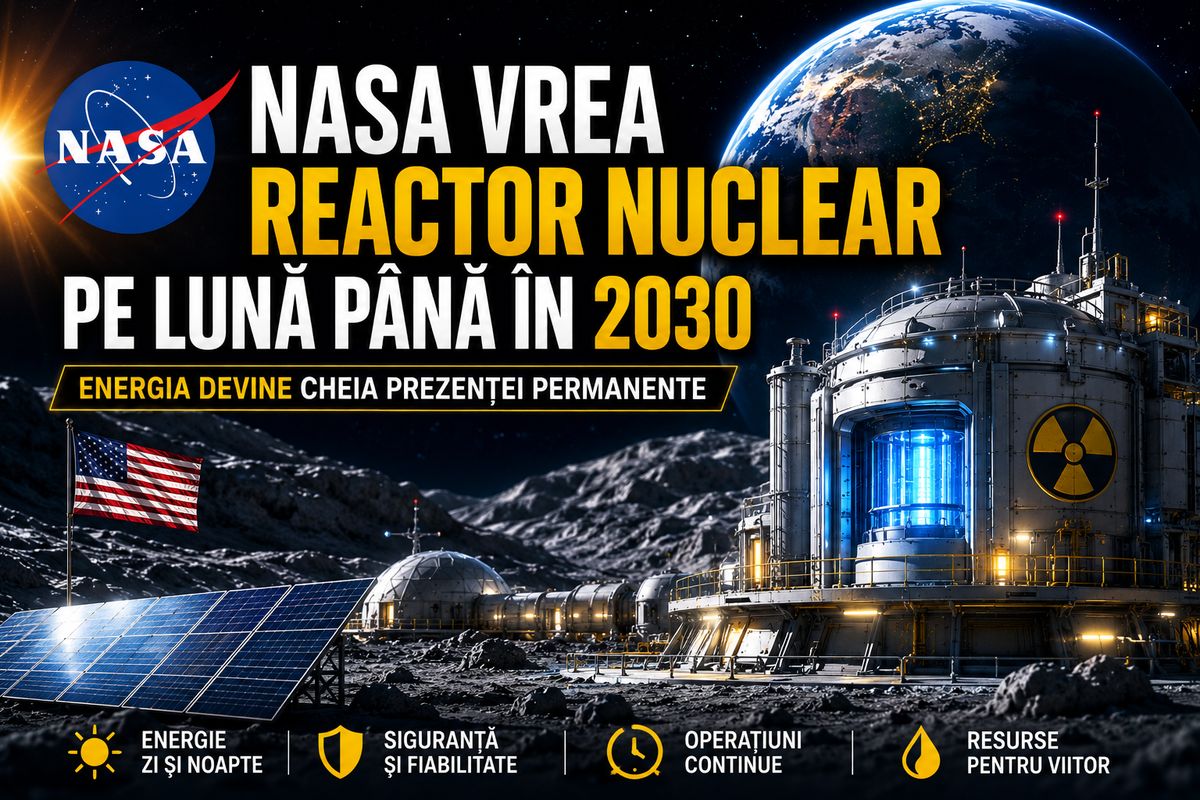
NASA and the US Department of Energy are preparing the development of a nuclear reactor for the lunar surface, aiming to have a fission system available by 2030. The project marks the transition of lunar programs into a new phase: after rockets, capsules, suits, and moon landings, the next major prerequisite for a permanent human presence is energy. The American plan does not eliminate solar energy from the equation. Solar panels remain an important solution for missions, equipment, robots, and activities in illuminated areas. The problem arises when the mission is no longer just a few days long, but must sustain a base, laboratories, communications, heating, cooling, vehicles, oxygen production, and potentially resource extraction. On the Moon, energy must keep flowing even when the Sun disappears for nearly two weeks. A lunar base begins with a secure energy source NASA describes surface fission as a necessary technology for sustained missions on the Moon and, eventually, Mars. Such a system would need to generate electricity for years without frequent refueling and without relying on sunlight or temperature. This is the essential difference from a short mission: a lunar base cannot operate under the logic of a temporary shutdown when conditions turn unfavorable. On Earth, energy is often invisible to the user. There are grids, power plants, reserves, fuels, operators, and balancing mechanisms. On the Moon, all these functions must be rebuilt from scratch in a hostile environment. Every kilowatt must be generated, transported, protected, and used with care. A manned base needs energy for life support systems, communications, thermal control, research, vehicle charging, robotic operations, and local material processing. If future missions use ice from the lunar south pole for water, oxygen, or fuel, energy requirements will escalate even further. Extracting, heating, separating, and storing resources demand constant power. Solar helps, but the lunar night changes the equation Solar energy has an obvious advantage on the Moon: there is no atmosphere, and solar radiation can be captured directly in illuminated areas. For surface equipment, probes, robots, and activities scheduled during the lunar day, photovoltaic panels can be an efficient solution. The limitation lies in continuity. A lunar day lasts about 29.5 Earth days, which means nearly two weeks of light and nearly two weeks of darkness for many areas. During this period, panels do not generate power, temperatures drop drastically, and equipment must be kept operational. The lunar south pole, the preferred target for many space programs, complicates the issue further. While there are regions with favorable illumination, there are also permanently shadowed craters where ice might exist. These areas are crucial for resources but offer no direct solar energy. A base aiming to operate near them requires a combination of solar power, storage, cabling, demand-side management, and sources capable of delivering energy regardless of light. Batteries can cover short periods and help stabilize consumption. However, for two weeks of darkness, storage becomes heavy, bulky, and difficult to transport. Every kilogram launched from Earth is highly expensive, meaning energy systems must be compact, reliable, and easy to operate. Nuclear steps in as a continuity technology A surface fission reactor does not depend on the Sun. It can operate during the lunar night, in freezing zones, in dust, in shadowed craters, or during periods when solar panels cannot deliver enough power. For a permanent base, this advantage is decisive. NASA has previously worked on compact nuclear system concepts for exploration, including projects like Kilopower. The new objective takes this logic to a more ambitious stage: nuclear energy is no longer just a power source for distant probes or experiments, but infrastructure for sustained human activity on another celestial body. A fission system for the Moon should not be envisioned as a large, Earth-style nuclear power plant. It is a compact unit designed for lower but continuous power, capable of supporting critical elements of a base. Depending on the configuration, such systems can power habitats, laboratories, communication equipment, robots, and resource processing facilities. The stakes are reliability. On the Moon, a power outage does not just mean equipment shutting down. It can threaten crew survival, thermal protection, communications, and the ability to resume operations. Energy becomes the primary layer of security for a base. The lunar race becomes an infrastructure race The American program is unfolding within an increasingly clear geopolitical context. China aims for a manned moon landing by 2030 and the development of the International Lunar Research Station, alongside Russia and other partners. The plans presented for this station include solar panels, cabling infrastructure, and, according to Reuters, a nuclear power plant…
Ioana Buzoaica — Independent Editorial Board
The NRG-IA newsroom continuously monitors Romanian energy markets, ANRE regulatory decisions, and national grid telemetry (SEN/SNT). We deliver independent intelligence anchored exclusively in official primary data.
Editorial Charter, Ethics & Verification Methodology →