Transgaz’s €5B Plan for Neptun Deep Gas Transmission — NRG-IA
Gaze Naturale Author: Aurora AITransgaz's €5B plan includes 22 gas projects, but only €260M have advanced past early stages, leaving major regional expansions pending funding and FIDs.
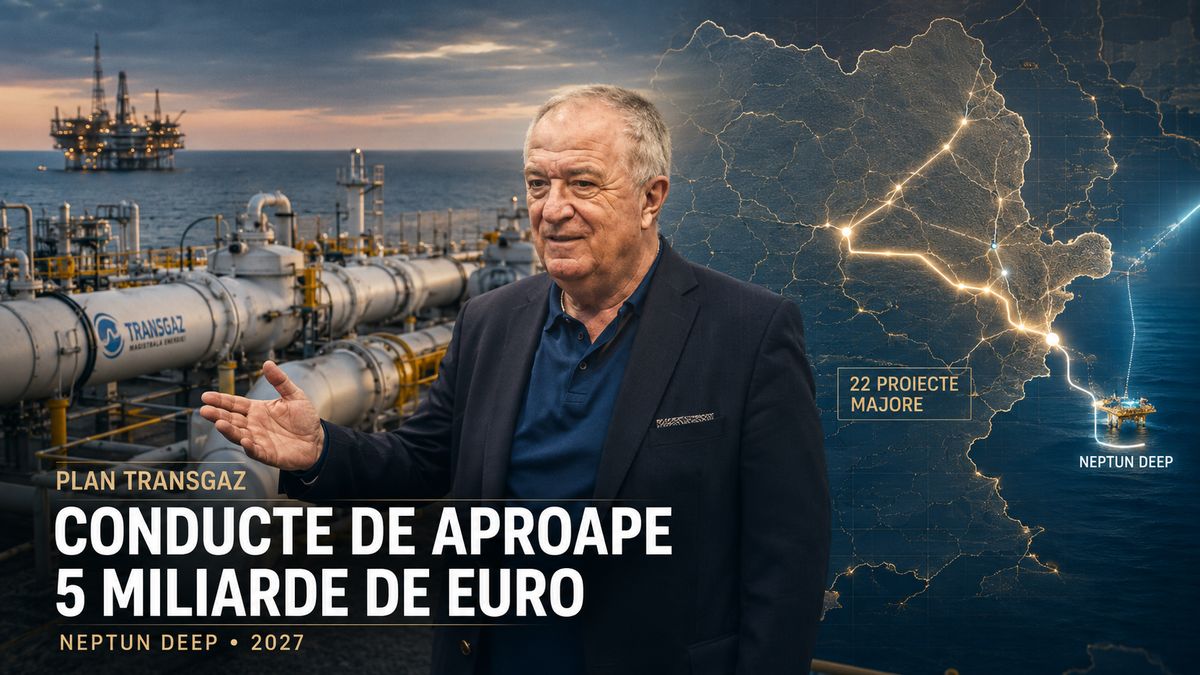
Romania is approaching the moment when it will receive approximately eight billion cubic meters of gas annually from Neptun Deep, but the network required to distribute these volumes domestically and to regional markets is still largely in the planning phase. Transgaz is proposing 22 major transmission projects for the next decade, with a total estimated value of €4.985 billion. The development plan for the 2026–2035 period was preliminarily approved by Transgaz shareholders on July 21 and is set to be submitted to the National Energy Regulatory Authority for final approval. The document outlines the network's development direction, but this does not mean all investments have secured funding, contracts, or definitive execution schedules. The gap between the plan and actual investment decisions is substantial. Projects for which Transgaz indicates a final investment decision total €174.02 million. The interconnection with Serbia, valued at €86.8 million, is categorized separately in a more advanced stage, but still lacks a final investment decision. The rest of the portfolio, approximately €4.724 billion, is in its early stages and has not yet received final approval for capital commitment. This structure changes the significance of the €5 billion figure. It represents the scale of the infrastructure that Transgaz deems necessary or strategic by 2035, rather than capital already secured for construction. Gas will reach the shore ahead of major network expansions Neptun Deep is progressing at a much clearer pace than most projects in the transmission plan. OMV Petrom and Romgaz have completed the installation of the Neptun Alpha production platform, drilled six of the ten development wells, and installed the 160-kilometer subsea pipeline that brings the gas ashore. Production is scheduled to begin in 2027. The Transgaz plan estimates that the first gas will enter the system in the autumn of 2027 through the Tuzla–Podișor pipeline, at an annual volume of approximately 8.16 billion cubic meters. The onshore pipeline built to receive the Black Sea gas is already completed. Consequently, the main bottleneck is no longer the link between the shore and the national grid. This infrastructure is in place. The next phase is the flow of volumes from Podișor to power plants, industrial consumers, underground storage facilities, and interconnection points with neighboring countries. This is where the timeline mismatch occurs. The gas is expected in 2027, while the largest network expansions have tentative deadlines between 2029 and 2033. Romania will first have to rely on existing infrastructure and projects already under construction before the entire architecture envisioned by Transgaz can become operational. Six projects account for over 80% of investments The largest investment is Eastring Romania, valued at €1.654 billion. The project aims to create a bidirectional flow connection between Slovakia and the external border of the European Union, passing through Hungary, Romania, and Bulgaria. The proposed capacity ranges between 20 and 40 billion cubic meters annually, far exceeding Neptun Deep's production, which gives it a regional role rather than one limited to Romanian gas. The feasibility study is completed, but the project lacks a final investment decision. The first phase is estimated at €1.297 billion, and the second at €357 million, with tentative deadlines in 2029 and 2033. The expansion of the Vertical Corridor is the second-largest project, valued at €800 million. Transgaz aims for a phased increase in transmission capacity along the south-north route by approximately 4.38–5.32 billion cubic meters per year. The investment involves new pipelines, upgrades, and additional compressor stations, with an estimated deadline of 2029. The Gherăești–Siret interconnection with Ukraine is valued at €450 million, with a tentative deadline of 2032. The project would create an additional link between the systems of the two countries, enabling bidirectional gas transmission. The modernization of infrastructure in northwestern Romania, estimated at €405 million, is divided into three phases, with deadlines in 2029, 2031, and 2033. The objective is to increase domestic capacity and improve connections to Central European markets. The Onești–Coroi pipeline is valued at €371 million, and the proposed liquefied natural gas (LNG) terminal on the Black Sea coast is estimated at €360 million. A separate €19.6 million project is planned to connect the terminal to the National Transmission System. These six investments total approximately €4.04 billion, representing over 80% of the total value of the 22 projects. However, none of them have received a final investment decision. The new map targets Ukraine, the Republic of Moldova, and Western Europe The plan introduces nine new projects compared to previous versions. These include the interconnection with Ukraine along the Gherăești–Siret route, capacity expansion toward the…