Netanyahu Rejects Gaza Plan: Risks to East Med Gas — NRG-IA
Geopolitică & Energie Author: Ioana BuzoaicaNetanyahu has rejected the Gaza roadmap, demanding full disarmament before withdrawal, risking East Med gas flows vital to Egypt and Jordan.
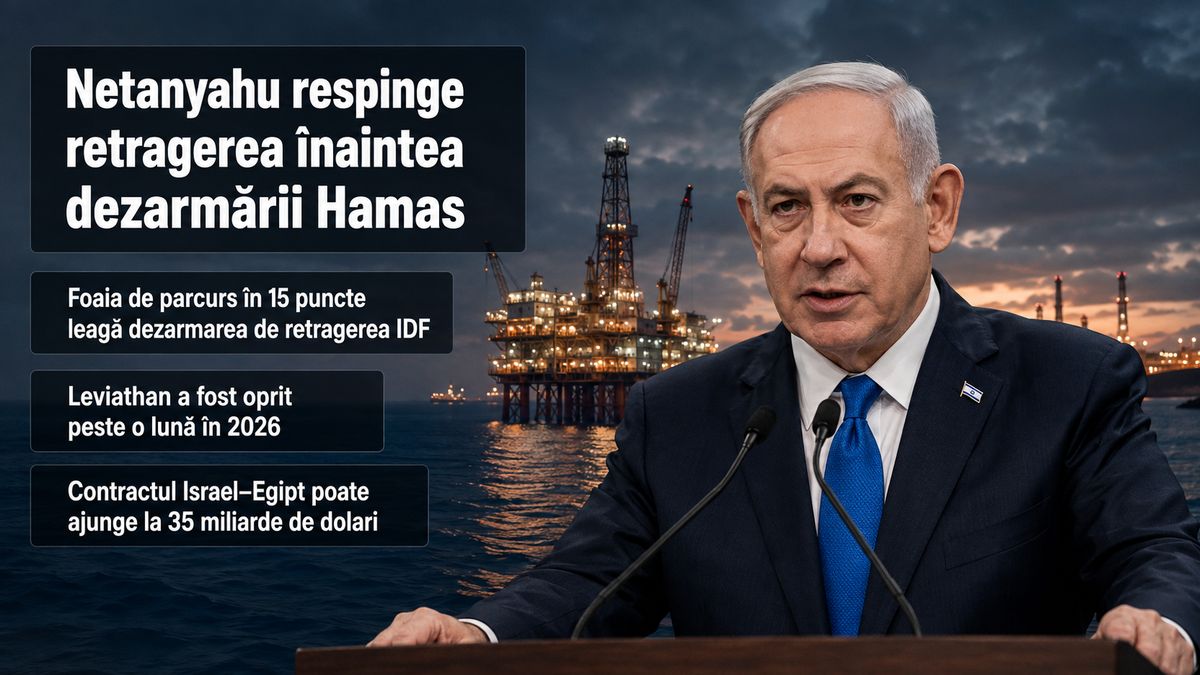
Benjamin Netanyahu has publicly rejected the 15-point roadmap backed by the Trump administration for the next phase of the Gaza process, opening a strategic rift with Washington over the sequencing of Hamas's disarmament and the withdrawal of the Israeli military. The Israeli Prime Minister is demanding the complete disarmament of the organization prior to any withdrawal, whereas the mechanism negotiated by the United States and regional partners links the two processes through reciprocal and verifiable steps. However, the dispute extends beyond Gaza. Washington is simultaneously attempting to build de-escalation mechanisms in Lebanon and in relations with Iran, while Israel insists on maintaining military pressure until threats it deems direct are neutralized. If this regional architecture fractures and the conflict intensifies once more, one of the major economic exposures lies in the Eastern Mediterranean, where Israeli gas fields have become vital for Israel, Egypt, and Jordan, and are tied to tens of billions of dollars in investments and contracts. The precedent is very recent. Leviathan, Israel's primary offshore field, was shut down for more than a month in 2026 for security reasons following the expansion of the conflict with Iran. A new escalation would not automatically produce the same outcome, but this year's experience demonstrates that offshore energy infrastructure can be taken offline when security assessments demand it. Netanyahu challenges the sequencing of disarmament and withdrawal The Israeli Prime Minister's statement on August 9 is explicit: Israel does not accept the 15-point document in its current form and does not intend to begin the IDF's withdrawal from Gaza before Hamas is fully disarmed, including both heavy and light weaponry. Negotiations with Washington are ongoing, and Netanyahu noted that certain elements of the US proposal are acceptable. However, the dispute concerns one of the central components of the entire architecture: who takes the first step, and what guarantee exists that the other party will fulfill its corresponding obligation. The 15-point document is a roadmap for implementing the broader Gaza plan backed by the Trump administration. It was drafted through the Board of Peace structures alongside the guarantors of the process—the United States, Egypt, Qatar, and Turkey—and presented to the UN Security Council in May 2026. The mechanism is built on reciprocity and verification. The decommissioning of arsenals and armed structures must proceed in phases, in parallel with proportional steps by Israel, with progress verified before moving to the next phase. UN Security Council Resolution 2803, adopted in November 2025, also links the Israeli withdrawal to demilitarization thresholds and the deployment of a new security apparatus. Netanyahu's position alters this sequence. Israel demands that disarmament be completed before the withdrawal begins. For Washington, the difference is not merely procedural. The entire mechanism was designed precisely to avoid a situation where one party surrenders its primary leverage before receiving the other's concession. Hamas accepts the process but conditions the surrender of weapons Nor can Hamas's position be reduced to an unconditional acceptance of disarmament. Officials from the organization have stated that Hamas remains committed to the negotiated roadmap, but links the surrender of weapons to Israeli withdrawal and the cessation of attacks. The organization prefers a formula of transferring and storing weaponry under the control of a technocratic Palestinian administration, avoiding the term "disarmament" used by the Trump administration. This results in two positions that converge on the idea of a negotiated process, but diverge precisely on the sequence in which it must be executed. For Israel, disarmament must first bring about an irreversible change in the security situation. For the mechanism backed by Washington, disarmament and withdrawal must advance together, with each stage triggering the next. Blocking this sequence risks halting the process before the actual transfer of control to the Palestinian and international structures envisioned by the plan. The same equation emerges in Lebanon The dispute is not isolated. In Lebanon, the United States is mediating a mechanism based on the same logic: the verified disarmament of Hezbollah must be coupled with Israel's progressive withdrawal. On August 7, Israel and Lebanon agreed on a list of states that could provide personnel to verify the disarmament process, though a final agreement on the subsequent Israeli withdrawal remains outstanding. The structure is nearly identical: Israel's security must be enhanced by reducing the military capability of an armed organization, while the withdrawal of Israeli forces must provide the necessary political and territorial counterweight for the process to continue. Netanyahu thus faces the same strategic dilemma on two fronts:…
Ioana Buzoaica — Independent Editorial Board
The NRG-IA newsroom continuously monitors Romanian energy markets, ANRE regulatory decisions, and national grid telemetry (SEN/SNT). We deliver independent intelligence anchored exclusively in official primary data.
Editorial Charter, Ethics & Verification Methodology →