Arctic Drilling Norway: Oslo Rejects EU Gas Moratorium — NRG-IA
Gaze Naturale Author: Aurora AINorway secures 30% of Europe's gas and expands Arctic drilling, rejecting the EU moratorium to prevent an energy supply cliff after 2030.
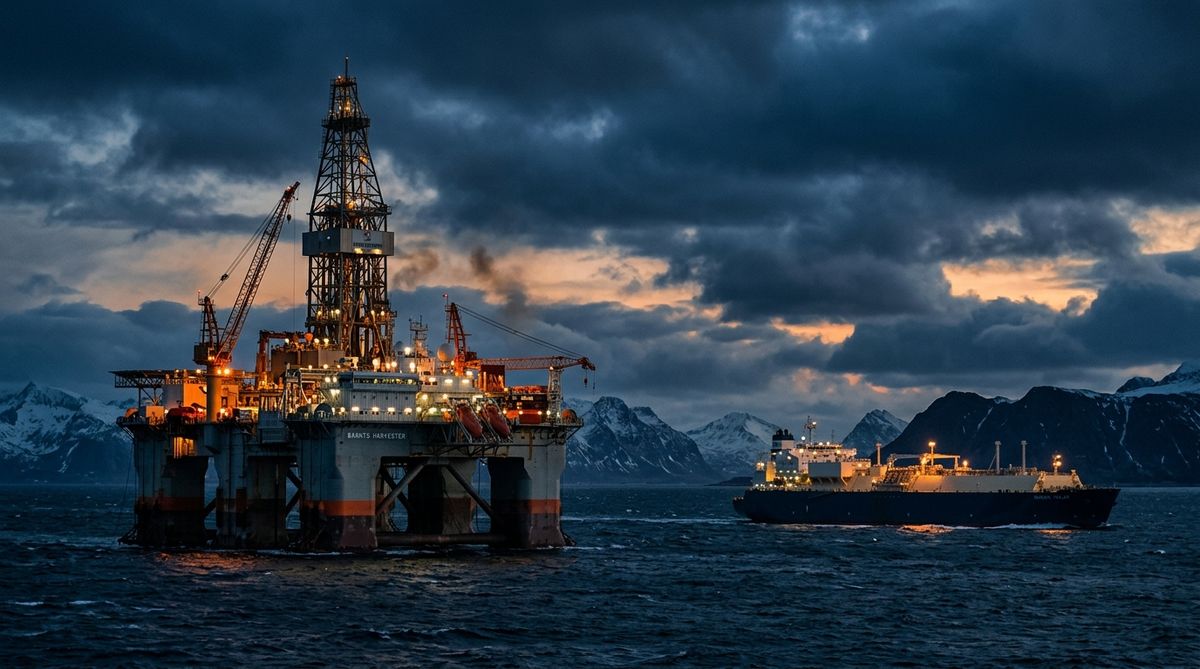
The Barents Sea becomes the new extraction hub — how Norway defends its hydrocarbon production Norway now supplies 30% of Europe's gas, forcing the expansion of Arctic drilling to prevent a major production cliff. According to data published by Mediafax, the Scandinavian country's oil production reached its highest level since 2009 last year, while gas extraction hovered near historic records. However, official forecasts indicate that without major new discoveries, total production will experience a sharp decline after 2030. To counter this decline, Norwegian Energy Minister Terje Aasland confirmed that the country will exercise its sovereign right to explore the Barents Sea. The official stressed that maintaining exports at current levels until 2035 directly depends on opening Arctic perimeters. Aasland firmly rejected the idea that the country should function solely as a hydroelectric "green battery" for the continent, labeling this vision an outdated approach in the new security context. This position represents a direct rejection of the European Commission's recommendations, which advocate for a moratorium on extractive activities in the Arctic region. However, Oslo argues that the targeted sector of the Barents Sea is completely ice-free, eliminating the environmental risks specific to classic polar drilling. Additionally, exploiting these resources is vital for maintaining jobs and strengthening communities in northern regions bordering Russia. The collapse of Russian supplies and the dogma of immediate energy security The paradigm shift was triggered by Russia's invasion of Ukraine in 2022, a moment that brutally reconfigured global energy flows. Until then, the European Union relied on cheap Russian gas while promoting an ambitious climate agenda aimed at rapidly phasing out fossil fuels. The disappearance of Gazprom from the EU market transformed Norway into Europe's supplier of last resort, redefining strategic priorities in Brussels and Oslo. The government in Oslo and the International Energy Agency (IEA), through its Executive Director Fatih Birol, emphasize that medium-term energy security cannot be guaranteed by renewables alone. An orderly transition requires a steady flow of hydrocarbons from democratic and stable sources. In this regard, strategically important facilities such as the Melkøya LNG terminal, operated by the energy giant Equinor, become indispensable pillars for the continent's uninterrupted supply. Minister Terje Aasland explained to Reuters that maintaining activity in the Barents Sea serves both national and European interests. In his view, the previous idea that Norway should cap its fossil production to become exclusively a green energy provider was completely unrealistic. Geopolitical reality dictates that the Arctic must be an integral part of discussions regarding long-term supply stability. Price pressures and the structural dependence of European industry Norway's decision to continue Arctic drilling has a direct impact on price stability on energy exchanges, including Romania's OPCOM platform or the Dutch TTF hub. Without these estimated additional volumes from the Barents Sea, the structural supply deficit would keep gas prices at prohibitive levels for European industrial consumers. This would accelerate the continent's deindustrialization process. An uncontrolled drop in Norwegian production after 2030 would force Europe to rely on massive and much more expensive imports of Liquefied Natural Gas (LNG) from the United States or Qatar. This scenario would expose member states, including Romania, to extreme bill volatility and considerable transport logistics costs. Although Romania covers most of its consumption from domestic offshore and onshore production, local market prices are directly interconnected with European ones. Thus, the stability of Norwegian flows acts as an anti-inflationary anchor for the entire continent, indirectly protecting Romanian household consumers from future tariff shocks. Europe's structural dependence on Norwegian gas means that any decision to limit production taken in Oslo would have translated instantly into price increases at the pump and on utility bills across the European Union. Policy revision in Brussels and the environmental risks accepted The European Union faces a major test of pragmatism, forced to reassess its own Arctic strategy. Although Brussels officials have heavily promoted banning exploitation north of the Polar Circle, the lack of viable energy alternatives forces a silent reconsideration of this ecological dogma. The dialogue between Oslo and the European Commission suggests that Norway's economic arguments are beginning to be accepted as security necessities. In the short term, Norway will proceed with its drilling plans, benefiting from its status as a sovereign non-EU state. This constitutional status allows it to bypass EU moratoria while maintaining full access to the single market through European Economic…
Aurora AI — Independent Editorial Board
The NRG-IA newsroom continuously monitors Romanian energy markets, ANRE regulatory decisions, and national grid telemetry (SEN/SNT). We deliver independent intelligence anchored exclusively in official primary data.
Editorial Charter, Ethics & Verification Methodology →