New 160 MW Gas Plant in Romania: E-Infra Begins Testing — NRG-IA
Piața de Energie Author: Ioana BuzoaicaE-Infra starts technical testing at its new 160 MW combined-cycle gas plant in Câmpia Turzii, with first fire set for December 15, 2026.
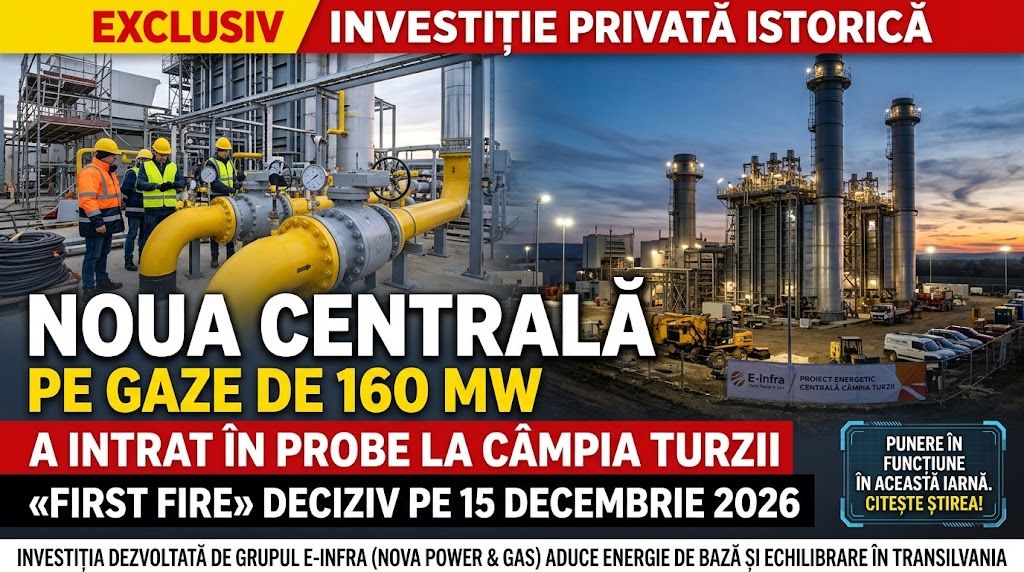
Romanian entrepreneurial group E-Infra, through its energy division Nova Power & Gas, has begun technical testing at its new 160 MW combined-cycle gas turbine (CCGT) power plant in Câmpia Turzii, Cluj County. According to the commissioning schedule confirmed at the end of October 2026, the decisive hot commissioning phase—the gas turbine's first fire—is scheduled for December 15, 2026. Entering the technological systems verification phase makes the Câmpia Turzii project the most significant new private gas-fired capacity to reach testing in Romania this year. In an energy sector marked over the past decade by the retirement of legacy coal-fired units and repeated delays on major thermal power projects managed by state-owned enterprises, the progress at the Cluj site demonstrates local private capital's ability to deliver complex generation infrastructure on predictable schedules. The new 160 MW unit addresses one of the National Power System's most acute vulnerabilities: the lack of flexible units capable of generating baseload electricity and ramping up quickly during evening peak demand, when solar output drops to zero and Day-Ahead Market prices spike to critical levels. Technical testing timeline and the significance of the December 15 milestone Transitioning a combined-cycle power plant from construction and electromechanical installation to commissioning requires sequential testing of all natural gas feed circuits, cooling systems, high-voltage equipment, and control and automation systems. These preliminary cold commissioning tests are already underway at the former industrial platform in Câmpia Turzii. The technical milestone on December 15, 2026—first fire—marks the initial controlled admission and ignition of natural gas in the turbine's combustion chamber, signaling the transition to hot commissioning. Following validation of the turbine's mechanical operation at rated speed, standard commissioning procedures will proceed with generator synchronization to the National Power System, variable load operation testing, and performance verification of the heat recovery steam generator (HRSG) and steam turbine completing the combined cycle. Reaching this milestone in mid-December positions Nova Power & Gas's investment to deliver its first megawatt-hours to the national grid during the cold season, a period when every new dispatchable generation unit directly enhances security of supply and reduces pressure on electricity imports. Combined-cycle technology and the role of 160 MW in grid balancing Unlike legacy thermal power plants, the unit developed by E-Infra in Câmpia Turzii utilizes gas-and-steam combined-cycle technology, which offers the highest commercially available thermodynamic efficiency for natural gas generation. Waste heat from the gas turbine exhaust is captured in a heat recovery steam generator rather than vented, producing pressurized steam that drives a second turbine to generate additional electricity from the same volume of combusted fuel. This superior efficiency translates into reduced specific natural gas consumption per megawatt-hour produced and significantly lower carbon emissions—a major economic advantage in a European market where EU ETS carbon allowance costs and gas prices dictate merit-order dispatch. Furthermore, the modern configuration enables fast startups and rapid load ramping, indispensable attributes for offsetting output fluctuations from wind and solar farms. Siting the 160 MW plant in the heart of Transylvania provides an added benefit to the grid topology operated by Transelectrica. Central and northwestern Romania features high industrial and urban electricity demand but possesses far less local baseload generation capacity compared to the southern region or Dobrogea. Injecting 160 MW directly into this regional hub balances power flows on high-voltage transmission lines and reduces long-distance transmission losses. Private investments take the lead amid delays in state projects The commencement of testing at Câmpia Turzii highlights the sharp contrast in execution speed between private investments and major state-led energy developments. While Romgaz's 430 MW gas plant in Iernut—located just a few dozen kilometers away along the Mureș River—has accumulated six years of delays beyond its original 2020 deadline and now targets a Q1 2027 synchronization, private group E-Infra advanced its 160 MW project to testing free from the bureaucratic bottlenecks typical of public procurement. For Nova Power & Gas—a company that has already developed cogeneration units, gas engines, and some of Romania's largest photovoltaic plants and battery energy storage systems (BESS) in the Câmpia Turzii area—the new 160 MW plant completes an integrated energy hub. By combining daytime solar generation, battery storage, and CCGT capacity at a single industrial platform, the operator secures energy for its supply portfolio while offering high-value balancing services to the entire…
Ioana Buzoaica — Independent Editorial Board
The NRG-IA newsroom continuously monitors Romanian energy markets, ANRE regulatory decisions, and national grid telemetry (SEN/SNT). We deliver independent intelligence anchored exclusively in official primary data.
Editorial Charter, Ethics & Verification Methodology →