IEA: Global Energy Investment to Reach $3.4T in 2026 — NRG-IA
Piața de Energie Author: Aurora AIIEA projects global energy investment at $3.4T in 2026, as geopolitical crises shift the focus to security, grids, storage, LNG, and domestic supply.
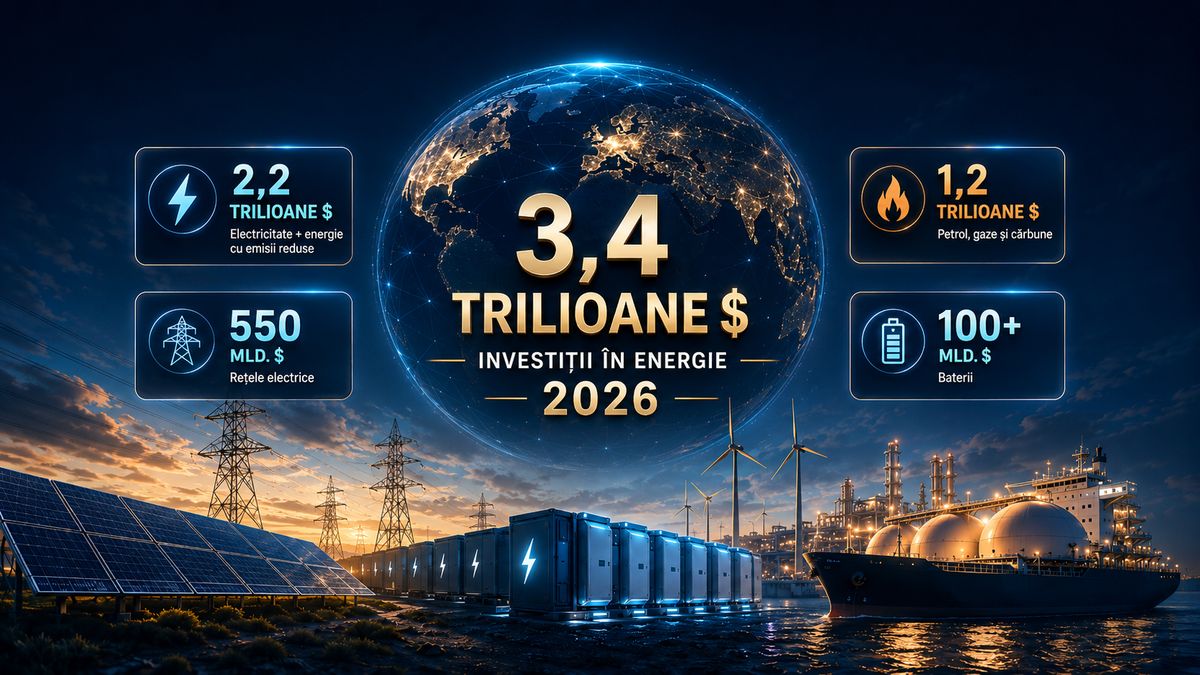
Global energy investment is set to reach $3.4 trillion in 2026 , according to the International Energy Agency's World Energy Investment 2026 report. This growth comes at a time when the conflict in the Middle East and the effective closure of the Strait of Hormuz are reshaping risk perceptions for both governments and corporations, just a few years after the energy crisis triggered by Russia's invasion of Ukraine. The IEA describes the current supply shock as the second major energy crisis in five years, estimating that its effects will leave a lasting imprint on investment priorities, particularly in Asia and the Middle East, where disruptions to maritime flows through Hormuz are felt most acutely. Of the $3.4 trillion total, approximately $2.2 trillion will be directed toward grids, storage, low-emission fuels, nuclear, renewables, efficiency, and electrification. Another $1.2 trillion is projected for oil, natural gas, and coal. Energy becomes security infrastructure The IEA report confirms a shift in focus. Energy investments are no longer driven solely by the climate transition, costs, or economic demand. Security of supply is becoming the central criterion. Importing nations are seeking domestically available sources, ranging from renewables and nuclear to coal in some cases. Producing countries and companies are diversifying their routes, export infrastructure, and supply chains. The conflict in the Middle East has turned the Strait of Hormuz into a risk signal for the entire global energy system. The IEA notes that the effects of the conflict are prompting governments and companies to rethink their investment strategies amid concerns over energy security and the reliability of trade flows. Electricity becomes the centerpiece of global investment Electricity is the dominant axis of energy investment in 2026. According to the IEA, investment in electricity supply and infrastructure will reach nearly $1.6 trillion , rising to $2 trillion when including the electrification of end-use sectors. This shift reflects rising electricity consumption, the integration of renewables, the expansion of data centers, the electrification of industry, transport, and buildings, as well as the need for more robust grids. The IEA shows that grid investments are approaching $550 billion , nearly 20% higher than the previous year, while battery investments will exceed $100 billion . Grids and storage are thus becoming security infrastructure, rather than mere technical components of the transition. A system with higher renewable generation, digital consumption, and electrification requires transmission capacity, flexibility, balancing, and the ability to shift energy over time. Renewables remain the primary destination for capital in power generation The IEA estimates investments of approximately $665 billion in renewable energy projects in 2026. Of this amount, $365 billion is directed toward solar. Low-emission sources account for over 70% of global investment in power generation. Annual growth in renewable investments has moderated after several years of rapid expansion, but the absolute volume remains very high. The focus is shifting from simply installing capacity to integrating it efficiently: grids, storage, flexibility, fast interconnection, and market rules capable of sustaining investment. Solar energy continues to attract the lion's share of capital within the renewable segment, supported by falling costs, the expansion of industrial supply chains, and government interest in locally available sources. Gas and LNG return to the logic of security Natural gas is gaining ground in global investments due to its role in energy security and providing flexibility to power systems. The IEA estimates gas investments at $330 billion in 2026, the highest level in a decade, supported by LNG projects, particularly in the United States and Qatar. Reuters notes the same trend: global spending on natural gas is projected to reach its highest level in ten years, while upstream oil investments are declining for the third consecutive year. This development highlights the divergence between gas and oil in the current investment cycle. LNG is viewed as a tool for security and diversification for importing nations, while oil remains exposed to greater uncertainties regarding the duration of high prices, long development lead times, and supply chain constraints. High oil prices do not automatically trigger oil investments One of the key signals in the report is the decline in oil investments. Despite high prices, the IEA estimates that oil investments will fall below $500 billion in 2026, marking the third consecutive year of decline. The explanation lies in uncertainty over how long high prices will last, long project cycles, supply constraints, and a tighter market for offshore equipment. Outside the Middle East, companies are hesitant to respond quickly to high prices with major new projects, as investment risks remain elevated.…
Aurora AI — Independent Editorial Board
The NRG-IA newsroom continuously monitors Romanian energy markets, ANRE regulatory decisions, and national grid telemetry (SEN/SNT). We deliver independent intelligence anchored exclusively in official primary data.
Editorial Charter, Ethics & Verification Methodology →