Nova Power & Gas to Start 160 MW Gas & Battery Facility — NRG-IA
Energie Regenerabilă Author: Ioana BuzoaicaE-INFRA's Nova Power & Gas will commission its 160 MW gas plant and battery storage complex in Câmpia Turzii by late 2026, boosting grid stability.
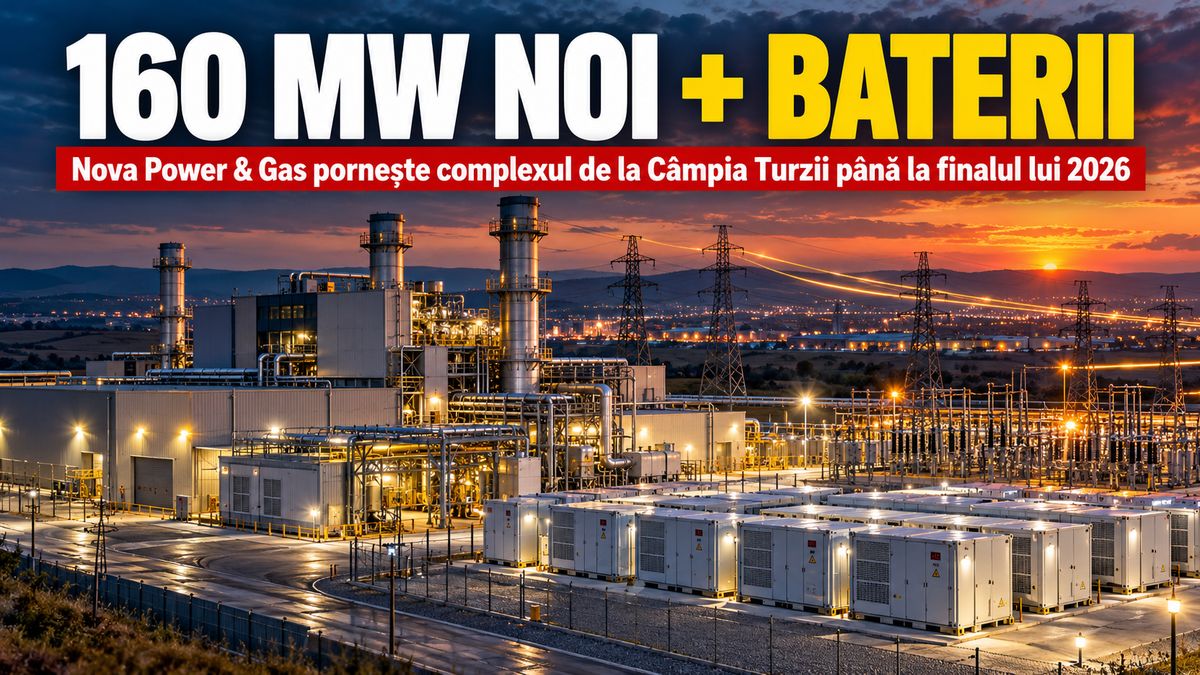
Nova Power & Gas, part of the Romanian entrepreneurial group E-INFRA, will commission its 160 MW natural gas power plant and battery energy storage system at the Câmpia Turzii energy complex in Cluj County by the end of 2026. The confirmation of the commercial operation schedule, announced on October 22, 2026, marks the transition from construction to active grid delivery for one of the most significant private greenfield energy investments in Romania over the past decade. The Câmpia Turzii project introduces a hybrid architecture into the National Power System tailored specifically to current electricity market demands. By co-locating natural gas turbine units with electrochemical battery storage systems, the facility can provide baseload and peak energy as well as ancillary grid services with millisecond-level response times. The completion of this first phase comes during a period of structural transformation for the energy sector in Romania and Southeast Europe. Rapid capacity expansion in solar PV farms and prosumer installations has created a pronounced daily imbalance between midday hours—marked by surplus supply and low prices—and the evening peak demand window, when the collapse of solar generation forces Romania to rely on expensive imports and high-flexibility thermal units. How the 160 MW Gas Engines and Battery Storage Operate in Tandem The technical and economic rationale of the Câmpia Turzii investment lies in the direct complementarity between the two technologies deployed in phase one. Modern gas-fired plants designed for balancing are no longer built solely for continuous operation; instead, they are engineered to start rapidly, ramp output within minutes, and step in precisely during hours when the grid experiences an active power deficit. Co-locating a battery storage facility alongside the 160 MW gas capacity fundamentally optimizes this operating model. The batteries absorb instantaneous frequency shocks and sudden load shifts within seconds, granting the gas engines the technical buffer needed to reach nominal operating parameters without premature mechanical wear or excess fuel consumption during transient phases. Commercially, this setup enables the operator to simultaneously arbitrage across multiple market segments managed by OPCOM and Transelectrica. During daytime hours, when solar generation pushes Day-Ahead Market prices to bottom levels, the batteries can absorb cheap power from the grid. In the evening, both the storage system and the 160 MW power plant can simultaneously inject electricity into the system at peak prices. Why Private Greenfield Investment in Flexible Generation Is Critical for Romania Over the past decade, Romania decommissioned thousands of megawatts of legacy coal- and gas-fired thermal capacity, while major state-backed projects for new gas plants faced repeated execution and procurement delays. This lag has left the national system with an increasingly thin reserve of dispatchable power—the capacity that the National Power Dispatcher can ramp up at any given hour regardless of weather conditions. The investment delivered by Nova Power & Gas at Câmpia Turzii demonstrates that the domestic private sector possesses the financial and engineering capability to execute large-scale, complex energy assets on schedule, beyond renewable assets. Locating the facility in Transylvania—at a major energy hub near the former industrial site of Câmpia Turzii—adds a vital geographic advantage for balancing the transmission grid. Most of Romania's baseload and steady generation—the Cernavodă nuclear plant and major wind farms in Dobrogea—is concentrated in the southeast, while major hydropower plants span the Carpathian arc and the Danube. A firm 160 MW gas source paired with battery storage at the core of Transylvania's consumption sink reduces high-voltage transmission losses and bolsters voltage stability across the northwestern half of the country. Impact on the Balancing Market and Consumer Costs The immediate impact of commissioning the new capacity at Câmpia Turzii will be felt primarily on the balancing and intraday markets. Over the past two years, system imbalance costs in Romania reached record highs, ultimately trickling down into supply margins and tariffs paid by industrial and residential end-users. The primary driver behind these elevated costs has been limited competition in system services and a shortage of units capable of rapidly ramping output up or down when wind or solar forecasts deviate in real time. Every additional hundred megawatts of flexible capacity entering the market deepens bid liquidity for TSO Transelectrica and dampens extreme price spikes on the balancing market. Simultaneously, bringing the complex online by the end of 2026 provides tangible support for navigating the 2026–2027 winter peak. During freezing spells, when national demand tops 8,500–9,000 MW while river flows or wind speeds remain low, the availability of a highly…
Ioana Buzoaica — Independent Editorial Board
The NRG-IA newsroom continuously monitors Romanian energy markets, ANRE regulatory decisions, and national grid telemetry (SEN/SNT). We deliver independent intelligence anchored exclusively in official primary data.
Editorial Charter, Ethics & Verification Methodology →