Nuclearelectrica approves €800m EIB loan for Cernavoda Unit 1 — NRG-IA
Piața de Energie Author: Ioana BuzoaicaNuclearelectrica shareholders approved an €800M EIB loan to refurbish Cernavodă Unit 1, securing an additional 30 years of operation for the reactor.
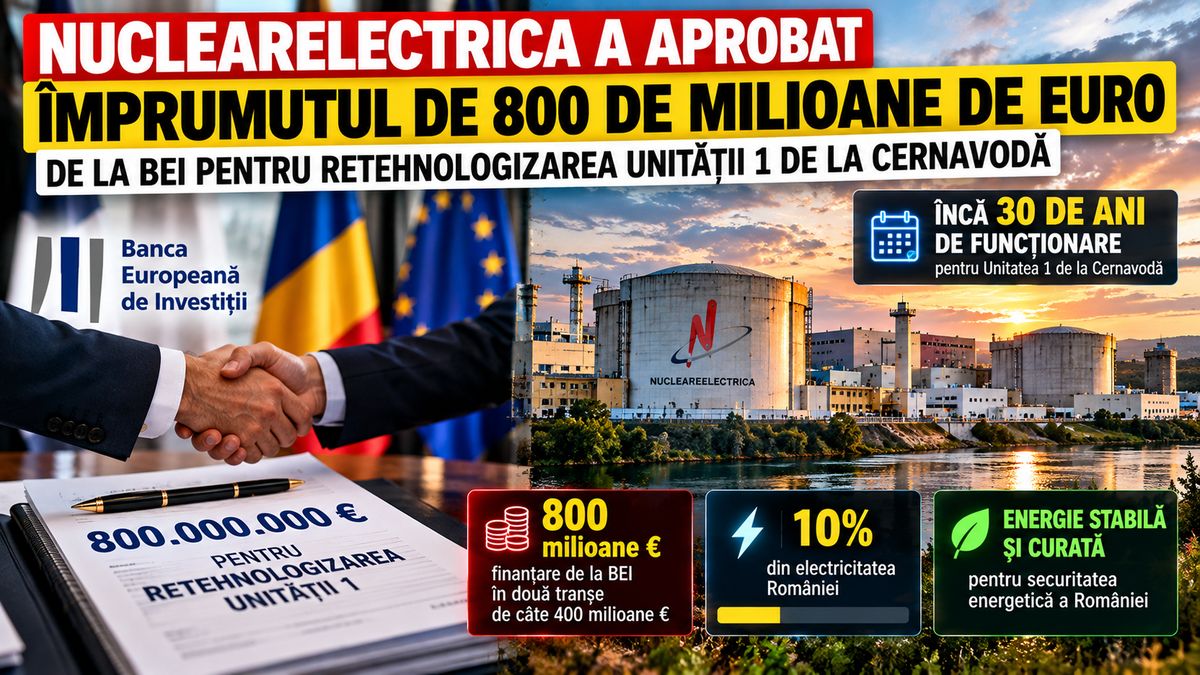
On Thursday, October 29, 2026, Nuclearelectrica's shareholders approved securing an €800 million financing facility from the European Investment Bank (EIB) for the refurbishment of Unit 1 at the Cernavodă Nuclear Power Plant. The decision marks a major financial milestone for the project, which aims to extend the reactor's operating life by another 30 years, securing one of Romania's primary power generation assets. The resolution was adopted during the Extraordinary General Meeting of Shareholders (EGMS) with 99.877% of votes cast by attending or represented shareholders, according to the Ministry of Energy. The financing will be split into two loan agreements of €400 million each, to be signed sequentially. The significance of this investment extends beyond the overhaul of an industrial facility. Under normal operating conditions, Cernavodă Unit 1 supplies approximately one-tenth of Romania's electricity. The refurbishment aims to retain this capacity within the power system for another three decades, supporting security of supply and maintaining low-carbon power generation. The €800 million loan will be contracted in two phases According to documents presented to Nuclearelectrica shareholders, the EIB financing will be structured into two distinct €400 million contracts. The estimated timeline sees the first contract signed during 2026, followed by the second in early 2027. Shareholders also authorized the Board of Directors to approve the final form of the loan agreements currently under negotiation with the European institution, as well as any subsequent amendments. The October 29 decision provides the required corporate sanction for contracting the loans, with the actual drawdown of funds contingent on signing the final documentation and fulfilling precedent conditions. According to terms disclosed following the meeting, the financing carries a 22-year repayment period with a four-year grace period on principal repayments. Fund disbursement is also conditional upon the entry into force of a state guarantee covering 80% of the principal. This structure reflects the combined commitment of the European lender, the company, and the Romanian state to a project with a multi-decade investment horizon. The EIB loan represents a key component of the refurbishment's financial structure rather than the total project cost. The investment encompasses complex industrial works, the procurement and replacement of major components, system upgrades, and safety testing required to resume operation in full compliance with nuclear safety standards. Unit 1 refurbishment targets another 30 years of nuclear generation Cernavodă Unit 1 entered commercial operation in 1996 and utilizes Canadian CANDU technology featuring a heavy-water nuclear reactor. The refurbishment project involves replacing and modernizing components and systems critical to extending operation beyond its initial design life. Such an undertaking differs substantially from routine maintenance. Refurbishment entails preparing the reactor for a whole new operating cycle, including work on core components, modernizing auxiliary systems, and undergoing comprehensive technical and nuclear safety reviews. The goal is to return the unit to service for approximately 30 additional years, subject to obtaining all necessary regulatory permits and meeting compliance requirements. For Romania, keeping Unit 1 in operation is of strategic importance. The Cernavodă plant currently operates two reactors, which together constitute one of the country's primary sources of baseload power. Nuclear energy provides electricity independent of daily variations in wind and solar output, thereby supporting demand coverage and grid stability. Extending the reactor's lifespan maximizes the value of existing nuclear infrastructure, maintaining significant dispatchable capacity without the need to construct a replacement greenfield plant. At the same time, the project demands rigorous coordination of works and outage schedules, as taking a reactor of this scale offline requires careful integration into national generation planning and reserve capacity management. European financing supports a strategic project for Romania's energy system The involvement of the European Investment Bank holds additional significance for Nuclearelectrica. Nuclear projects require high upfront capital expenditure and long cost-recovery horizons; long-term financing facilitates a sustainable cost structure and spreads the financial burden over the facility's future operational life. For Unit 1, securing financing approval enables contract preparation with the EIB to advance alongside technical and contractual project execution. Financial and industrial milestones must be closely aligned to ensure required capital is available according to schedule. The investment fits into Romania's broader nuclear expansion roadmap, which includes the Cernavodă Units 3 and 4 expansion and the Small Modular Reactor (SMR)…
Ioana Buzoaica — Independent Editorial Board
The NRG-IA newsroom continuously monitors Romanian energy markets, ANRE regulatory decisions, and national grid telemetry (SEN/SNT). We deliver independent intelligence anchored exclusively in official primary data.
Editorial Charter, Ethics & Verification Methodology →