Nuclearelectrica Halts 20-Year PPAs for Up to 70.1 TWh — NRG-IA
Piața de Energie Author: Ioana BuzoaicaNuclearelectrica halted its 20-year power auctions as no bidders qualified, showing the difficulty of securing counterparties for multi-billion euro PPAs.
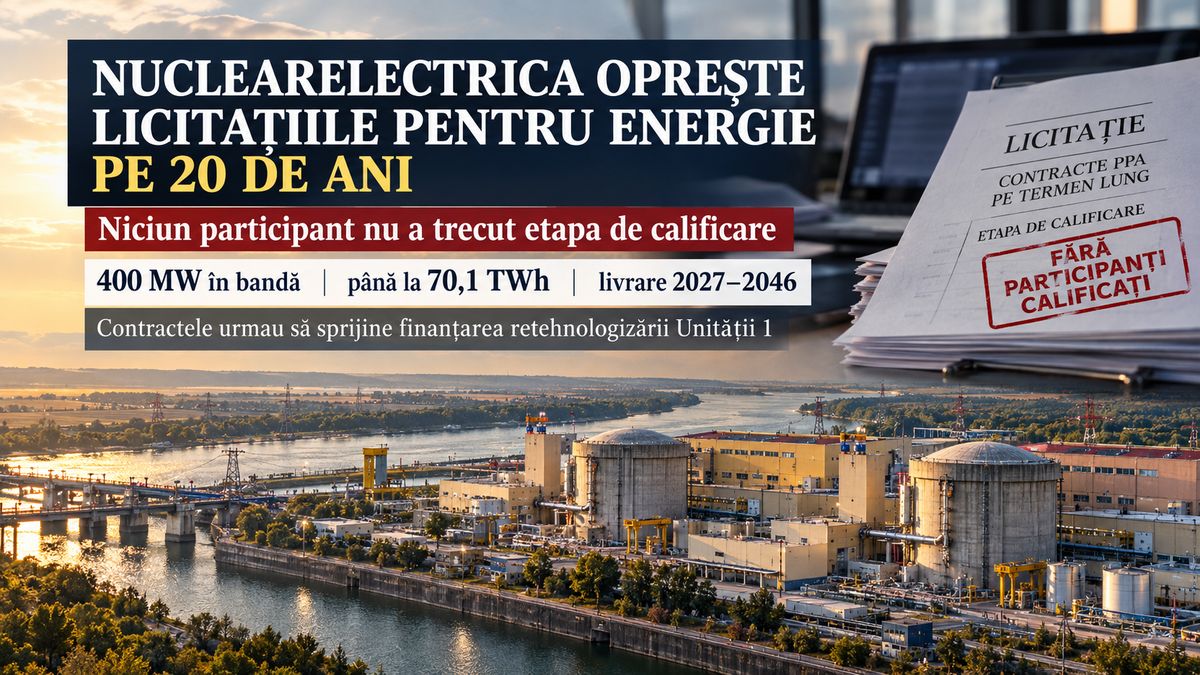
Nuclearelectrica has halted five auctions through which it intended to pre-contract up to 70.1 TWh of electricity over the next 20 years, after no participant passed the preliminary qualification stage. The electronic sessions scheduled on the Romanian Commodities Exchange (BRM) for September 21–25, 2026, did not take place, and the company announced it will analyze restarting the process. However, the scale of the operation went far beyond a simple long-term power sale. Nuclearelectrica had prepared to contract 400 MW of baseload delivery between January 1, 2027, and December 31, 2046, and the revenues secured through these contracts were intended to help secure financing for the refurbishment of Unit 1 at Cernavodă. The outcome of the procedure thus shifts the focus from energy prices to the market's capacity to support multi-billion euro contracts with counterparties that are financially robust enough for two-decade commitments. Contracts Worth at Least €5.6 Billion Halted Before the Auction Nuclearelectrica's offer was divided into five lots: three of 100 MW and two of 50 MW. Depending on options regarding non-delivery periods associated with planned outages, unplanned outages, or power reductions, the total contracted volume could vary between approximately 59.5 million MWh and 70.1 million MWh. For the minimum contractual volume and without inflation indexing, SNN documents estimated the minimum value of the 20-year contracts at approximately €5.6 billion . At the maximum volume limit, the operation would have covered approximately 70 TWh of nuclear power delivered by the end of 2046. The minimum price threshold indicated before the auctions was €91.5/MWh , equivalent at the time to approximately RON 481.5/MWh before the grid injection component and VAT. However, this represented the floor of the pricing mechanism, not a simple fixed price for the entire contract period. More importantly, the procedure never reached the bidding stage. Nuclearelectrica officially announced that no participant met the eligibility criteria and, consequently, did not complete the necessary steps for the award of the physical-delivery PPAs. Therefore, the available data does not support the conclusion that the power failed to find buyers due to the €91.5/MWh price level. The process was halted before the electronic auction could actually test buyers' willingness to contract at that level. 20-Year Contracts Raised the Financial Bar Significantly The duration and value of the contracts came with corresponding creditworthiness requirements. Eligibility criteria included an investment-grade credit rating of at least BBB- (Fitch classification) for the participant or the parent group guaranteeing the contractual obligations. The collateral mechanism was also substantial. The performance bond was to be established based on risk analysis and could reach the value of power delivered over a period of up to 365 days, plus VAT if applicable. The initial guarantee had to be valid for at least ten years, with renewal or replacement for successive five-year periods. For power payments, there was a separate option for a guarantee covering a 58-day delivery window or advance payment. These conditions considerably restrict the number of companies capable of undertaking such a commitment. Profit.ro identified PPC Energie, E.ON Energie România, and Premier Energy Furnizare among the participants registered on the BRM PPA platform, but Nuclearelectrica's official reporting does not specify who actually entered the qualification phase for each lot, nor the specific criterion each participant failed to meet. What is confirmed is the outcome: no one fully passed the screening required to reach the actual auction . PPAs Were Intended to Bolster Financing for Unit 1 The long-term contracts served a strategic purpose for Nuclearelectrica. In the documentation supporting the approval of the strategy for the 2027–2046 period, the company indicated that it intended to use the PPAs to facilitate securing the financing needed for the refurbishment of Unit 1. The logic is tied to revenue predictability. Very long-term price forecasts consulted by the company indicated that wholesale prices could fall below the estimated total average cost of electricity produced by Unit 1 after refurbishment. A long-term contract can mitigate part of this risk by securing revenues in advance. The 20-year duration of the PPAs covered the 2027–2046 period, targeting approximately 16 years after Unit 1 returns to operation following its refurbishment. The scale of the project explains the financial stringency. The European Investment Bank indicates an estimated total cost of approximately €3.2 billion for the refurbishment of Unit 1 and approved, at the project level, a proposed financing of approximately €800 million in July 2026. In the framework designed by Nuclearelectrica, awarding the auctions would not have concluded the process anyway. The contracts would…