Nuclearelectrica Tenders 70 TWh from Cernavoda over 20 Years — NRG-IA
Piața de Energie Author: Ioana BuzoaicaNuclearelectrica launches its largest long-term power tender for Cernavoda: up to 70.1 million MWh over 20 years, securing revenues for Unit 1's upgrade.
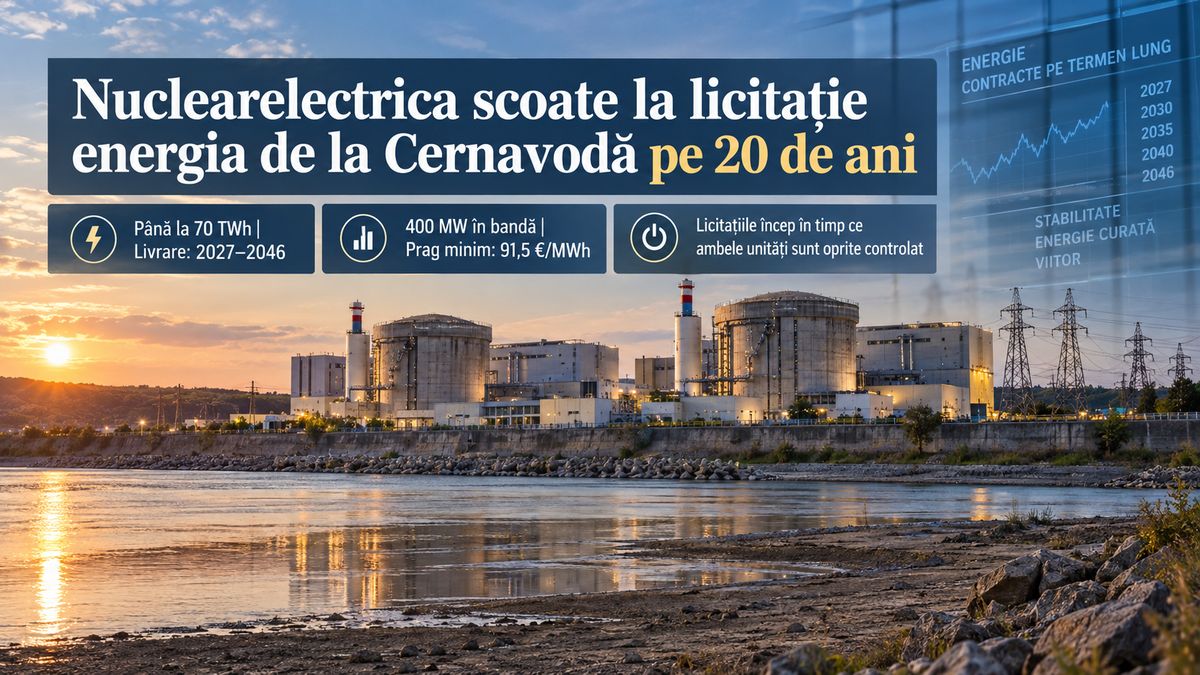
On Monday, September 21, Nuclearelectrica begins the first of five tenders aimed at securing long-term contracts for a significant portion of the Cernavoda nuclear power plant's output. The package covers up to 400 MW of baseload power delivered from January 1, 2027, to December 31, 2046, totaling between 59.5 and 70.1 million MWh, depending on contractual options regarding planned outages, unplanned outages, and power reductions. The scale of this operation moves the discussion far beyond a simple wholesale transaction. At the proposed minimum threshold of €91.5/MWh—equivalent to approximately RON 481.5/MWh before grid injection tariffs and VAT—the maximum volume put out to tender is valued at over €6.4 billion. What is decided now could tie a substantial portion of Romanian nuclear generation to contracts running until 2046. Up to 400 MW from Cernavoda enters a two-decade commercial bet The five lots are divided into two 50 MW products and three 100 MW products. If the entire 400 MW capacity were delivered continuously for a year, it would represent approximately 3.5 TWh. For comparison, the two units at Cernavoda delivered around 10.02 TWh to the National Energy System in 2024. Against this benchmark, the maximum tendered volume is equivalent to about 35% of the annual energy delivered by the plant in a normal year. However, the actual volume may be lower. The documentation allows the seller to use a non-delivery option for up to 45 days per year for planned outages, and an additional maximum of 10 days per year for unplanned outages or power reductions. These very mechanisms explain the difference between the minimum volume of 59.5 million MWh and the maximum of 70.1 million MWh over the entire contract period. However, Nuclearelectrica is not selling 70 TWh at €91.5/MWh today. What is starting is the bidding process, and €91.5/MWh represents the minimum price threshold for the procedure. The actual price will depend on the auction results, and the contracts must subsequently be negotiated and corporately approved before taking effect. SNN shareholders approved the strategy for the 2027–2046 period in July, but the final form and entry into force of the contracts are subject to a new approval by the General Meeting of Shareholders (AGA). €91.5/MWh for 20 years enters a market where the daily price is nearly double The timing of the tender presents a sharp contrast with today's market. For delivery on September 21, the baseload price on the Day-Ahead Market (DAM) is RON 964.83/MWh , while the proposed minimum threshold for Nuclearelectrica's contracts is approximately RON 481.5/MWh . The difference does not mean Nuclearelectrica is offering nuclear power at "half price." The two figures represent fundamentally different products. The DAM sets the electricity price for the next day in a market subject to hourly variations and immediate supply-demand imbalances. The contracts currently up for tender cover two decades, shifting a portion of future price risk into a very long-term commercial commitment. For Nuclearelectrica, the value of such a contract lies not only in the price level but also in revenue predictability. For the buyer, the stake is long-term access to baseload power with a contractually established price structure, in a market where costs can fluctuate wildly from year to year. PPC Energie, E.ON Energie România, and Premier Energy Furnizare are already registered alongside Nuclearelectrica as participants on the Romanian Commodities Exchange (BRM) PPA platform. However, registration does not mean these companies have submitted bids for Nuclearelectrica's lots or that they will become buyers; the outcome must be determined through the bidding procedures. 20-year contracts feed directly into the Unit 1 refurbishment equation This commercial operation overlaps with the largest project under preparation at Cernavoda: the refurbishment of Unit 1. The documentation supporting SNN's strategy links long-term contracts to facilitating project financing, as securing future revenues can mitigate some of the uncertainty analyzed by lenders. Project financing is already being structured. In September 2025, Nuclearelectrica signed a €540 million loan with a banking syndicate led by J.P. Morgan for the preliminary stage of the refurbishment. In July 2026, the European Investment Bank Board approved an additional €800 million , a financing package currently undergoing the necessary corporate procedures at SNN. The company states that its overall strategy combines equity with loans and guarantees provided by international financial institutions, export credit agencies, and commercial banks. The refurbishment is designed to extend Unit 1's operational life by approximately 30 years. Phase three of the project is scheduled for 2027–2030 and includes shutting down the reactor for major works, followed by testing and a return to service in 2030. The PPAs starting on January 1, 2027, will thus span the exact…