Nuclearelectrica Posts RON 32M Q3 Loss After Danube Drought — NRG-IA
Piața de Energie Author: Ioana BuzoaicaNuclearelectrica posted a Q3 2026 net loss of RON 32m as low Danube water levels shut down Cernavodă reactors, cutting 9-month net profit to RON 1.18bn.
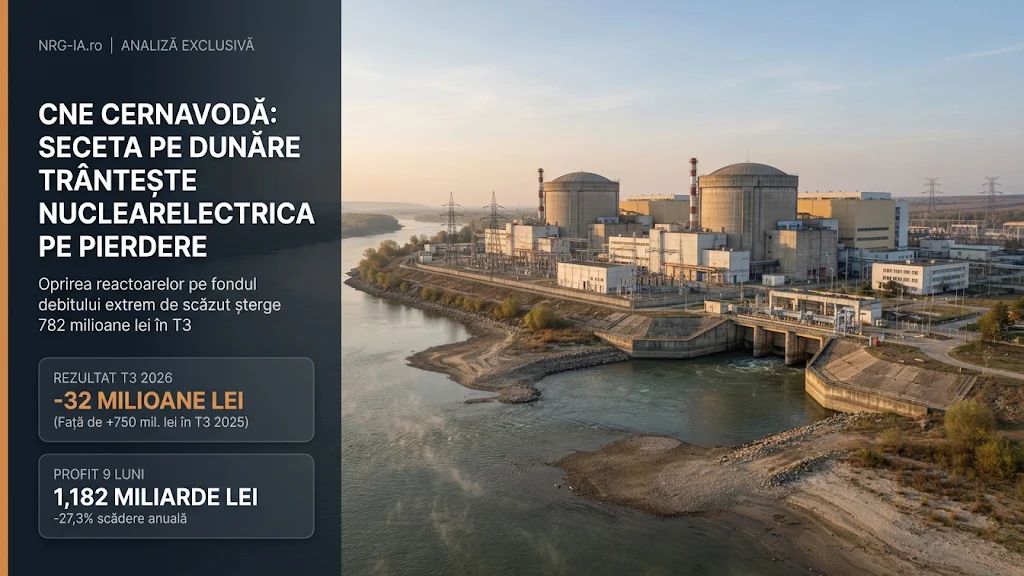
Societatea Națională Nuclearelectrica, Romania's sole nuclear power generator and one of the most resilient issuers on the Bucharest Stock Exchange, recorded a consolidated net loss of RON 32 million (approximately €6.4 million) in the third quarter of 2026. Financial results submitted to the stock exchange mark a sharp reversal from the same period in 2025, when the group generated a net profit of RON 750 million during the late summer and early autumn months. The RON 782 million quarterly swing into negative territory was triggered by a severe drop in Danube water levels between July and September 2026, forcing a shutdown of both reactors at the Cernavodă Nuclear Power Plant. For the first nine months of the year, the majority state-owned utility remains profitable thanks to strong earnings in the first half, reporting a net profit of RON 1.182 billion—a 27.3% decline compared to the January–September 2025 period. Beyond the immediate accounting impact, the third-quarter performance upends a core assumption of the National Power System. For decades, hydrological droughts on the Danube were viewed almost exclusively as an issue for Hidroelectrica and river transport, while nuclear energy was regarded as an all-weather anchor delivering roughly a fifth of the country's electricity. This autumn's financial statement confirms through direct bottom-line losses that river flow has become a shared risk for Romania's two main low-carbon power producers. Why a nuclear plant shutdown rapidly turns profits into losses The mechanism that erased three-quarters of a billion lei from Nuclearelectrica's quarterly results stems from the physical and economic design of the Cernavodă facility. Its two CANDU 6 units, with an installed capacity of approximately 700 MW each, rely on an open-loop cooling system to condense turbine-driving steam and dissipate heat from auxiliary systems, drawing water from the Danube via the intake basin of the Danube–Black Sea Canal's first reach. When river levels approach minimum hydro-technical safety thresholds, the plant's massive cooling water pumps face the risk of cavitation and flow loss required for nominal operation. Strict operational safety guidelines dictate power derating or controlled, preventive reactor shutdowns under such conditions, well before nuclear systems face any emergency threshold. While radiological and technical safety remains fully uncompromised, commercial output delivered to the grid vanishes precisely when the system needs it most. Unlike a natural gas or coal-fired power plant, which significantly lowers operating expenses during outages by halting fuel consumption and carbon allowance purchases, a nuclear power plant operates under an overwhelmingly fixed-cost structure. Nuclear fuel accounts for a small fraction of the total megawatt-hour cost, while expenses for highly specialized personnel, continuous maintenance, asset depreciation, physical and nuclear security, or heavy-water management accrue unchanged for every day the reactors remain offline. On top of fixed operating costs comes the financial penalty imposed by late-summer electricity market conditions. A baseload generator forward-sells a significant portion of its projected output through long-term bilateral contracts with firm delivery commitments. When reactors undergo unplanned outages during extreme heat and drought—a period when hydro output is also suppressed and air-conditioning demand keeps spot prices elevated—the company not only forfeits revenue from its own generation but becomes exposed to high market costs to balance its committed commercial positions. The International Energy Agency's global warning validated at Cernavodă The Cernavodă incident provides a tangible case study in Southeast Europe for the findings published on November 19 by the International Energy Agency in the 2026 edition of its flagship report, World Energy Outlook. The document highlights a major paradox of the current energy transition: while the global nuclear sector experiences a resurgence, with under-construction capacity reaching 90 GW—the highest level in 35 years—operational conventional fleets face escalating exposure to extreme weather events. According to the IEA's analysis, space cooling has emerged as a more dynamic driver of global electricity demand growth than heating, pushing peak loads into hot summer months—precisely when prolonged drought and river overheating constrain thermal and nuclear plants dependent on inland river basins. For Romania, the alignment of summer peak demand with low Danube hydrology turns cooling water into a critical national energy security issue. When up to 1,400 MW of nuclear baseload capacity suddenly disconnects from the grid alongside depressed hydro output, the supply deficit can only be covered by firing up fossil-fuel units and importing costly power across interconnectors, particularly during evening hours as solar generation ramps down to zero. The impact…
Ioana Buzoaica — Independent Editorial Board
The NRG-IA newsroom continuously monitors Romanian energy markets, ANRE regulatory decisions, and national grid telemetry (SEN/SNT). We deliver independent intelligence anchored exclusively in official primary data.
Editorial Charter, Ethics & Verification Methodology →