Undetected Drone Explodes Near Trans-Balkan Pipeline — NRG-IA
Geopolitică & Energie Author: Ioana BuzoaicaAn undetected explosive drone crossed Romania and exploded near the Trans-Balkan pipeline, raising key security concerns at the NATO border.
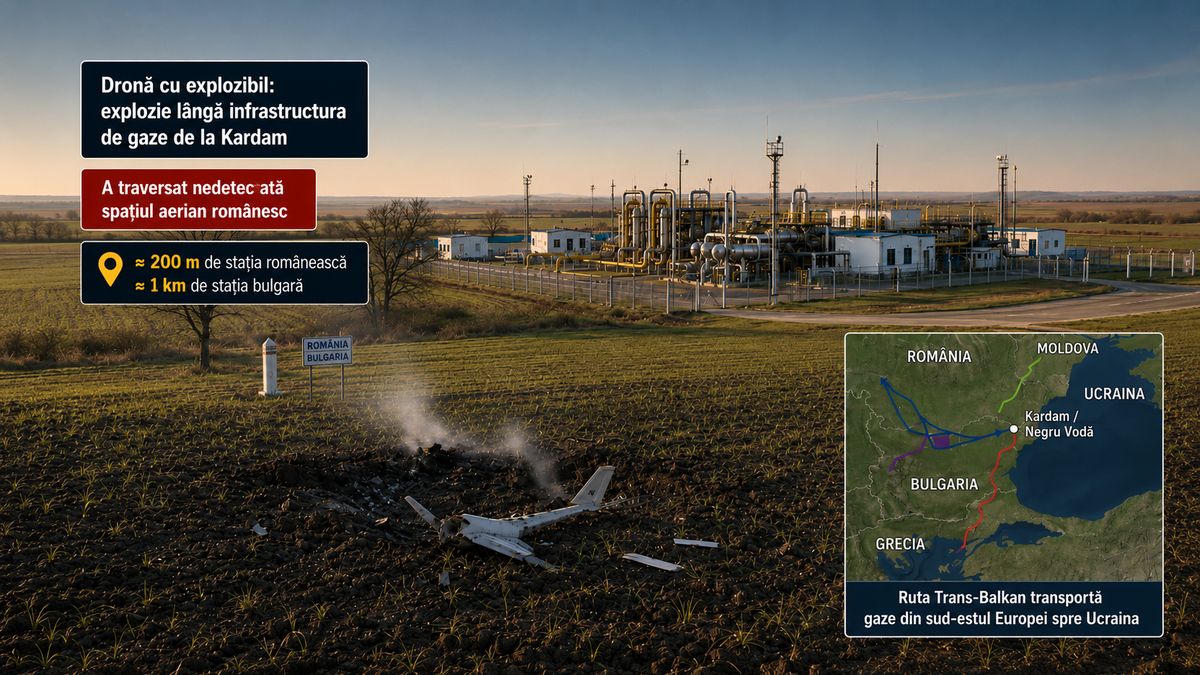
On Saturday, August 8, an explosive-laden drone entered Bulgarian airspace from Romania and exploded in a field near the town of Kardam, on the border between the two countries. According to authorities in Sofia, the aircraft had not been previously detected in either Romanian or Bulgarian airspace. There were no casualties, and no damage to infrastructure was reported. The blast site is located approximately 200 meters from a Romanian gas compressor station and about 1,000 meters from the Bulgarian compressor station associated with the Trans-Balkan system . The drone entered Bulgaria at 08:10 local time and exploded in a sunflower field near the Kardam border crossing. The proximity to energy infrastructure is significant enough to turn the incident into a regional energy security concern, but there is currently no evidence that the compressor stations or the pipeline were the target of the aircraft. Preliminary analysis points to a Maya decoy drone Following a preliminary examination of the debris, the Bulgarian Ministry of Defense announced that the aircraft is most likely a Maya-type decoy drone , a model widely used by the Ukrainian armed forces. Bulgarian authorities simultaneously stated that, at this stage, there is no reason to believe the incident was intentional . This conclusion is preliminary. Identifying the model does not, on its own, establish the launch site, the full flight path, the original mission, or the reason why the aircraft ended up at the Romanian-Bulgarian border. The Bulgarian Ministry of Defense estimated that the drone was carrying a significant amount of explosives, an assessment based on the intensity of the detonation and the resulting column of smoke. However, the exact amount of explosive material had not been publicly disclosed at the time of the available reports. Consequently, there is no factual basis to definitively attribute the incident to either Russia or Ukraine, nor to conclude that the gas infrastructure was deliberately targeted. "It came from Romania" does not mean the drone was launched from Romania For now, the publicly confirmed flight path only covers the final leg of the flight. Bulgarian authorities state that the drone entered Bulgaria from Romanian airspace . This information establishes the direction from which the aircraft crossed the border, not its launch point. There is no verified public information indicating that the drone was launched from Romanian territory. This distinction is crucial because the aircraft was not detected while crossing Romanian airspace. Bulgarian President Rumen Radev stated that the incident confirms the difficulty of identifying small, low-flying drones and announced the strengthening of surveillance along the border with Romania. Bulgaria also plans to redeploy border police equipment for drone detection and counter-measures to the Romanian border, which was previously stationed on the border with Turkey. Bulgarian Defense Minister Dimitar Stoyanov announced that the incident is also set to be discussed at the North Atlantic Council level. The issue thus goes beyond the still-unclear origin of a single aircraft: an explosive-laden drone managed to reach cross-border energy infrastructure without being previously identified by the systems of the two NATO member states. Negru Vodă–Kardam is one of the major links between the Romanian and Bulgarian gas systems The infrastructure near the explosion is not an isolated local facility. The Negru Vodă 1/Kardam interconnection point links Romania's National Gas Transmission System with the Bulgarian system operated by Bulgartransgaz. For this point, Transgaz indicates a technical capacity of approximately 6.36 billion cubic meters per year in the Romania–Bulgaria direction and about 5.31 billion cubic meters per year in the Bulgaria–Romania direction , under the technical conditions applicable to each transport direction. The pipeline is part of the infrastructure historically known as the Trans-Balkan pipeline, originally built to transport gas from the north to the Balkans and Turkey. However, shifting regional flows and the development of interconnections have transformed the network into an infrastructure that can also be used in reverse, from Southern Europe to Romania, Moldova, and Ukraine. For 2026, Transgaz explicitly publishes capacity products for "Route 1" , which connects the transmission systems of Greece, Bulgaria, Romania, Moldova, and Ukraine via the Trans-Balkan pipeline. This allows Ukraine access to gas from Southeast Europe, including alternative sources transported through Greek and Bulgarian infrastructure. Kardam is undergoing expansion for the Vertical Corridor The importance of this border point is set to increase. Bulgartransgaz is implementing projects to increase transmission capacity from Bulgaria to Romania, including the reversal of the Kardam compressor station , the expansion of the control system, and the construction of the additional…
Ioana Buzoaica — Independent Editorial Board
The NRG-IA newsroom continuously monitors Romanian energy markets, ANRE regulatory decisions, and national grid telemetry (SEN/SNT). We deliver independent intelligence anchored exclusively in official primary data.
Editorial Charter, Ethics & Verification Methodology →