Zinc–iodine battery reaches 6,800 cycles with new electrolyte — NRG-IA
Tehnologie & Inovație Author: Ioana BuzoaicaResearchers developed an iron-modified zeolite electrolyte enabling a zinc–iodine battery to operate for 6,800 cycles, targeting key stability issues.
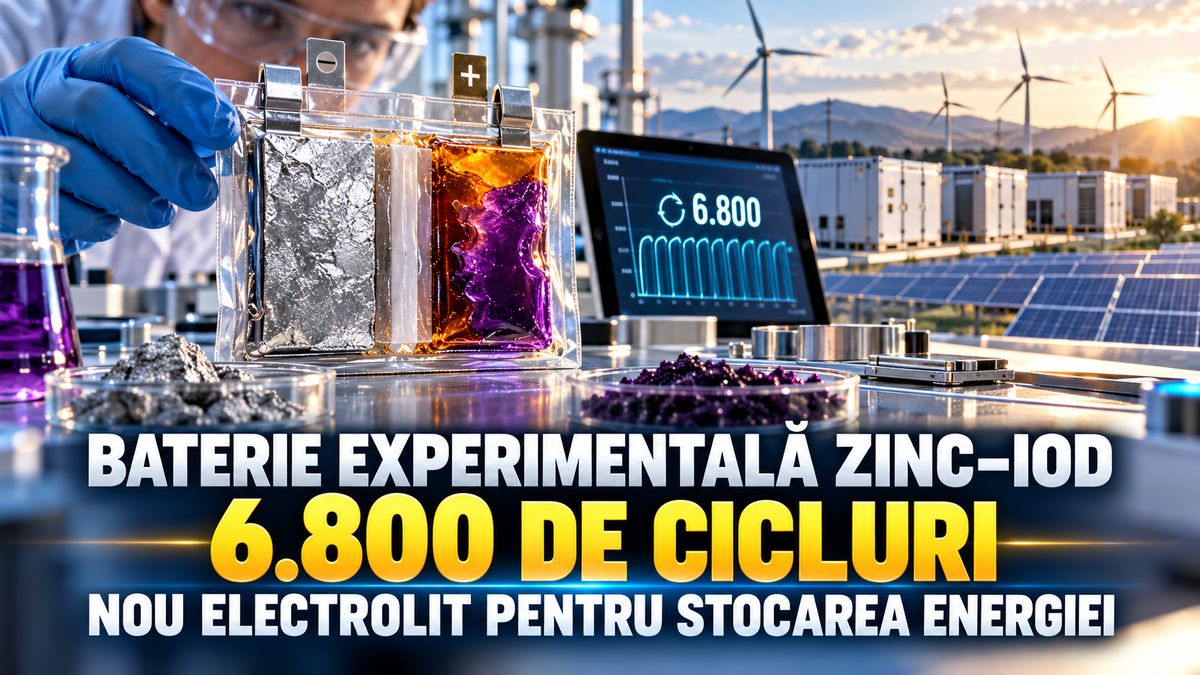
An international team of researchers has developed a new type of electrolyte for zinc–iodine batteries, achieving 6,800 charge and discharge cycles in an experimental cell. The findings, published on October 24, 2024 in the scientific journal Nature Communications, represent a breakthrough in electrochemical energy storage research through an approach that combines a porous material with individually distributed metal atoms. The new technology uses iron-atom-modified zeolite combined with an aqueous zinc sulfate solution. The resulting material forms a quasi-solid electrolyte capable of influencing chemical reactions at both electrodes. In durability testing, the battery retained a discharge capacity of 81.2 mAh per gram of iodine after 6,800 cycles at a current density of 4 A/g based on iodine mass. The research, conducted by specialists affiliated with institutions in Singapore, China, and Taiwan, addresses a major hurdle in zinc–iodine batteries: maintaining electrochemical stability during repeated charging and discharging. The results are particularly relevant for a class of technologies being investigated as alternatives for stationary energy storage, where durability, safety, and cost can matter more than achieving peak energy density. Zinc–iodine batteries offer a key advantage, but side reactions limit their performance Zinc–iodine batteries operate through reversible electrochemical reactions where zinc participates at the negative electrode and iodine at the positive electrode. During charge and discharge cycles, these reactions enable the conversion of electrical energy into chemical energy and its subsequent recovery. Interest in this chemistry stems from the potential to use materials distinct from those dominating lithium-ion batteries. Zinc is an industrially abundant metal, while aqueous electrolytes provide a development path for systems that avoid the risks associated with flammable organic solvents. These characteristics make zinc–iodine batteries attractive for stationary energy storage research. However, their performance is constrained by two major electrochemical phenomena. The first is the migration of polyiodide species between electrodes, known in scientific literature as polyiodide shuttling. This disrupts intended reactions and leads to capacity and efficiency losses. The second is the occurrence of side reactions at the zinc electrode, which can impair metal deposition stability and long-term battery operation. Quasi-solid electrolytes have been investigated to mitigate these issues by limiting free water content and the mobility of chemical species. However, a technological tradeoff exists: reducing liquid content can slow charge transfer at the electrolyte-electrode interface, diminishing battery performance during rapid charging and discharging. Researchers aimed to overcome this tradeoff by designing a material that restricts parasitic reactions while simultaneously promoting the electrochemical processes required for operation. Iron-atom-modified zeolite controls chemical reactions within the battery The core component of the new technology is zeolite, a porous material whose properties can be tailored to interact selectively with target substances. In this case, researchers incorporated single metal atoms into its framework, creating active sites capable of steering reactions involving iodine species. Zeolite variants modified with iron, cobalt, nickel, and copper were evaluated. Among these, the iron-based configuration demonstrated the best performance in the reported study. The material functions through a combination of catalytic and adsorption mechanisms. The active metal single atoms facilitate iodine electrochemical transformations, while the zeolite structure helps retain species that would otherwise migrate through the electrolyte. Together, these dual mechanisms mitigate unwanted polyiodide shuttling. The iron-modified zeolite also influences water molecule behavior within the electrolyte. According to the study, it helps stabilize water, reduce side reactions, and promote more uniform zinc deposition on the negative electrode. Uniform deposition is crucial for long-term cycling, as non-uniformities accelerate degradation and compromise electrochemical stability. The authors investigated these mechanisms using theoretical calculations, in situ spectroscopy during operation, and confocal laser microscopy. Combining these analytical methods enabled them to correlate material structure with observed chemical reactions and overall battery performance. The findings highlight a more dynamic role for the electrolyte: actively controlling electrochemical processes rather than acting solely as a passive ion-conduction medium. 6,800 lab cycles and distinct performance metrics for pouch cells The most notable quantitative outcome of the study is the durability test of the cell constructed with iron-modified zeolite. After 6,800 cycles, the experimental cell retained a…
Ioana Buzoaica — Independent Editorial Board
The NRG-IA newsroom continuously monitors Romanian energy markets, ANRE regulatory decisions, and national grid telemetry (SEN/SNT). We deliver independent intelligence anchored exclusively in official primary data.
Editorial Charter, Ethics & Verification Methodology →