Ontario threatens US with power and critical mineral cutoff — NRG-IA
Geopolitică & Energie Author: Ioana BuzoaicaOntario puts energy at the center of the US-Canada trade row. Having taxed power exports in 2025, the province can easily reactivate the mechanism.
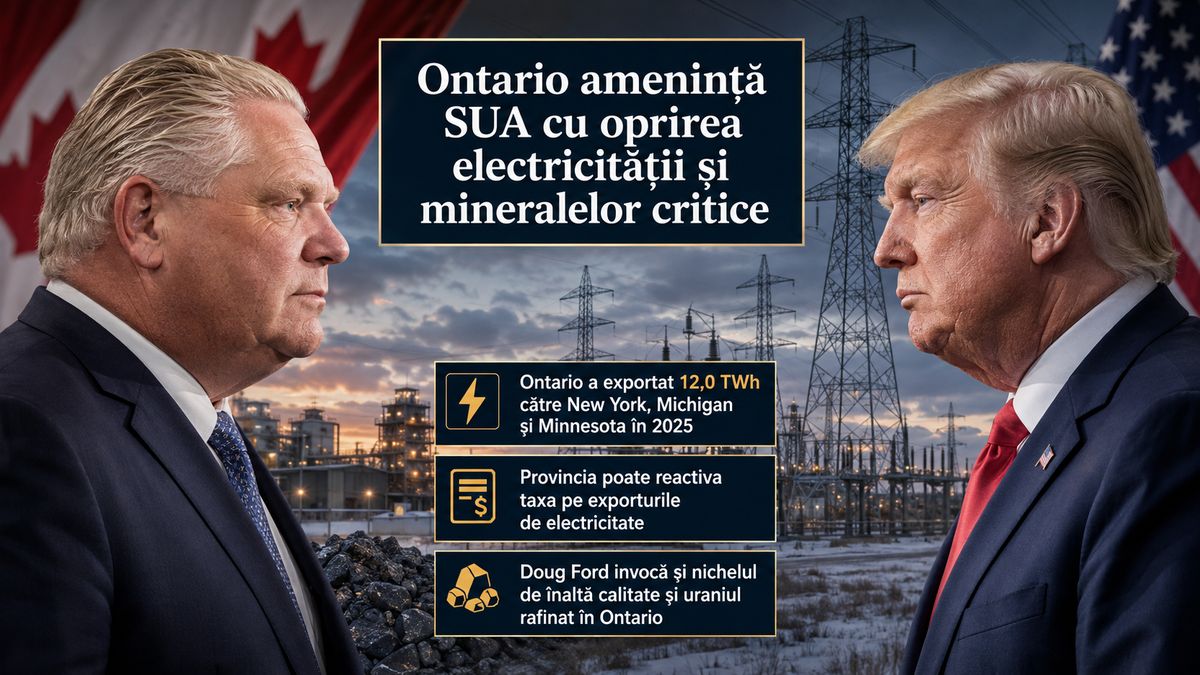
Ontario Premier Doug Ford has threatened to halt exports of electricity and critical minerals to the United States if the trade dispute between Washington and Ottawa continues to escalate. The statement follows the implementation of 50% US tariffs on approximately $20 billion worth of Canadian goods, and a new threat from President Donald Trump of 50% tariffs on Canadian cars, trucks, and auto parts starting January 1, 2027. Ford told the Associated Press that "everything is on the table" if the situation worsens. Regarding minerals, the Ontario premier explicitly pointed to high-grade nickel sent to the US and uranium refined in the province. For electricity, the threat is even more concrete: Ford said Ontario could increase the cost of deliveries or halt exports to the south altogether. No decision to halt exports has been made at this time. Canada has announced retaliatory tariffs against the new US duties to take effect on September 8, while Ford proposes using energy and resources as an additional layer of leverage if Washington continues to escalate. Electricity is a lever Ontario has already tested Ford's threat has a direct precedent. On March 10, 2025, the Ontario government introduced a 25% surcharge on electricity exported to the United States, equivalent to CAD 10/MWh. At the time, the provincial government estimated that the measure affected deliveries associated with approximately 1.5 million homes and businesses in New York, Michigan, and Minnesota, and could generate between CAD 300,000 and CAD 400,000 per day. The surcharge was quickly suspended after the confrontation eased at the time, but the regulatory infrastructure remains in place. IESO, Ontario's independent electricity system operator, notes that the market modifications remain in effect, and the special fee for US exports is currently set at $0/MWh and can be adjusted again at the minister's instruction. The difference from a mere political threat is significant: Ontario has already demonstrated that it can directly intervene in the economics of its power exports to the US without needing to build a new mechanism from scratch. Over 12 TWh flowed directly from Ontario to three US states in 2025 Ontario is electrically interconnected with New York, Michigan, and Minnesota, as well as with Quebec and Manitoba. In 2025, the province exported a total of 21.1 TWh of electricity , according to the IESO. Of this volume, 7.461 TWh were exported to New York , 4.403 TWh to Michigan , and 0.171 TWh to Minnesota . Together, the three US states directly received approximately 12.0 TWh of electricity from Ontario last year. The importance of this relationship is even greater at the level of the entire Canadian energy system. Canada exported 32.7 TWh of electricity to the United States in 2025 , valued at CAD 3.3 billion, and supplied 81.3% of total US electricity imports . The Canada Energy Regulator emphasizes that cross-border trade contributes to the reliability of power systems in both Canadian provinces and US states. These figures do not mean that New York, Michigan, or Minnesota would automatically face blackouts if Ontario suspended exports. Interconnections operate within a system where power can come from multiple sources, and grid operators can respond with domestic generation, other imports, and by rerouting flows. However, a sudden withdrawal of Ontario's power would eliminate a tangible source of supply and flexibility, with the impact becoming more pronounced during periods of peak demand or reduced availability of other capacities. The most direct consequences would likely manifest in prices, alternative generation requirements, and the safety margins of the affected grids, rather than as guaranteed blackouts. Indeed, the IESO describes interconnections precisely as tools that enhance operational flexibility, reliability, and the economic efficiency of the system. Critical minerals, not "rare minerals": Ford pointed to nickel and uranium The second lever raised by Ford involves critical minerals. The terminology is important: critical minerals are not synonymous with rare earths . Rare earths represent just one category within a much broader group of resources deemed strategic for industry, energy, defense, and advanced technologies. Ford specifically mentioned high-grade nickel shipped to the United States and uranium refined in Ontario. He also urged Canada to consider oil or potash in any tougher response. However, the latter are national-level Canadian levers, not resources that the Ontario government controls on its own. The commercial scale of the relationship with the US is substantial. In 2025, Canada exported critical minerals totaling approximately CAD 50.6 billion , including re-exports. The United States received CAD 28.8 billion , roughly 57% of these exports. Nickel accounted for Canadian exports of about CAD 4.38 billion , and uranium approximately CAD 3.59 billion , with both figures including re-exports. Ontario…
Ioana Buzoaica — Independent Editorial Board
The NRG-IA newsroom continuously monitors Romanian energy markets, ANRE regulatory decisions, and national grid telemetry (SEN/SNT). We deliver independent intelligence anchored exclusively in official primary data.
Editorial Charter, Ethics & Verification Methodology →