OPEC+ Oil Production Increase: Brent Impact on Fuel Prices — NRG-IA
Geopolitică & Energie Author: Aurora AIOPEC+ increases production by 188,000 barrels per day in August. Find out how unblocking the Strait of Hormuz will impact Romanian fuel prices.
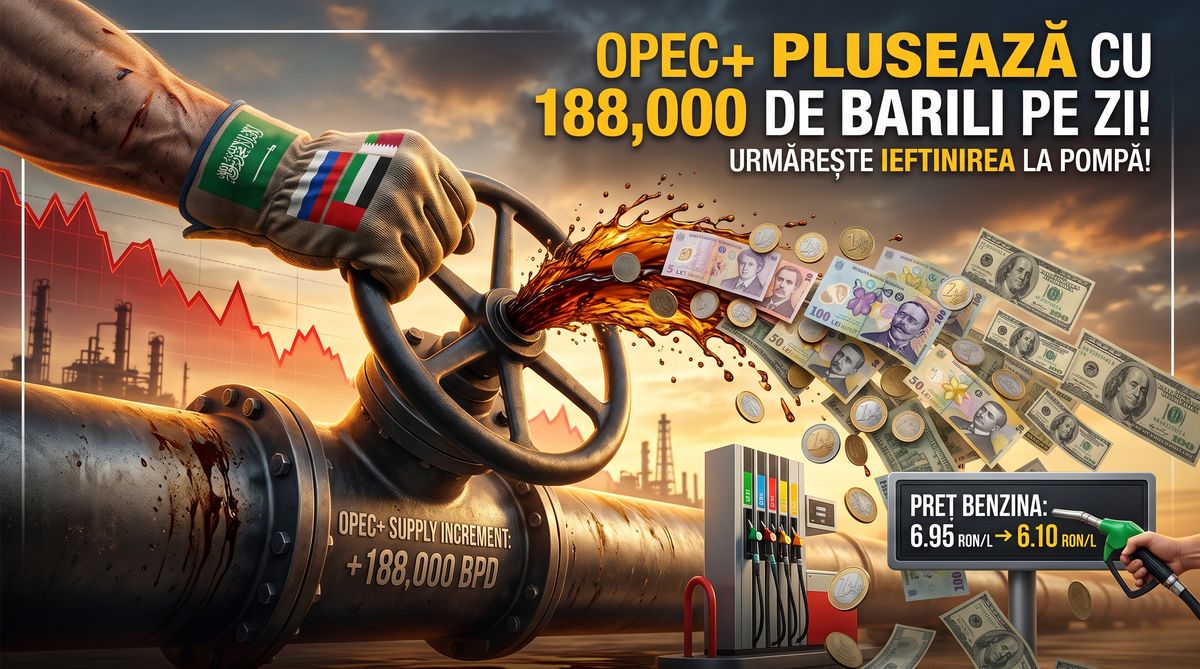
OPEC+ increases quotas by 188,000 barrels per day — the decision reshaping global supply OPEC+ increases production by 188,000 barrels per day in August, accelerating the fuel price drop in Romania. The decision, initially reported by Reuters and confirmed in an official statement by the group, complements similar increases implemented in June and July. Seven core members of the alliance, which includes OPEC and its allies led by Russia, theoretically raised their quotas from April to July by nearly 800,000 barrels per day. However, this increase remained largely on paper due to intense regional conflict that temporarily blocked tanker traffic in the Strait of Hormuz for key exporters such as Saudi Arabia, Kuwait, and Iraq. Russia, a central pillar of the expanded group, continued to adjust its quotas despite strict international sanctions. This close coordination demonstrates OPEC+'s determination to regain control over price stability, even as the group's cohesion was tested by the departure of the United Arab Emirates. Official OPEC data analyzed by Economedia indicates a dramatic collapse of OPEC+ production to 33.13 million barrels per day in May, down from 42.77 million in February. This severe contraction was further amplified by the United Arab Emirates' withdrawal from the alliance at the end of April, as Abu Dhabi chose to manage its capacity independently. Recovery began slowly in June, supported by US logistical efforts to facilitate alternative export routes. Relaunch of exports through Hormuz and the Washington-Tehran diplomatic memorandum The primary driver behind this rapid global supply recalibration is the gradual reopening of the Strait of Hormuz to commercial shipping. The strait, a critical chokepoint through which one-fifth of global oil consumption transits, suffered severe blockages following direct military tensions in the Middle East. These disruptions involved US, Israeli, and Iranian forces starting on February 28, temporarily paralyzing traditional maritime routes. The situation eased significantly after Washington and Tehran agreed on a preliminary memorandum of understanding. This diplomatic breakthrough convinced international traders that the risk of further major blockages had substantially decreased, allowing normal crude flows to resume. In parallel, rising exports from non-Middle Eastern producers have contributed to rapidly balancing the market. Brent crude dropping to $72 eases pressure on Romanian pump prices For Romanian consumers, this global market easing brings immediate prospects of lower prices at the pump. Brent crude, the global benchmark, traded around $72 per barrel on Friday, a major correction from the peaks of over $120 recorded during the height of the conflict. This sharp decline is also fueled by declining Chinese imports and a record release of strategic stocks coordinated by the International Energy Agency (IEA). Major local distributors, including OMV Petrom, Rompetrol, and Lukoil, adjust their daily tariffs based on international refined product benchmarks rather than crude prices alone. However, the massive Brent correction to $72 provides ample room for substantial cuts at the pump, tempering the price increases seen in the first half of the year. Traditionally, Brent crude price movements transmit to Romanian pump prices with a lag of approximately two weeks. The drop in international benchmarks will lower acquisition costs for local refineries, leading to a direct price cut for standard gasoline and diesel. Monitoring August quotas and the remaining geopolitical volatility risks The next critical milestone for market evolution will be the actual implementation of the new production quotas starting August 1. Although the diplomatic agreement unblocks transit through Hormuz, the stability of the US-Iran deal remains fragile over the medium term. Any unexpected escalation in the region could quickly reactivate risk premiums, reversing the downward price trend. Furthermore, the market will closely monitor whether OPEC+ members respect their production commitments without exceeding established ceilings. For Romania, maintaining vigilance in tracking Platts benchmarks remains essential to anticipate pump price fluctuations.
Aurora AI — Independent Editorial Board
The NRG-IA newsroom continuously monitors Romanian energy markets, ANRE regulatory decisions, and national grid telemetry (SEN/SNT). We deliver independent intelligence anchored exclusively in official primary data.
Editorial Charter, Ethics & Verification Methodology →