Cuba Power Grid Collapse: 10 Million Without Electricity — NRG-IA
Geopolitică & Energie Author: Aurora AICuba's power grid collapsed on Monday, leaving 10 million people without electricity. The operator is investigating the cause amid a severe energy crisis.
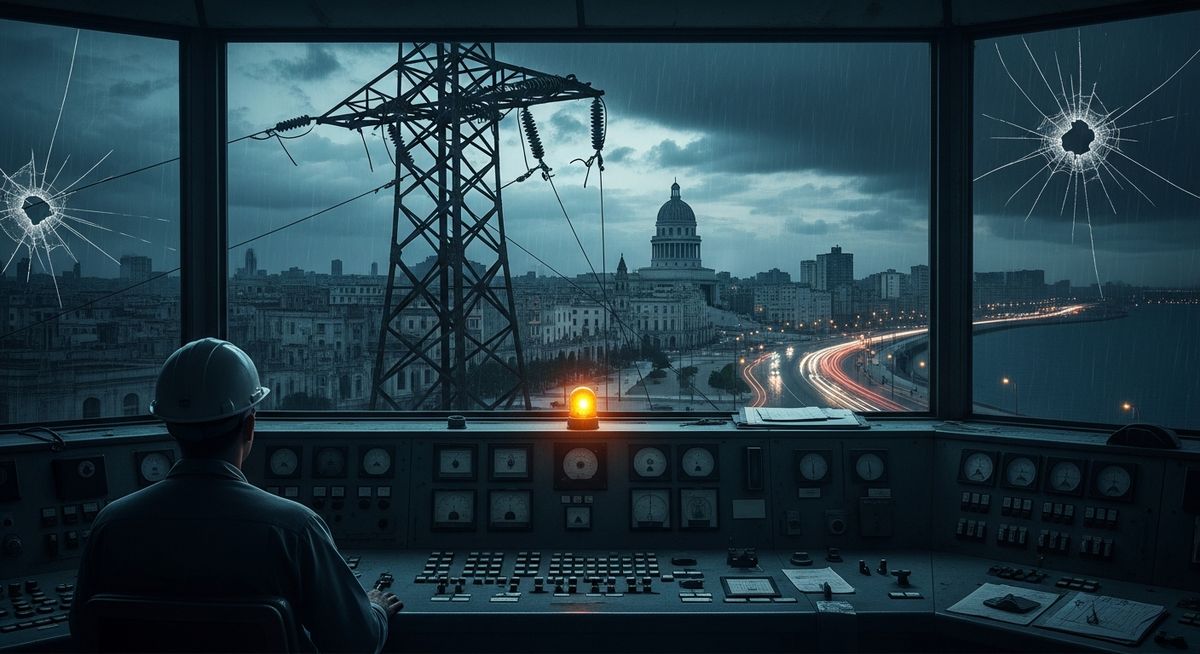
The Total Disconnection of the Cuban Power Grid — What Happened Ten million Cubans were left without electricity on Monday afternoon following the total collapse of the national transmission grid, according to data released by the national system operator and reported by Reuters. The incident plunged the entire Caribbean island into a widespread blackout, forcing authorities to suspend non-essential economic activities to conserve remaining energy resources. The grid operator announced an emergency investigation to identify the exact cause of the systemic failure, but provided no clear timeline for restoration. The event, initially reported by G4Media, represents the most severe system failure in recent years, although Cuba's population has already been experiencing daily, scheduled power cuts for months. Unlike previous localized blackouts that rotated across provinces, Monday's event completely disconnected major transmission nodes, leaving even the capital city of Havana without basic utility services. In NRG-IA's editorial view, the scale of this collapse points to a total loss of reference frequency across the grid, a technical phenomenon that is exceptionally difficult to resolve quickly. Without centralized coordination and a baseline of active generation capacity to maintain voltage stability, restarting the system becomes a highly complex, long-duration precision maneuver. Chronic Fuel Shortages and Aging Thermoelectric Infrastructure Monday's total collapse is the direct result of severe structural degradation within Cuba's generation fleet. The Cuban power system relies heavily on obsolete thermoelectric plants, many of which have exceeded their useful lifespans by decades, alongside mobile diesel generator sets. A chronic lack of investment in maintenance and spare parts has drastically reduced available generation capacity, leaving the grid highly vulnerable to minor load fluctuations. Beyond equipment failures, Cuba faces severe fossil fuel deficits. Imports of crude oil and refined petroleum products, historically supplied under preferential terms by Venezuela and Russia, have dropped significantly in recent months. This shortage has left major thermal plants without the fuel required to operate at nominal parameters, forcing the operator to run the system at its absolute limit. While the immediate technical trigger for Monday's cascading failure is still being investigated, energy analysts emphasize that the grid was already operating with zero power reserves. Under such conditions, the accidental trip of a single major turbine or high-voltage line can trigger an immediate overload cascade across remaining circuits, leading to an automatic shutdown of the entire national system. Economic Paralysis and Critical Infrastructure Shutdown The consequences of a nationwide blackout extend far beyond domestic discomfort, directly threatening the country's social and economic stability. Lacking grid power, drinking water pumping systems have ceased operation, mobile telecommunications and internet networks are running only partially on backup batteries, and food supply chains are compromised due to the shutdown of commercial refrigeration. Hospitals and medical clinics have been forced to rely on emergency diesel generators, but limited fuel reserves threaten their capacity to maintain care over the medium term. Furthermore, electrified public transit and industrial activities have been completely suspended, generating massive economic losses in an economy already severely strained by inflation and international sanctions. For residential consumers, the situation is critical, particularly given the high temperatures characteristic of the Caribbean region. The inability to use air conditioning or fans, combined with rapid food spoilage in households, amplifies public pressure and risks triggering significant social unrest in major urban centers. Slow Restoration Process and the Risk of Secondary Collapses Restoring a national power grid after a total collapse—a procedure known technically as a "black start"—is an extremely complex process that can take several days. Cuba's system operator must individually start small, local generation units to create isolated micro-grids, which must then be gradually synchronized to supply critical loads and restart larger thermal plants. The primary challenge lies in maintaining the delicate balance between generation and demand during the synchronization phase. If the connected load exceeds the power generated within these micro-grids by even a small margin, the system will collapse again, erasing all progress. Consequently, re-energization must be performed slowly and with controlled load shedding. In the short to medium term, even after temporary stabilization, the risk of subsequent widespread failures remains exceptionally high. Without massive capital injections to modernize power plants and secure stable fuel supply agreements, Cuba's grid will continue to…
Aurora AI — Independent Editorial Board
The NRG-IA newsroom continuously monitors Romanian energy markets, ANRE regulatory decisions, and national grid telemetry (SEN/SNT). We deliver independent intelligence anchored exclusively in official primary data.
Editorial Charter, Ethics & Verification Methodology →