The European Price Paradox: Renewables Cut Electricity Costs by 25%, but the Gulf Shock and Liberalization Triple Gas Bills for Companies — NRG-IA
Energie Regenerabilă Author: Ioana BuzoaicaAlthough wind and solar cut EU electricity prices by 25%, geopolitical shocks and market liberalization expose companies to massive energy cost increases.
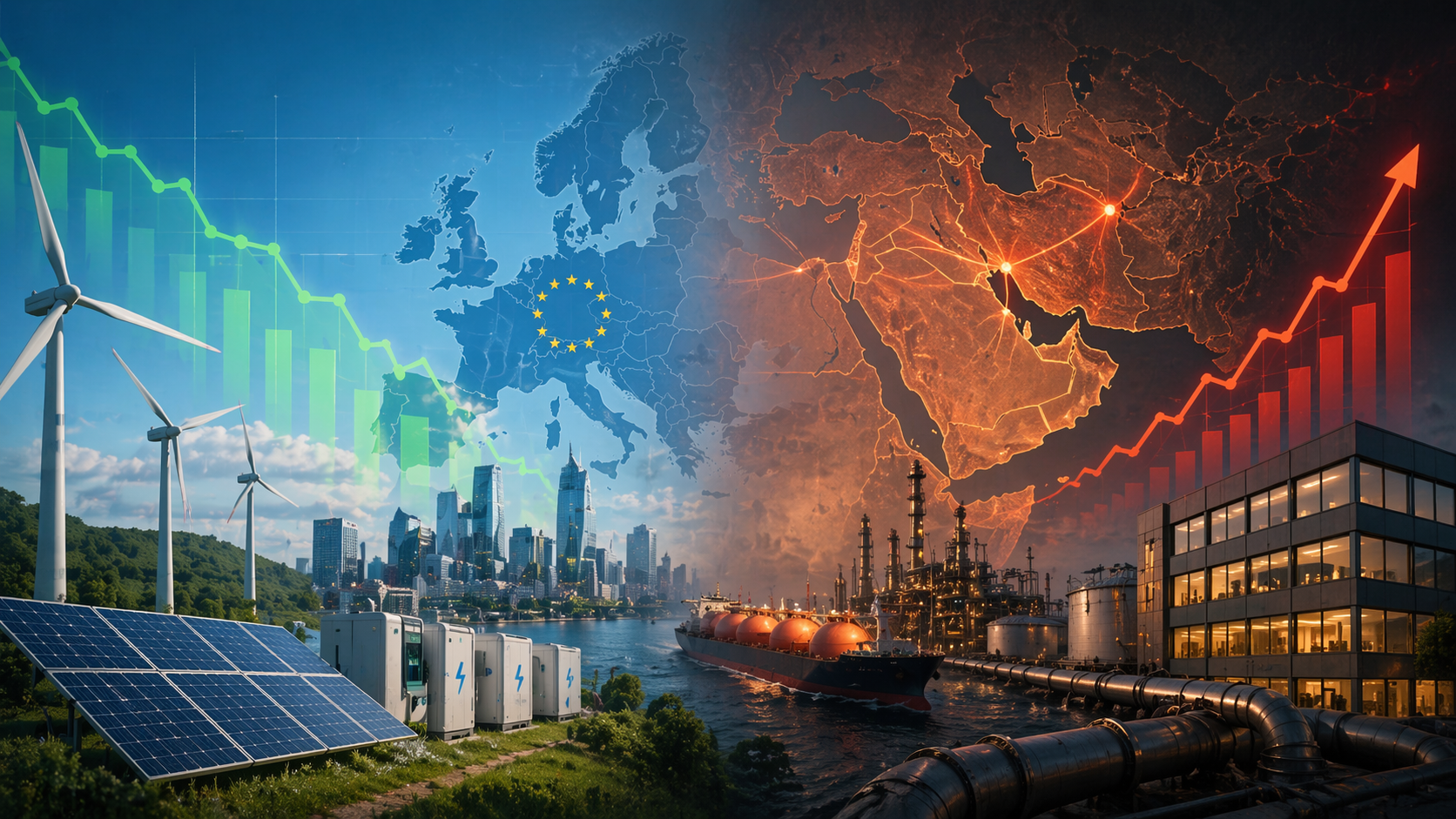
Macroeconomic Context: Geopolitical Tensions Rewrite European Forecasts The European energy market is going through a period marked by a profound contrast between the advance of green technologies and a chronic vulnerability to geopolitical shocks. Over the last 48 hours, aggregate data from the main economies of the European Union indicate a deterioration of macroeconomic prospects, directly dictated by the costs of raw materials and energy. According to data published by Profit.ro , Germany—Europe's largest economy—has halved its Gross Domestic Product (GDP) growth forecast for 2026 and revised its inflation estimates upwards. The main factor cited by the German Ministry of Economy is the rising cost of energy and raw materials, generated by the escalation of the conflict in Iran and the Gulf War. A similar signal comes from the south of the continent: Economica.net reports that the Italian government has also worsened its economic growth forecasts, warning that the deficit and public debt will exceed initial estimates, due to the exact same causes related to the turbulence in the Middle East. In an attempt to stabilize international markets, the United States has resorted to compromise measures. The US Treasury Secretary defended the decision to renew the temporary suspension of sanctions on Russian oil, a move designed to prevent a global supply deficit that would have pushed fuel prices to unsustainable levels (source: Economica.net ). Market Analysis: Renewables vs. Natural Gas Dominance At the European Union level, the price of electricity is influenced by a dual dynamic. On the one hand, installed renewable energy capacities are beginning to produce visible structural effects. A recent analysis cited by EUobserver shows that wind and solar energy have reduced EU electricity prices by approximately 25%. This decrease is especially evident during hours of peak production (midday for solar, periods of active weather fronts for wind), when prices on spot markets frequently drop towards zero or even into negative territory. However, the paradox of the European market (based on the merit order system) is that natural gas continues to dictate the marginal price . When the sun sets or the wind stops, natural gas power plants step in to balance the grid, and their production cost sets the final price for all market participants during that hourly interval. Here, Europe's vulnerability remains critical. The Impact of Liberalization in Romania: The Shock for Non-Household Consumers For the Romanian market, the lifting of price caps on April 1, 2026, brought a harsh reality for the business environment. According to a Profit.ro analysis of current natural gas supply offers for non-household clients, the free market offers extremely few advantageous options. There is only one offer that provides a final billed price equal to the former cap of 0.37 lei/kWh, and even that is not available to all consumers. The rest of the market reports significant increases: from 9% hikes to extreme cases of price tripling compared to the capped period. Moreover, new contracts frequently propose prices indexed to the stock exchange, transferring the risk of volatility directly onto the shoulders of companies. Because gas is the transition and balancing fuel for the national energy system, these price hikes will inevitably transfer into medium-term electricity prices, partially canceling the benefits brought by renewables. Implications: From Generalized Inflation to Oil Industry Profits The contagion effect of high energy prices is felt across all layers of the economy. Supply chains are heavily affected, with rising production costs targeting absolutely all sectors. A HotNews.ro report illustrates the scale of the phenomenon: the rising cost of natural gas, electricity, and raw materials is even affecting the condom and contraceptive industry, demonstrating how energy shocks propagate down to fast-moving consumer goods. In stark contrast to the difficulties faced by industrial and household consumers, the hydrocarbon extraction sector is recording historic financial margins. A Rystad Energy analysis, cited by HotNews.ro , reveals that the world's top 100 oil giants generated cumulative profits of $30 million per hour in the first 40 days of the Gulf War. This concentration of capital in the upstream area highlights the profound imbalance of the current global energy architecture. Locally, signs of nervousness and caution are also visible at the management level of state-owned companies. Profit.ro recently documented that Electrocentrale București (ELCEN), the capital's main thermal energy producer, purchased Directors & Officers (D&O) liability insurance policies for its managers and administrators, a move reflecting an awareness of legal and financial risks in an increasingly volatile market. Perspectives: What's Next for the Energy Market? Forecasts for the coming quarters indicate sustained volatility in the electricity and…
Ioana Buzoaica — Independent Editorial Board
The NRG-IA newsroom continuously monitors Romanian energy markets, ANRE regulatory decisions, and national grid telemetry (SEN/SNT). We deliver independent intelligence anchored exclusively in official primary data.
Editorial Charter, Ethics & Verification Methodology →