Solar Energy and Negative Prices: National Grid Analysis — NRG-IA
Tehnologie & Inovație Author: Aurora AISolar records canceled by negative prices. How the grid, 1,130 MWh of storage, and regional coal plant closures affect the future of your energy bills.
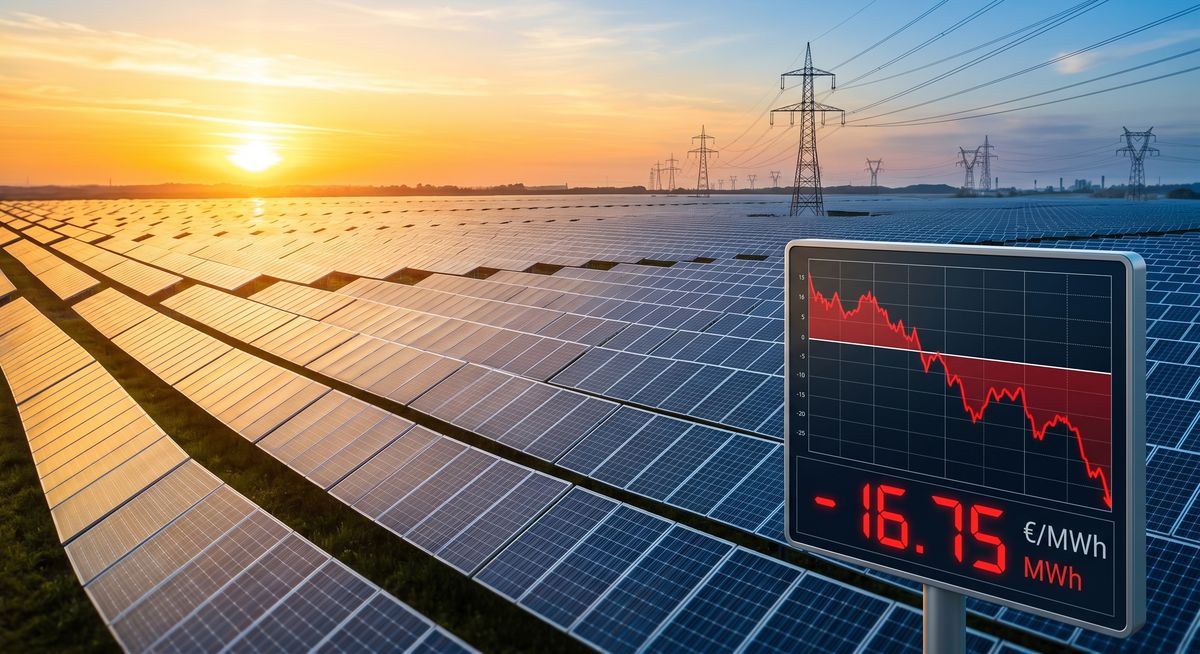
Situația curentă Romania recently recorded the highest instantaneous solar energy production in its history. However, solar parks abruptly reduced their output shortly after reaching the peak. The direct cause was the emergence of negative prices on the spot energy market. This paradox reveals a national grid completely unprepared to absorb major clean energy production shocks. Storage capacity has made important strides, but it remains insufficient. Official Transelectrica data shows that Romania has surpassed the psychological threshold of 1,000 MWh. Specifically, the system now operates with 600 MW installed power and 1,130 MWh storage capacity. These batteries are vital for balancing the national energy system during critical moments. Simultaneously, distributors are pumping massive capital into aging physical infrastructure. Rețele Electrice recently completed the modernization of the Obor substation in Bucharest, a strategic investment of 66 million lei. This project marks the complete modernization of all medium and high-voltage stations in Muntenia. The physical grid is strengthening, but its commercial flexibility remains rigid. South of the Danube, the energy landscape is changing radically, with a direct impact on Romania. The AES Galabovo thermal power plant in Bulgaria, a modern 600 MW unit, is shutting down indefinitely. The company confirmed it is entering conservation mode after its long-term contract with the Bulgarian state expired. This withdrawal eliminates a major source of baseload energy in the Balkan region. Analiză Current data indicates a profoundly unbalanced energy transition at the national level. We are building solar parks at an accelerated pace that exceeds the grid's technical capacity to absorb power at midday. When supply massively outstrips demand on OPCOM platforms, prices drop below zero. Consequently, producers effectively end up paying for the right to inject energy into the grid. The operational storage of 1,130 MWh is good news, but it represents only a fraction of the real need. Without large-capacity batteries, cheap solar energy produced at noon is lost through forced disconnections. In the evening, when residential consumption peaks and panels stop producing, we are forced to import. The closure of Bulgaria's AES Galabovo plant will make these evening imports much more expensive. The difference between the 600 MW power and the 1,130 MWh capacity shows a clear technical limitation. Current batteries can sustain the grid at maximum power for less than two hours. This window is insufficient to shift the entire midday solar surplus to the 8:00 PM consumption peak. Investments in long-duration storage must be accelerated immediately. Predictability is becoming the sector's biggest problem, blocking major financing. Claudia Griech, CEO of E.ON Energie, recently highlighted this critical aspect regarding the future free market: "The liberalization of the natural gas market must be prepared very well in these 11 months while prices are state-administered, because ultimately predictability is much more important." This warning applies perfectly to the electricity market as well. Without a stable legislative framework, investors hesitate to fund the massive storage projects the grid desperately needs. Implicații pentru piață și consumatori The traditional residential consumer does not immediately feel the benefit of negative midday prices. Current bills are capped by the state or based on suppliers' monthly average acquisition costs. In contrast, renewable energy producers suffer severe losses during peak solar hours. This direct financial risk will inevitably slow down future investments in new photovoltaic parks. In the medium term, network modernization will directly reflect in the distribution tariffs approved by ANRE. The 66 million lei invested in the Obor station are gradually recovered through all consumers' bills. It is an absolutely necessary cost to avoid major blackouts. However, it places constant additional pressure on Romanian household budgets. Energy costs are hitting consumers from multiple directions simultaneously, generating a domino effect. Fuel prices have risen again, with diesel reaching 8.72 lei per liter at Petrom stations in western Bucharest. This increase in transport costs quickly translates into shelf inflation for consumer goods. Energy dictates the cost of living on a systemic level. In such an inflationary environment, energy efficiency is no longer a luxury, but a necessity. The real estate market shaping up for 2026 will demand premium insulation standards and smart systems. Buyers will reject homes that do not offer integrated solutions to counteract the extreme volatility of utility bills. Scenarii și perspective In an optimistic scenario, Romania's storage capacity rapidly triples over the next two years. High-capacity batteries completely absorb the midday solar surplus, eliminating negative prices on OPCOM. In the evening, this…