BVB 9M 2026: Transelectrica Profit Triples, Romgaz Q3 Down 46% — NRG-IA
Piața de Energie Author: Ioana BuzoaicaTranselectrica's 9M profit tripled to RON 611m despite falling consumption, while Romgaz Q3 profit fell 46.4%, shifting focus to 2027 power tariffs.
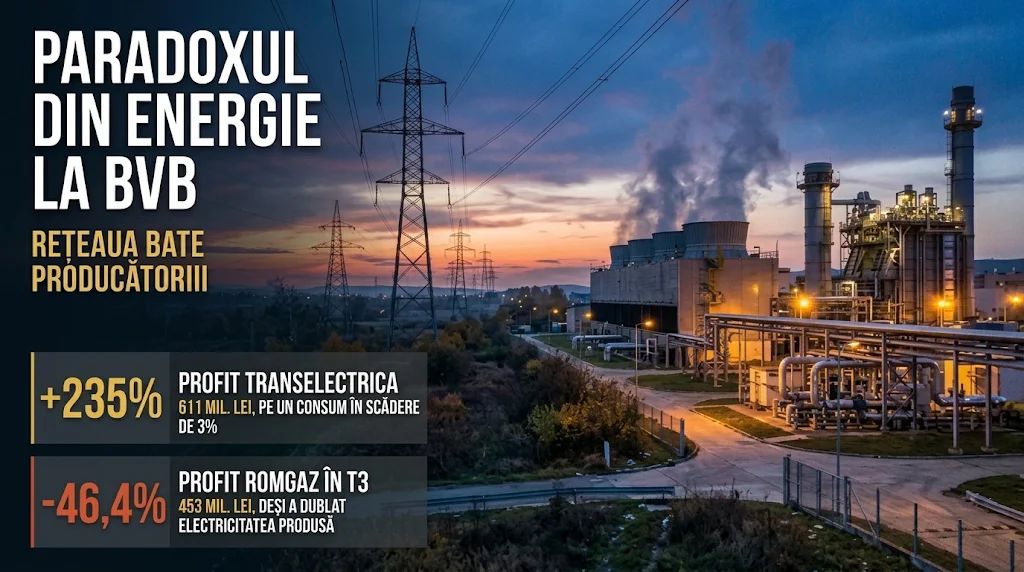
Financial reports for the first nine months of 2026 published on the Bucharest Stock Exchange by CNTEE Transelectrica and SNGN Romgaz outline a major shift in profit distribution across the state-owned energy sector. The national high-voltage transmission system operator more than tripled its net profit in January–September 2026 to RON 611 million, up 235% compared to the same period in 2025, even as Romania's net domestic electricity consumption contracted by 3% to 38.2 TWh. Conversely, the Romgaz Group reported a consolidated nine-month net profit of RON 2.217 billion, down 8.9% year-on-year, after third-quarter net results dropped by 46.4% to RON 453.1 million, despite doubling its electricity output during the summer months. The divergence between the two strategic companies dismantles a classic market perception that summer energy stress automatically boosts producers' earnings while penalizing infrastructure operators when transported volumes fall. Exchange filings reveal an inverse structural reality: the regulated transmission monopoly accumulated substantial gains on total revenues of RON 4.81 billion, up 16% compared to 9M 2025, whereas Romania's largest natural gas producer bore the full financial brunt in the summer quarter, eroding its first-half gains. Beyond their immediate relevance for investors on the Bucharest Stock Exchange and Pillar II private pension funds, these financial statements provide a physical snapshot of the Romanian economy ahead of winter. Tariffed energy drawn from the grid decreased by 2.7% over the first nine months, while Romania's net import balance dropped by 48% to 1.85 TWh from approximately 3.56 TWh in the prior-year period—signaling that the external rebalancing of the system occurred alongside a visible slowdown in demand measured across public networks. The Grid Earns More in an Economy Drawing Less Electricity The 235% surge in Transelectrica's net profit—from a baseline of roughly RON 182 million in 9M 2025 to RON 611 million this year—is rooted in the TSO's specific regulatory framework. The company's business is strictly segregated by the National Energy Regulatory Authority (ANRE) into an allowed-profit segment (comprising regulated transmission tariffs and cross-border capacity allocation revenues) and a zero-profit segment (covering technological system services and the balancing market). In a year characterized by wide price spreads between Central European and Balkan markets, the operator's total financial turnover reached RON 4.81 billion. However, its net performance relies on ANRE-approved regulatory mechanisms and settlements from cross-border capacity usage rather than commercial speculation on the balancing market, where temporary discrepancies between revenues and costs are retroactively adjusted through tariffs. This structure provides the TSO with short-term financial protection against the 2.7% decline in tariffed energy volumes. The contraction of net domestic consumption to 38.2 TWh reflects two concurrent economic and technological trends impacting the National Power System. On the one hand, energy-intensive heavy industry continues to operate below capacity due to high regional energy costs, depressing baseload demand on the high-voltage grid. On the other hand, the rapid expansion of prosumers—surpassing 385,000 connected users this autumn—is shifting an increasingly large share of daytime consumption behind the meter into local self-consumption, bypassing the national transmission grid and exiting Transelectrica's tariff base. This structural shift in daily production and consumption profiles also explains why the net import balance was halved to 1.85 TWh over the nine-month period. This figure measures the cumulative net difference between physical imports and exports, rather than an elimination of import dependency during peak hours. Midday solar surpluses reduced the cumulative nine-month balance via cheap exports or reduced daytime inflows, whereas evening demand peaks remained exposed to costly imported power and flexible gas-fired generation. Romgaz's Third-Quarter Shock and the Critical Role of Gas-Fired Power While the first three quarters consolidated historic results for Transelectrica, Romgaz Group's report highlights an abrupt deceleration confined entirely to the summer months. The drop in 9M consolidated net profit to RON 2.217 billion (down from roughly RON 2.434 billion in 9M 2025) masks two drastically different phases within the same financial year. The gap between nine-month cumulative results and the July–September period shows that Romgaz closed H1 2026 with a net profit of RON 1.764 billion, outperforming the ~RON 1.588 billion recorded in H1 2025. The entire 8.9% annual decline was generated in Q3, when consolidated net profit stalled at RON 453.1 million, down 46.4% from approximately RON 845 million in Q3 2025. The operational paradox of the summer lies in the fact that this net earnings compression occurred…
Ioana Buzoaica — Independent Editorial Board
The NRG-IA newsroom continuously monitors Romanian energy markets, ANRE regulatory decisions, and national grid telemetry (SEN/SNT). We deliver independent intelligence anchored exclusively in official primary data.
Editorial Charter, Ethics & Verification Methodology →