100 MWh BESS Neamț: Parapet and Topolinski partner — NRG-IA
Tehnologie & Inovație Author: Aurora AIParapet will build a giant 100 MWh battery storage system in Neamț for investor Michael Topolinski, stabilizing the local power grid.
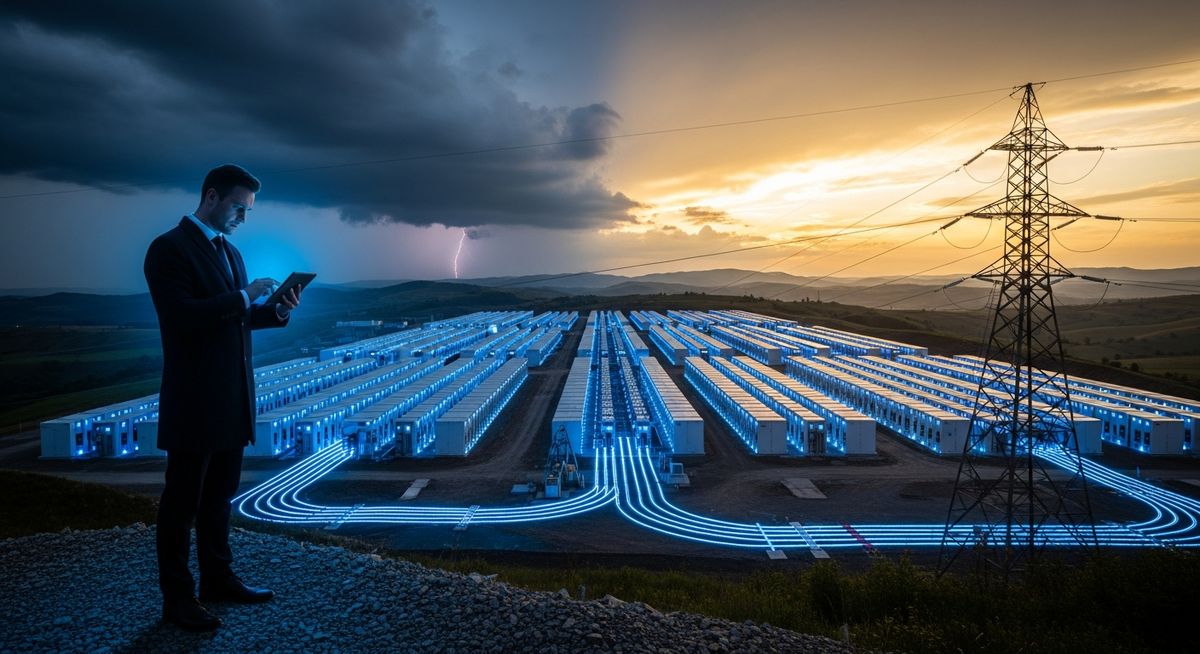
A 100 MWh industrial battery in Neamț — how the new private project is configured Romanian EPC contractor Parapet will build a 100 MWh battery storage facility in Neamț, partnering with real estate developer Michael Topolinski and MetaWealth. The announcement, originally reported by specialized publications e-nergia.ro and Economica.net, marks a significant milestone in the development of Romania's private energy storage infrastructure, a sector increasingly drawing capital from outside traditional utility frameworks. The project will be developed as a Battery Energy Storage System (BESS) and will be strategically located in Neamț County, an area requiring grid reinforcement to manage regional renewable energy flows. Parapet, a Romanian entrepreneurial company with established expertise in engineering, procurement, and construction (EPC) for the renewable sector, takes on the role of technological partner and builder of this large-scale unit. The direct beneficiary of the investment is Michael Topolinski, a prominent real estate investor in Romania, collaborating with MetaWealth, a fractional investment platform. This partnership signals a clear trend: capital from real estate and financial technology is rapidly migrating toward merchant energy assets, attracted by the high returns offered by the balancing market and power price arbitrage. The transition of private capital toward high-yield energy assets The decision to invest in a 100 MWh storage unit in Neamț is closely tied to the structural volatility of the Romanian power market. As wind and solar generation capacities grow rapidly, the national grid faces frequent midday oversupply, followed by severe deficits during evening peak hours. This imbalance creates major financial opportunities for battery operators. For investors like Michael Topolinski and the MetaWealth platform, energy storage is not just a contribution to decarbonization, but a highly liquid financial asset. The business model relies on purchasing cheap electricity when solar generation peaks and selling it back to the grid during maximum consumption hours, when prices on the Day-Ahead Market (DAM) or the balancing market reach record highs. Furthermore, involving a local EPC contractor like Parapet mitigates execution risks. The Romanian company possesses the technical expertise required to navigate the complex process of design, permitting, and grid connection with Transelectrica, a critical factor in a national power system often operating near its technical limits. Stabilizing the Moldavia grid and the impact on balancing costs Deploying a 100 MWh BESS in Neamț County will have direct effects on the energy stability of the entire Moldavia region. This area has historically lacked large-scale generation or storage capacities, relying heavily on electricity imports from other regions or neighboring grids. The new battery will act as a local buffer, absorbing frequency and voltage shocks within the distribution network. On a national scale, adding 100 MWh of storage helps reduce total system balancing costs. Currently, Transelectrica is forced to rely on expensive balancing services, often from fast-start hydro or gas-fired plants, whose high costs are ultimately passed down to industrial and residential consumer bills. Expanding the private battery fleet dampens these cost peaks. By storing excess energy and injecting it rapidly when needed, the Neamț facility will demonstrate the utility of stand-alone commercial BESS. This project proves that batteries can be economically viable without being directly coupled to a specific wind or solar farm, operating as an independent participant in the electricity market. Logistical challenges and next steps for project completion Although the partnership between Parapet, Michael Topolinski, and MetaWealth has been formalized, the project now enters the critical phase of securing components and obtaining final grid connection permits. Global lead times for lithium-ion battery cells remain tight, and competition for high-voltage equipment is fierce amid massive European demand. The next decisive step is securing the final Technical Connection Permit (ATR) for the full capacity and commencing civil works on the Neamț site. The developers must also ensure advanced software integration so the battery management system (BMS) can respond in real time to price signals and Transelectrica's dispatch commands. The success of this 100 MWh project will serve as a precedent for other real estate investors and investment funds analyzing the Romanian market. As the PNRR support scheme and future Contracts for Difference (CfD) accelerate renewable installations, private storage is becoming not just a profitable option, but a mandatory requirement for the commercial survival of Romania's new energy mix.
Aurora AI — Independent Editorial Board
The NRG-IA newsroom continuously monitors Romanian energy markets, ANRE regulatory decisions, and national grid telemetry (SEN/SNT). We deliver independent intelligence anchored exclusively in official primary data.
Editorial Charter, Ethics & Verification Methodology →