Four AI Chip Fabs Require 6.3 GW and 650k Tons of Water — NRG-IA
Tehnologie & Inovație Author: Aurora AISouth Korea's planned AI chip fabs require 6.3 GW and 650k tons of water daily, shifting the tech race from labs to heavy infrastructure.
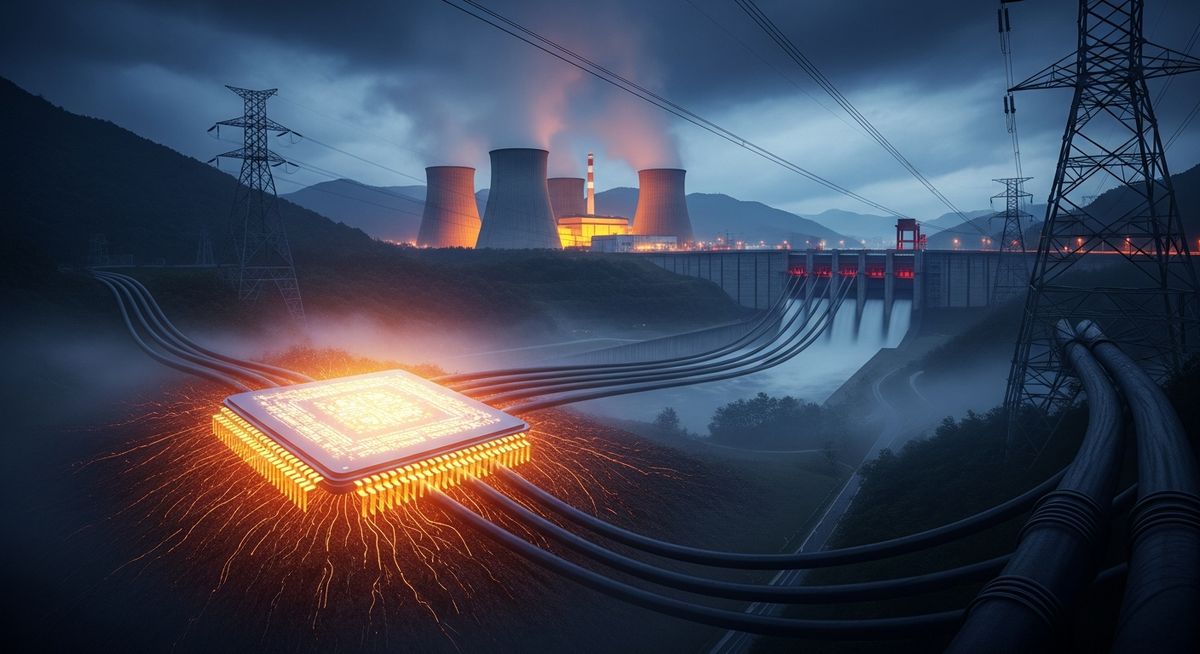
South Korea's plan for four new semiconductor fabrication plants in its southwestern region exposes the physical scale of the global artificial intelligence race. The facilities planned by Samsung Electronics and SK Hynix would require approximately 6.3 GW of electrical power and 650,000 tons of water per day, according to estimates presented by South Korean authorities. The required power is comparable to the generation capacity of five to six large nuclear reactors. The water demand exceeds the entire daily supply provided to household consumers in Gwangju, one of the region's major cities. These two figures demonstrate that competitive advantage in AI no longer depends solely on processor design or available capital, but on a territory's capacity to permanently sustain a highly resource-intensive industry. 800 trillion won for the next generation of memory Samsung Electronics and SK Hynix have announced cumulative investments of 800 trillion won in new production capacities in southwestern South Korea, equivalent to approximately $540 billion at the exchange rate used by Reuters in July. The plan outlines four new manufacturing facilities, two for each company. Samsung has selected Gwangju for its future cluster, while SK Hynix is preparing a production base in the same broader region, though it had not finalized the exact location at the time of the announcement. The company has allocated 400 trillion won for southwestern investments, which will cover land acquisition, factory construction, and equipment installation. These funds will not be spent in a single phase and do not represent a fully approved public budget. The investments are long-term corporate commitments, dependent on demand trends, infrastructure readiness, and successive corporate approvals. SK Hynix notes that the scale and timing of each phase will be adjusted based on market conditions and its investment discipline. The driver of this expansion is the demand for advanced memory used by AI systems. Samsung and SK Hynix are among the world's leading producers of DRAM and HBM (High Bandwidth Memory), which allows AI accelerators to rapidly transfer massive volumes of data. HBM is manufactured by stacking multiple memory layers, and its production requires more silicon wafers and larger industrial capacities than conventional memory. 6.3 GW must be delivered continuously, not just generated annually A semiconductor fabrication plant operates 24/7 and requires high-quality power. It is not enough for the region to generate the same amount of electricity annually as the fab consumes. Power must be available at all times, with stable parameters, redundancy, and backup systems. Voltage fluctuations or outages can halt manufacturing processes, ruin production batches, and cause significant financial losses. Consequently, a chip fab requires robust transmission lines, dedicated substations, dispatchable capacity, storage, and backup solutions, not just installed capacity on paper. The Seoul government claims that the country's southwest currently generates more electricity than it consumes locally, and that a significant portion of the required power could be sourced within the region. However, the current surplus does not guarantee that an additional 6.3 GW industrial load can be connected without expanding the infrastructure. Estimates cited by Reuters show that the four fabs could consume the equivalent of 70–80% of the current combined annual consumption of Gwangju and the North and South Jeolla provinces. This comparison is not a final forecast of the fabs' consumption, but it illustrates the massive shift in scale that the project would bring to the regional energy system. A region that currently exports electricity could become a massive industrial consumption hub once the fabs are connected. The grid will have to simultaneously manage the continuous power supply to the cluster, residential consumption, supplier development, and the expansion of surrounding cities. Renewables offer volume, but do not eliminate the need for baseload capacity The Honam region possesses significant solar and wind energy resources, and the government views this advantage as a key factor in attracting chipmakers. Tech companies are increasingly monitoring the carbon footprint of their supply chains, and access to renewable energy can help meet the climate commitments of global clients. Variable generation alone cannot sustain a 24/7 industrial operation. The gaps between sunny or windy hours and the constant consumption of the fabs must be covered by storage, pumped-storage hydropower, dispatchable generation, and power exchanges with the rest of the grid. Authorities have mentioned gas-fired plants, hydrogen, storage capacities, the expansion of pumped-storage hydro, and nuclear energy among the options. New reactors and small modular reactors (SMRs) have also been discussed, but the final power supply configuration has not yet been approved. The need for…
Aurora AI — Independent Editorial Board
The NRG-IA newsroom continuously monitors Romanian energy markets, ANRE regulatory decisions, and national grid telemetry (SEN/SNT). We deliver independent intelligence anchored exclusively in official primary data.
Editorial Charter, Ethics & Verification Methodology →