Brent Oil Hits $110/bbl: Yanbu and the Hormuz Crisis — NRG-IA
Geopolitică & Energie Author: Ioana BuzoaicaBrent oil hit $110/bbl on Oct 16 amid Middle East escalation and Russian refining disruptions, raising risks for key Saudi bypass routes as stocks fall.
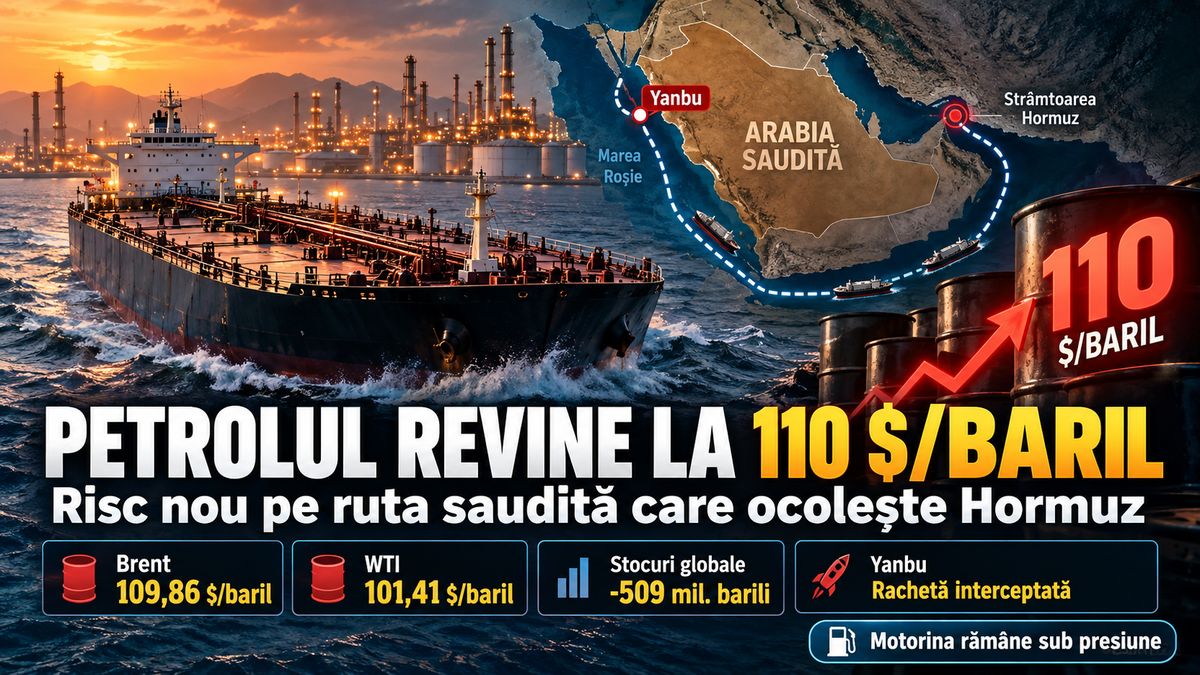
Brent crude reached the $110 per barrel mark on Friday, October 16, 2026, for the first time in nearly five months, in a market where attacks on Middle Eastern energy infrastructure threaten to derail the recovery of oil exports. Brent futures settled at $109.86 per barrel, up 3.7%, while US WTI crude reached $101.41 per barrel following a 3.5% daily gain. The latest escalation thrust the Saudi Red Sea port of Yanbu back into the spotlight after Saudi air defenses intercepted a ballistic missile launched toward the facility. The incident is significant as Yanbu serves as one of the main export gateways allowing Saudi Arabia to bypass the conflict-plagued Strait of Hormuz. Initial reports indicated no damage to port facilities, but the threat targets the critical infrastructure that has allowed a substantial portion of Saudi shipments to continue. Price pressure comes at a time when market inventories are severely depleted and global diesel supply capacity remains constrained. According to a report published on October 14 by the International Energy Agency (IEA), observed global oil inventories at the end of September were 509 million barrels below their late-February levels. Concurrently, global availability of diesel and other middle distillates fell by 1.7 million barrels per day in the third quarter compared to the same period in 2025. Yanbu, the strategic alternative to Hormuz, comes under threat again The port of Yanbu plays a pivotal role in Saudi Arabia's energy strategy. Via the East-West Pipeline—also known as Petroline—crude produced in the kingdom's eastern region is transported to the Red Sea coast, where it can be loaded onto tankers without passing through the Strait of Hormuz. The pipeline has a transport capacity of roughly 7 million barrels per day and has grown particularly vital following shipping disruptions in the Persian Gulf. On October 12, the Saudi Energy Minister outlined the possibility of expanding pipeline export capacity to around 10 million barrels per day through infrastructure modifications and additional investments. The plan highlights Riyadh's intent to reduce its reliance on conflict-exposed maritime chokepoints. However, this expansion remains a medium-term prospect, while securing existing facilities is critical for current export flows. The strategic value of this infrastructure was underscored in September, when the East-West Pipeline sustained damage from an attack. Saudi Aramco managed to restore flows swiftly, supporting the recovery of Saudi exports. According to the IEA, crude volumes routed around Hormuz rose by approximately 970,000 barrels per day in September, reaching 5.6 million barrels per day. The missile intercepted over Yanbu on October 16 reignited fears over the protection of this bypass route. Although pipeline transport bypasses the Strait of Hormuz, the crude must still reach coastal terminals, be loaded onto vessels, and navigate maritime passages exposed to other security risks. Any operational disruption at the port or fresh damage to the pipeline could curtail Saudi export flexibility precisely when global markets are counting on the recovery of Gulf supplies. Gulf exports stage partial recovery, but market vulnerabilities persist The IEA's October report shows that Persian Gulf producers managed to recover a significant share of the export volumes lost following the outbreak of conflict with Iran in late February. In September, crude exports from the region surged by 4.4 million barrels per day month-on-month to 13.9 million barrels per day, recovering to over 75% of pre-war levels. Total oil flows through the Strait of Hormuz reached approximately 10.9 million barrels per day, reflecting a monthly increase of 3.7 million barrels per day. The recovery was enabled in part by ship-to-ship crude transfers in the Gulf of Oman and greater utilization of alternative bypass routes. These operational workarounds allowed shipments to rise despite a hostile logistical environment marked by attacks, soaring freight rates, and operational constraints. However, shipments of refined petroleum products and liquefied petroleum gas (LPG) lagged significantly behind crude export recovery. In September, Middle Eastern refined product exports stood at roughly 1.9 million barrels per day, down from 4.7 million barrels per day prior to the war. This gap underscores ongoing bottlenecks in fuel refining and distribution that continue to ripple through international markets. Under these conditions, prices are responding not only to physical supplies but also to the risk of further supply losses. Soaring maritime insurance premiums, elevated tanker charter rates, logistical delays, and forced rerouting drive up delivered energy costs even before an incident physically cuts output or exports. Attacks on Saudi infrastructure and regional shipping heighten this uncertainty in a market attempting to rebuild drawn-down stocks. Diesel deficit compounds pressure on the…
Ioana Buzoaica — Independent Editorial Board
The NRG-IA newsroom continuously monitors Romanian energy markets, ANRE regulatory decisions, and national grid telemetry (SEN/SNT). We deliver independent intelligence anchored exclusively in official primary data.
Editorial Charter, Ethics & Verification Methodology →