Brent drops below $92 on Trump Iran update, record US supply — NRG-IA
Geopolitică & Energie Author: Ioana BuzoaicaBrent crude slipped to $91.58 after US President Trump cited progress on Iran. Record US output paves the way for lower fuel pump prices across Europe.
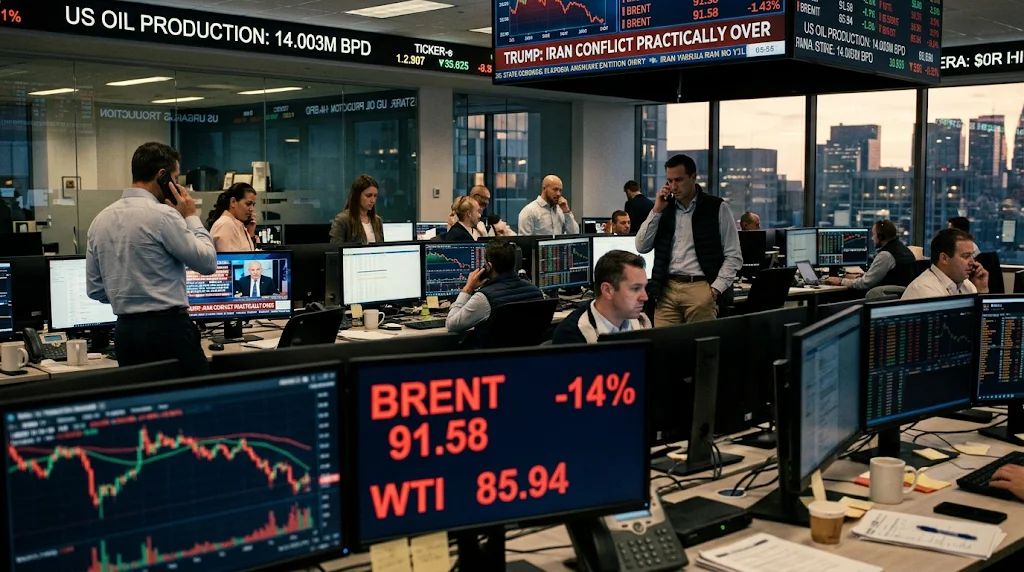
International crude oil quotes accelerated their decline during Tuesday morning's Asian trading session on November 10, 2026, pushing European benchmark Brent into the $91.58 – $92.33 per barrel range, after United States President Donald Trump stated at the White House that the war with Iran is "militarily, practically over." The American leader's message came on Monday, November 9, following discussions held with the Prime Minister of Qatar, through which Washington signaled positive diplomatic momentum toward halting hostilities in the Middle East and sharply reduced the probability of further military escalation in the region. The reaction on commodity exchanges quickly spread across the energy complex, where US benchmark West Texas Intermediate fell to $85.94 per barrel, its lowest level in nine weeks. Over the past month, crude prices have lost more than 14% from their October peaks, while US RBOB gasoline futures hit an eight-month low, indicating that the raw material correction is already feeding into wholesale refined fuel prices. Beyond the political signal from Washington, selling on energy exchanges is underpinned by a historic milestone in physical supply from the Western Hemisphere, where US crude oil production rose to an all-time high of 14.003 million barrels per day. This combination of diplomatic mediation and abundant American crude defuses the scenario of a global winter inflation shock, despite the fact that a formal ceasefire agreement with Tehran remains to be negotiated and commercial shipping through the Strait of Hormuz continues to face severe risks. The US record high of 14 million barrels per day removes the war premium from crude prices The mechanism that enabled oil to break below $92 per barrel stems from the accelerated unwinding of the geopolitical risk premium on futures markets. Throughout October, investment funds and traders priced a substantial insurance margin into crude against a total shutdown of Persian Gulf exports, holding quotes elevated. As soon as the White House publicly validated Doha's mediation channel and ruled out an expansion of military operations, speculative positions built around an acute supply crisis were unwound in quick succession, without financial markets waiting for the signing of a bilateral diplomatic document. This rapid investor repositioning is possible because the Atlantic basin possesses a physical cushion unprecedented in the history of the oil industry. The surge in US extraction to 14.003 million barrels per day provides refineries in North America, Europe, and Asia with massive volumes of crude that completely bypass vulnerable routes in the Middle East. Furthermore, on the same day, November 9, the US Senate voted by a broad bipartisan majority of 73 to 25 to advance federal reform aimed at expediting permitting for energy projects and trunk pipelines, reinforcing the market perception that US hydrocarbon supply will maintain its expansion capacity. The drop below $92 marks the second stage of a correction that began mid-last week, when Brent crude slipped toward the $95 per barrel area amid the US midterm elections. The structural difference brought by Tuesday's session lies in the shift from mere electoral expectations to active negotiations mediated by Qatar, and the confirmation that refining margins are following the downward trajectory of crude oil, as evidenced by benchmark gasoline dropping to its lowest level since March 2026. Tankers under alert and European gas at €81/MWh highlight the limits of de-escalation in the Strait of Hormuz The optimism on the oil market contrasts sharply with the operational situation in the Persian Gulf, where the physical security of maritime transport remains fragile. Centralized reporting from the United Kingdom Maritime Trade Operations shows that security incidents and attacks targeting commercial tankers remain near record levels, which is why marine insurers are maintaining elevated war risk premiums for vessels transiting the Strait of Hormuz. This discrepancy between market sentiment and on-the-ground disruptions is clearest in the divergent trajectory of the natural gas market. While crude is easing thanks to US supply and partial alternative overland routes across the Arabian Peninsula, liquefied natural gas exports from the Gulf—dominated by state giant QatarEnergy—depend exclusively on LNG carriers transiting the Strait of Hormuz. Persistent constraints on Middle East LNG shipments, combined with the European Union entering November with gas storage facilities filled to just 74.07%—the lowest level for this time of year since 2013—are keeping European gas prices under pressure. On the morning of November 10, the benchmark TTF contract in Amsterdam was trading at €81.40 per megawatt-hour, confirming that the gas market feels the physical risks in the Gulf far more acutely than the globalized oil market. Room for fuel price cuts in Romania, contrasting with the price shock in…
Ioana Buzoaica — Independent Editorial Board
The NRG-IA newsroom continuously monitors Romanian energy markets, ANRE regulatory decisions, and national grid telemetry (SEN/SNT). We deliver independent intelligence anchored exclusively in official primary data.
Editorial Charter, Ethics & Verification Methodology →