Brent Drops 10% Post-US Midterms Amid Hormuz Tanker Hits — NRG-IA
Geopolitică & Energie Author: Ioana BuzoaicaBrent crude corrected 8–10% as markets bet on post-US midterm diplomacy, but physical supply cuts in Hormuz lead banks to target $105 oil by year-end.
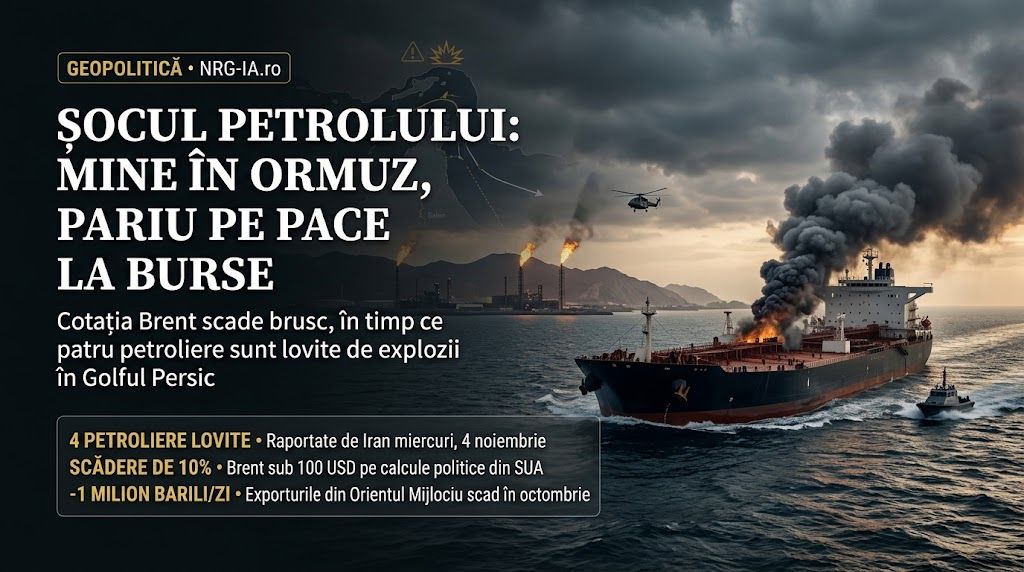
The global oil market is undergoing a rare decoupling between paper trading on commodity exchanges and military realities in the Persian Gulf. The European benchmark Brent crude plummeted 8% to 10% over the past 48 hours, falling from above $104 per barrel into a $94.6–$103.6 per barrel range, depending on contract maturities and intraday volatility. The heavy sell-off was triggered by political recalibrations following the US midterm Congressional elections on November 3, as traders bet that a shifted balance of power in Washington would prompt the US administration to expedite a diplomatic resolution to the war with Iran. However, this paper sell-off occurred on the very day physical risk on the ground hit a critical new high. On Wednesday, November 4, Iranian officials reported four oil tankers disabled or destroyed by naval mines near the Strait of Hormuz, the planet's primary energy artery. While hedge funds dumped futures contracts in London and New York on peace expectations, shipping data confirmed that Middle East crude exports had already dropped by 1 million barrels per day in October, falling to an average of 17.1 million barrels per day. Wall Street’s Bet Against Naval Mines in the Persian Gulf The divergence between falling exchange prices and a worsening maritime bottleneck stems from how the "geopolitical risk premium" functions in financial markets. Above $104 per barrel, oil prices baked in a hefty speculative premium, priced in by investment funds and algorithmic trading systems for a scenario involving a total halt to navigation in the Persian Gulf. Immediately after the polls closed in the United States, major fund managers assessed that domestic pressures over the cost of living and fuel prices would force the White House into swift negotiations with Tehran to end the conflict that began in February 2026. Simultaneous long-position liquidation to take profits drove futures contracts for upcoming months down to a low of $94.6 per barrel, while physical prompt-delivery barrels held firm at the upper end of the range, near $103.6. This unusually wide spread between spot oil and futures contracts underscores that refiners continue to pay a premium for real wet barrels, even as financial speculators sell off deferred months. In the waters of the Strait of Hormuz, the emergence of naval mines radically alters the commercial equation for shippers. Beyond the direct physical damage reported by Iranian authorities to the four tankers on Wednesday, the mine threat exerts a multiplier effect on insurance costs. London maritime underwriters assess risk based on physical fairway safety, not diplomatic speculation. A single mined lane triggers an exponential surge in war-risk premiums and prompts shipowners to hold vessels outside the Gulf—a phenomenon already evident in the 1 million barrel per day decline in regional exports recorded in October. Why Goldman Sachs and Morgan Stanley Retain Their $105 Target Confronted with this gulf between exchange-floor optimism and physical supply contraction, two of the world’s most influential commodity investment banks, Goldman Sachs and Morgan Stanley, chose to look past the temporary correction, raising their Brent crude forecasts to $105 per barrel for year-end 2026. The banks' thesis rests on the reality of the global energy balance: losing 1 million barrels per day in Middle Eastern exports equates to taking roughly 1% of total world oil consumption off the market, just as seasonal winter demand is picking up. Tightness in European physical supply was further exacerbated on Wednesday, November 4, by a major technical incident in the North Sea. Norwegian state-owned energy group Equinor was forced into an emergency shutdown of oil and gas production at its offshore Visund platform following an electrical fire, taking 13.2 million cubic meters per day of gas offline. This outage compounds an unprecedented shock in the liquefied natural gas (LNG) sector, where the Hormuz bottleneck curbed Qatari and UAE exports by over 60 billion cubic meters between March and October, forcing QatarEnergy to extend its force majeure through late December and paradoxically emerge as the largest buyer of US LNG. Should expectations of a swift diplomatic deal between Washington and Tehran fail to materialize in the coming weeks via verifiable mine-clearing operations in the Strait of Hormuz, the crude market faces a violent reversal. Traders who aggressively shorted contracts around $95 will be forced to buy them back into a market burdened by depleted inventories and fewer tankers willing to transit the Persian Gulf—a dynamic that underpins the $105 per barrel target set by Goldman Sachs and Morgan Stanley. European Impact and the Outlook for Romanian Fuel Prices The economic fallout from nine months of conflict in the Middle East is already evident in official European data released on November 4. According to preliminary Eurostat figures, Eurozone annual inflation climbed…
Ioana Buzoaica — Independent Editorial Board
The NRG-IA newsroom continuously monitors Romanian energy markets, ANRE regulatory decisions, and national grid telemetry (SEN/SNT). We deliver independent intelligence anchored exclusively in official primary data.
Editorial Charter, Ethics & Verification Methodology →