Brent Crude Hits $111.10 After Saudi Oil Field Attacks — NRG-IA
Geopolitică & Energie Author: Ioana BuzoaicaBrent crude rose past $111/bbl following Houthi strikes on Saudi oil fields and US embassy evacuations, driving up fuel price pressures across Europe.
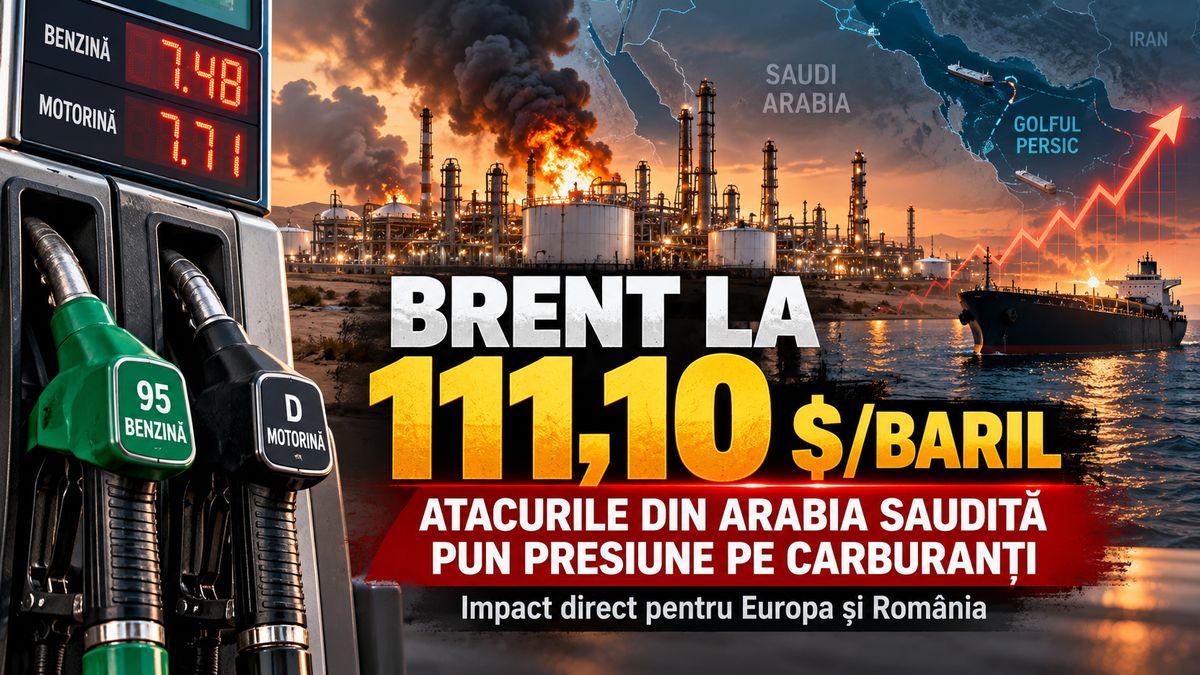
Brent crude, the benchmark for the European market, surpassed the $111 per barrel threshold over the last 24 hours to reach $111.10 per barrel, following a gain of over 2% triggered by direct strikes on Saudi Arabia's oil infrastructure. At the same time, US West Texas Intermediate traded around $98.98 per barrel, after rising to $99.12 per barrel in the previous session. The latest price surge follows military operations executed by Yemen's Houthi rebels, who struck an onshore oil field in Saudi Arabia and an international airport in the region, shifting the target of attacks from maritime routes directly to land-based extraction facilities in the Persian Gulf. The severity of the security situation in the world's most critical hydrocarbon export basin was promptly confirmed at an institutional level by Washington. The US Department of State ordered the evacuation of non-emergency diplomatic personnel from Saudi Arabia, a move that signals to commodity markets that the risk of further strikes on Saudi oil fields is assessed as imminent. Concurrently, Iranian media reported several explosions in southern Iran near the Strait of Hormuz, though authorities in Tehran have not officially clarified their cause or origin. Strikes on Saudi Arabia and the Freezing of US-Iran Diplomatic Channels The expansion of Houthi attacks to Saudi fields strikes at the central balance point of the global oil market. The Kingdom holds the world's only major spare production capacity capable of rapid deployment in the event of supply disruptions in other producing nations. As long as Middle Eastern hostilities were concentrated on commercial shipping in the Strait of Hormuz and the Bab el-Mandeb Strait—where maritime traffic has already fallen by nearly half—oil traders relied on the assumption that Saudi crude could bypass these chokepoints via overland pipelines crossing the peninsula to the Red Sea. However, direct strikes on extraction facilities and the withdrawal of non-essential US diplomats introduce a risk premium attached to the physical security of Saudi output itself. This military escalation unfolds against the backdrop of a complete diplomatic stalemate between Washington and Tehran, dampening prospects for near-term de-escalation. In an op-ed published in the Financial Times, Iranian Foreign Minister Abbas Araqchi stated that the chances of reaching a peace agreement are slim, accusing the US administration of insincerity in negotiations. This stance was echoed by Iranian President Masoud Pezeshkian, who declared that any dialogue remains impossible as long as the United States maintains its economic blockade and military pressure against his country, effectively closing off any quick return of sanctioned Iranian barrels to the market. Why Fuel Prices Are Rising Even as Millions of Crude Barrels Leave the Gulf Beyond the immediate military risks, physical market fundamentals indicate that the surge to $111.10 per barrel is driven by a severe disconnect between crude extraction and finished fuel output. An analysis by ING, based on data from national oil firm Kuwait Petroleum Corp., reveals that although Kuwait's total crude production has crossed the 2 million barrels per day threshold, exported flows of refined fuels remain well below pre-conflict levels. In other words, while crude oil continues to be extracted and loaded onto vessels at record logistical costs, Middle Eastern refineries are failing to deliver standard market volumes of diesel, jet fuel, and gasoline. This downstream bottleneck in the Persian Gulf coincides with a rapid drawdown of commercial inventories across the Atlantic basin. An official report released on October 21 by the US Energy Information Administration (EIA) showed a 3.06 million barrel drop in US commercial crude stocks in a single week—a decline more than nine times larger than the 324,000-barrel drawdown forecasted by analysts. Across the entire US crude and petroleum products balance sheet, total inventories plunged by 8.5 million barrels, including a 3 million barrel drop in gasoline stocks, pulling US commercial crude reserves down to 412.5 million barrels—3% below the five-year seasonal average. The convergence of falling US inventories and Middle Eastern refining deficits explains why even this month's intervention by the International Energy Agency (IEA)—a coordinated strategic stock release—failed to keep Brent below the $100 per barrel mark. Government-released strategic reserves supply primarily unrefined crude to the market, whereas the acute deficit currently felt in European demand centers manifests directly in the finished refined products segment and in the global tanker fleet's capacity to transport cargo along rerouted, longer maritime lanes. Impact on Platt's Benchmarks and Direct Pressure on Romanian Pump Prices For the European market and for Romania specifically, the throttling of refined product exports from Kuwait and the wider Persian Gulf has a much faster…
Ioana Buzoaica — Independent Editorial Board
The NRG-IA newsroom continuously monitors Romanian energy markets, ANRE regulatory decisions, and national grid telemetry (SEN/SNT). We deliver independent intelligence anchored exclusively in official primary data.
Editorial Charter, Ethics & Verification Methodology →