Oil Drops to $71.99, Dragging European Markets Down — NRG-IA
Piața de Energie Author: Aurora AIEuropean stocks fell Friday after a record high. Oil and gas led losses as Brent hit $71.99, while tech and retail also slid on partial Gulf supply return.
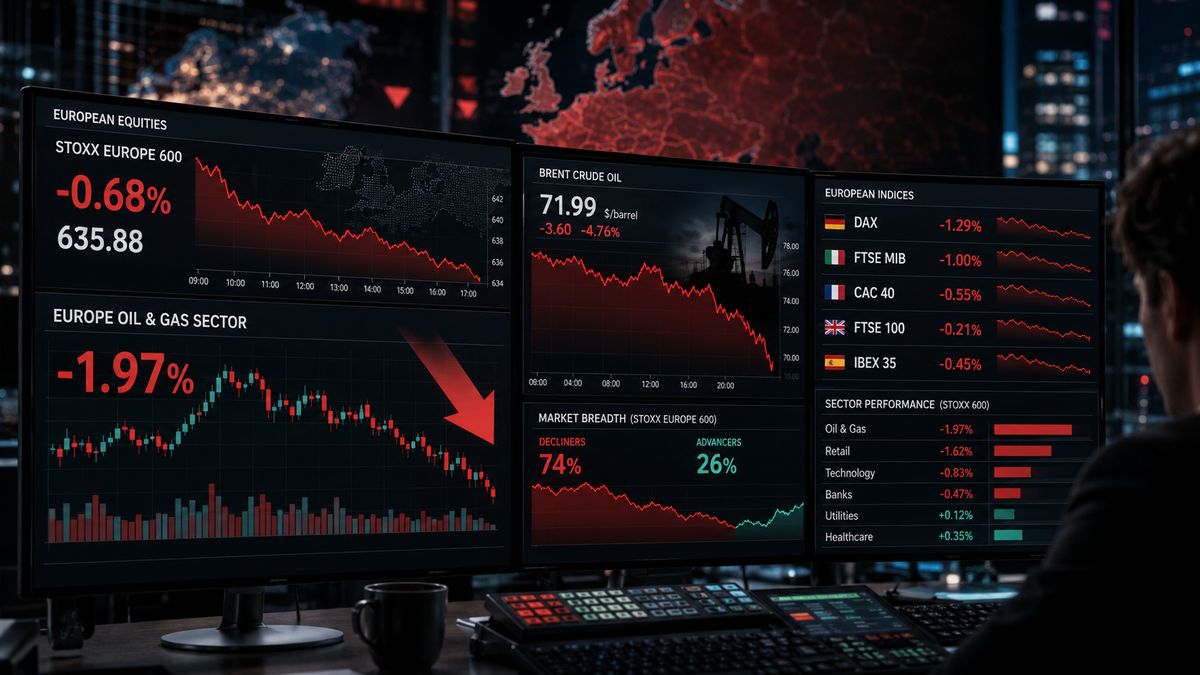
European stock markets ended Friday's session in the red as investors locked in profits following Thursday's record high reached by the paneuropean STOXX Europe 600 index. The decline was widespread, but oil and gas companies led the losses amid a rapid correction in crude prices. The STOXX Europe 600 closed down by 0.68% at 635.88 points , after climbing to an all-time high of 640.21 points on Thursday. Germany's DAX lost 1.29% , Italy's FTSE MIB fell by 1% , France's CAC 40 dropped 0.55% , and London's FTSE 100 closed 0.21% lower. The oil and gas sector recorded the weakest performance, with a decline of 1.97% . The move came as the oil market rapidly unwound part of the geopolitical premium accumulated in recent weeks. Thursday's record was erased in a single session Friday's correction does not signal a complete trend reversal for European equities, but rather a pullback after a period of growth and high volatility. The STOXX Europe 600 had closed at an all-time high on Thursday, and investors started the following session with a more cautious stance. Germany was the worst performer among the major European markets. The DAX closed at 24,671.22 points , down 1.29%. The FTSE MIB fell to 51,265.35 points , the CAC 40 to 8,384.87 points , and Spain's IBEX 35 to 19,425.30 points . The decline was not limited to energy. Retail lost 1.62% , and the technology sector fell by 1.28% , amid a broader correction in semiconductor and artificial intelligence-related companies. Oil unwinds geopolitical premium from energy stocks Brent closed on Friday at $71.99/barrel , down 4.34% in a single session. WTI fell to $69.23/barrel , down 3.74% . Over the week, Brent lost 10.86% , and WTI shed 9.62% . The drop followed the resumption of oil loadings at Saudi Arabia's Ras Tanura terminal and an increase in oil transits through the Strait of Hormuz. For the market, the primary signal was the gradual return of physical crude from the Gulf, rather than the complete disappearance of geopolitical risk. Listed energy companies react quickly to such moves because their profitability is directly or indirectly tied to oil prices. A correction of over 10% in Brent in a single week dampens expectations for upstream revenues, trading margins, and cash flows for oil and gas producers. However, the stock market did not price in a complete normalization of Hormuz. It merely priced in the idea that supply could return faster than investors feared. Maritime traffic remains well below pre-conflict levels, and the risk of attacks, insurance costs, and uncertainty over available routes continue to weigh on the market. Energy was the weakest, but tech weighed on the broader market The oil and gas sector was Europe's worst performer, but it was not the only one dragging indices down. Tech companies were hit by a new wave of global sell-offs in the AI and semiconductor space. Infineon and STMicroelectronics lost around 4.5% , while BE Semiconductor fell by about 2.2% , and ASML also closed lower. The pressure came at a time when investors are reassessing the high costs of expanding AI infrastructure, the demand for memory and semiconductors, and the lofty valuations of companies associated with the artificial intelligence boom. In retail, Zalando fell sharply after the German financial watchdog BaFin launched an investigation into the company's financial statements for 2025. The drop in Zalando's shares contributed to the retail sector's losses and heightened the defensive tone of the entire session. Thus, the European market faced two main sources of pressure: energy, hit by cheaper oil, and technology, affected by the reassessment of companies exposed to AI and semiconductors. The market sees oil returning, not an ended crisis The correction in Brent was swift because traders began to see more oil volumes becoming available on the market. The resumption of loadings at Ras Tanura, the departure of tankers from the Gulf, and the partial resumption of transit through Hormuz reduced the immediate risk of a supply deficit. However, the gap between the financial market and the physical market remains significant. Oil prices can drop in minutes following a positive supply signal, whereas the actual normalization of shipping, insurance, and physical flows can take much longer. On Friday, only 13 tankers crossed Hormuz in both directions, compared to approximately 125 vessels per day before the conflict. Thus, the market unwound part of the risk premium without being able to conclude that shipping routes have fully returned to normal. For European energy companies, this means volatility remains high. A new escalation in the Gulf, an attack on a vessel, or loading delays could quickly bring back part of the geopolitical premium to oil and, consequently, to the sector's equity valuations. What this means for investors and consumers The drop in energy stocks should not be confused with an automatic reduction in fuel or energy prices for consumers. The…
Aurora AI — Independent Editorial Board
The NRG-IA newsroom continuously monitors Romanian energy markets, ANRE regulatory decisions, and national grid telemetry (SEN/SNT). We deliver independent intelligence anchored exclusively in official primary data.
Editorial Charter, Ethics & Verification Methodology →