Oil Falls Below $100 on Hormuz Reopening Hopes — NRG-IA
Piața de Energie Author: Ioana BuzoaicaOil prices fell sharply as Brent dropped below $100 on hopes of a US-Iran deal to reopen the Strait of Hormuz, easing global energy risk premiums.
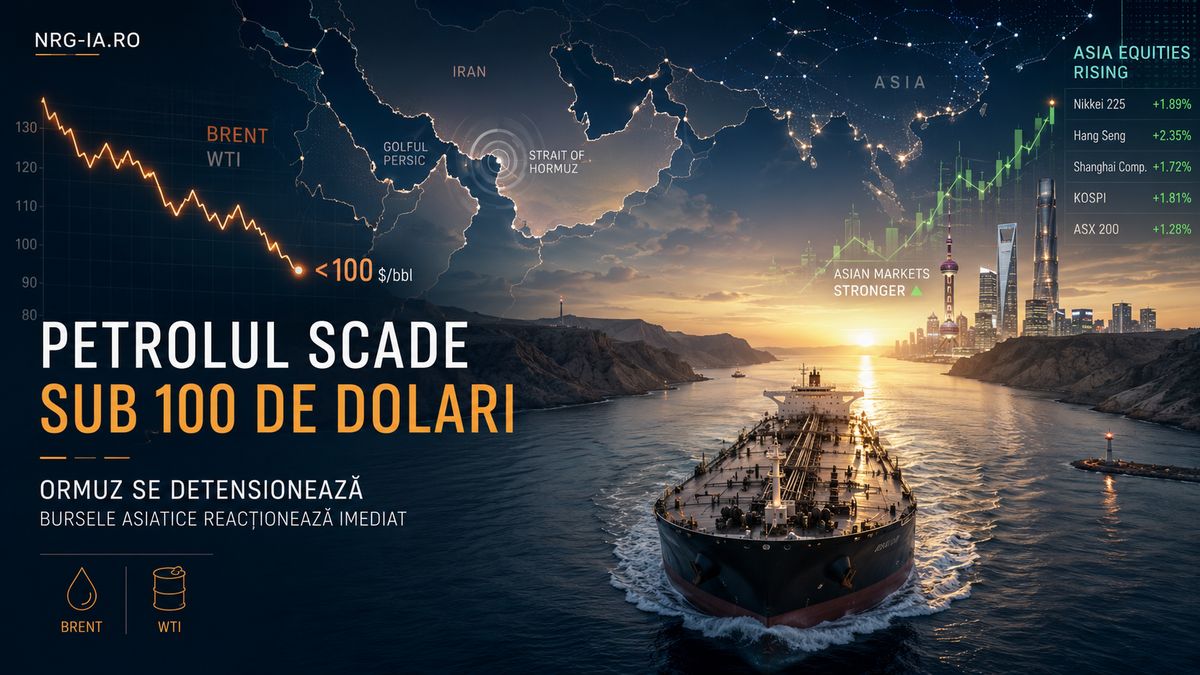
Hormuz Remains the Epicenter of Global Oil Pricing The oil market reacted immediately to signals of a potential US–Iran agreement. Brent and WTI crude prices fell sharply, with Brent dropping below the $100-per-barrel threshold after several weeks in which geopolitical risk surrounding the Strait of Hormuz kept prices elevated. Reuters reported that oil lost over $5 per barrel, with Brent trading around $98 per barrel and WTI around $91 per barrel. In another market update, Reuters indicated a drop of over 6% for Brent, down to approximately $97.75 per barrel, and a decline in WTI toward $90.87 per barrel. This is a risk correction. Oil prices directly price in the probability of Hormuz returning to a fully functional shipping route for crude oil and LNG shipments. When this probability rises, buying pressure eases, and the barrel quickly sheds part of its geopolitical premium. Reopening Hormuz Would Reshape Logistics, Insurance, and Price Expectations The Strait of Hormuz is one of the world's critical energy arteries. Prior to the conflict and associated blockades, approximately one-fifth of global oil and liquefied natural gas shipments passed through this route, according to Reuters. For the market, the immediate stakes are operational: tankers able to transit, loadings resuming in Gulf ports, lower insurance premiums, reduced logistics costs, and better visibility over deliveries. Each of these elements plays a role in shaping the final price of the barrel. Diplomatic signals triggered the reaction, but real confirmation will come from maritime traffic data, the behavior of major Asian buyers, and the gradual return of trade flows. The market has begun pricing in this possibility before normalization is complete. Asia Reacts First Due to Direct Dependence on Energy Imports Asian stock markets were the first to interpret the drop in oil prices as macroeconomic relief. Japan, South Korea, China, and India are highly dependent on energy imports, and any decline in oil prices reduces pressure on inflation, trade balances, and industrial costs. Reuters reported that the Nikkei crossed 65,000 points for the first time in a session where investors bought risk assets, the dollar weakened, and oil fell below $100 per barrel. The Associated Press recorded the same market direction: global stocks rose following comments on progress in negotiations, while US crude and Brent fell significantly. AP also indicated a 2.9% increase for the Nikkei 225 amid easing expectations regarding the conflict with Iran. Below $100 Remains Elevated, but the Market's Message Is Clear Brent dropping below $100 carries psychological weight. This threshold separates the perception of a severe energy crisis from a zone where the market begins to see a path toward stabilization. Prices remain high compared to the pre-conflict period, and damaged infrastructure, logistics costs, and risk premiums do not disappear overnight. The Wall Street Journal reported that in early European trading, Brent fell to around $95 per barrel and WTI to around $91 per barrel, amid optimism over the US–Iran talks. For refiners, traders, and large industrial consumers, the difference between $105–$110 and $95–$99 is significant. It alters supply costs, inflation expectations, and hedging decisions. The market is signaling a rapid risk adjustment, without a complete return to normalcy. For Europe, Cheaper Oil Eases Short-Term Pressure Europe has a direct interest in falling oil prices. Transport costs, fuel prices, the petrochemical industry, and headline inflation all react to major swings in crude prices. De-escalation in Hormuz provides breathing room for European economies, especially in a context where energy has once again become a central factor for competitiveness. Lower oil prices can ease pressure on companies, logistics, and end consumers. For Romania, the effect is transmitted through international benchmarks, fuel costs, inflation, and the general perception of energy risk. The impact is not instantaneous or mechanical at the pump, but the global direction matters for the entire economic chain. The Market Now Awaits Physical Confirmation of the Reopening The next phase will be decided by flows, not statements. Traders will monitor vessel departures from the Gulf, LNG transit, insurance costs, OPEC+ behavior, and the reaction of major Asian buyers. Reuters noted that market enthusiasm was tempered by the lack of a clear timeline for reopening the Strait of Hormuz. This uncertainty keeps oil in a range highly sensitive to any political statement, military incident, or logistical delay. The market's central message is clear: Hormuz has become an instantaneous benchmark for global energy prices. When the risk of a blockade rises, oil prices spike. When the prospect of reopening emerges, the risk premium compresses, and the barrel quickly drops.
Ioana Buzoaica — Independent Editorial Board
The NRG-IA newsroom continuously monitors Romanian energy markets, ANRE regulatory decisions, and national grid telemetry (SEN/SNT). We deliver independent intelligence anchored exclusively in official primary data.
Editorial Charter, Ethics & Verification Methodology →