Oil Falls Below $100 on Trump Iran Comments — NRG-IA
Geopolitică & Energie Author: Aurora AIBrent and WTI crude prices fall nearly 3% after U.S. President Donald Trump signals openness to diplomatic talks with Iran.
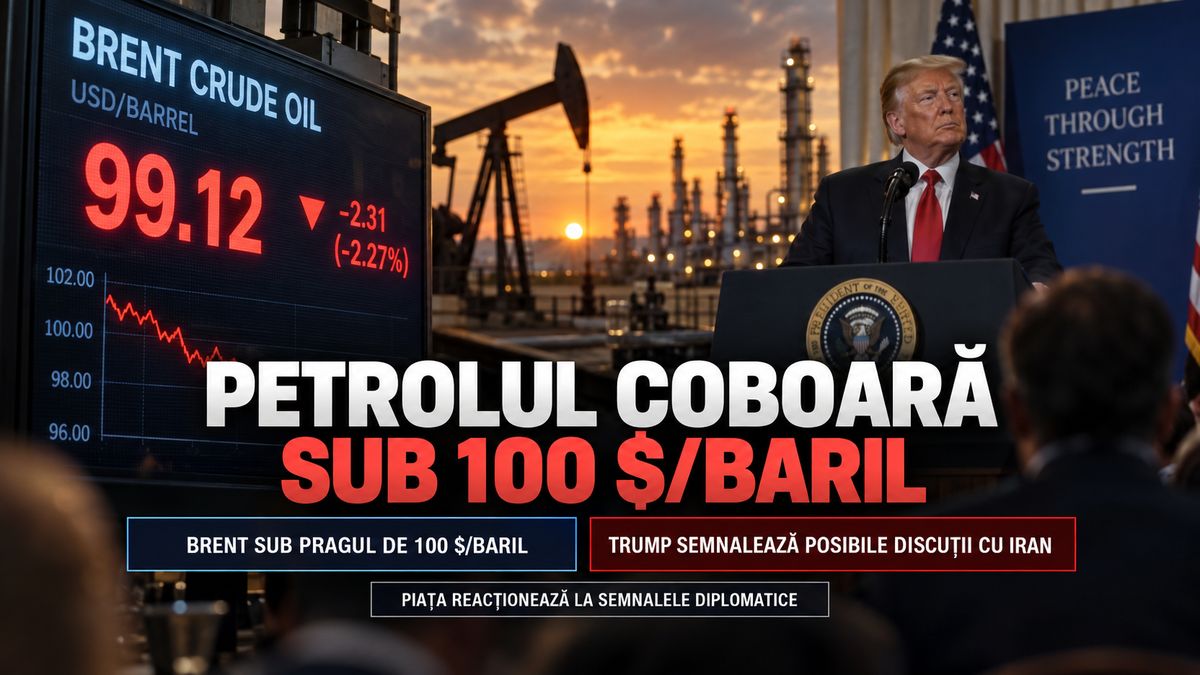
Diplomatic detente in the Middle East pushes WTI crude below the $100 threshold U.S. West Texas Intermediate futures fell 2.7% to $97.59 per barrel on September 21, 2026, driven by diplomatic de-escalation signals from U.S. President Donald Trump. At the same time, Brent crude, the global benchmark, dropped 2.8% to settle at $101 per barrel, according to data reported by CNBC Energy. This sharp correction halts an aggressive rally that saw oil prices surge by more than 11% earlier in September 2026. The market responded swiftly to Washington's signals, which temporarily stripped away the geopolitical risk premium embedded in crude prices. Trading activity over the last sessions reflects a rapid reassessment of supply risks in the Middle East, a vital region for global energy markets. Although underlying tensions remain elevated, the prospect of direct diplomatic engagement provided traders with strong justification to lock in profits after weeks of consecutive gains. This development comes at a highly sensitive moment for global energy markets, where high fuel prices were threatening to feed a new wave of inflation. This four-session decline demonstrates how quickly commercial positions can shift when diplomatic channels make concrete progress toward a breakthrough. Postponing military action in Yemen and opening diplomatic channels with Tehran The sharp decline in crude prices was directly triggered by President Donald Trump's statements expressing openness to meeting with Iranian President Masoud Pezeshkian. The meeting could take place at the UN General Assembly this week, according to CNBC Energy. This step represents a significant shift in tone from the U.S. administration, which had previously adopted an extremely harsh rhetoric. Furthermore, administration officials told The New York Times that the president decided against launching airstrikes on Iran-aligned Houthi militants in Yemen for the time being. This decision was made despite strong appeals from Saudi Arabia, a key U.S. ally in the region. Postponing military action reduces the risk of an extended regional conflict that could block essential maritime routes. Market stabilization was also supported by assurances that the critical Strait of Hormuz remains open to maritime traffic, as reported by Anadolu Ajansı and cited by Intl-Energy. This maritime choke point is highly critical, handling approximately one-fifth of global oil consumption daily. Concurrently, physical crude exports from the Middle East have shown resilience despite recent attacks that forced Saudi Arabia to shut down its East-West pipeline. A JPMorgan analysis dated September 18 noted that regional flows averaged 17.1 million barrels per day over the past 10 days. Although this level is surprisingly strong given the security incidents, it still remains 6.1 million bpd below the 2025 average. This difference indicates that the physical market remains tight, despite the diplomatic optimism prevailing in financial markets. Direct impact on Romanian pump prices and the tempering of inflationary pressures The correction in international Brent crude prices will directly ease pressure on fuel prices in Romania. Domestic oil companies adjust their retail prices based on Platts quotations, which closely track Brent movements. Stabilizing Brent crude around $100 per barrel is expected to halt the recent upward trend in diesel and gasoline prices at Romanian filling stations. This provides much-needed relief to retail consumers and commercial transport operators, curbing rising logistics costs that have accumulated recently. Fuel is a major input cost for consumer goods. Any sustained drop in crude prices typically trickles down to retail price stability within one to two weeks. Additionally, stabilizing fuel prices has a direct cooling effect on Romania's broader inflation rate. The National Bank of Romania and financial analysts closely monitor energy prices, considering them a major risk factor for year-end inflation forecasts. Stability in global markets reduces the likelihood of further monetary tightening measures. Geopolitical risks lurking behind the market's temporary calm Despite the temporary market calm, the short-term outlook remains highly volatile and heavily dependent on the progress of diplomatic talks. Daniel Takieddine, co-founder and CEO of Sky Links Capital Group, warned that any breakdown in negotiations or deterioration in shipping conditions would quickly restore upward pressure on prices. He emphasizes that the physical market is extremely sensitive to flow disruptions. President Trump emphasized that he remains in a "deciding mode" and that significant developments regarding the U.S.-Iran relationship are expected in the near future. This persistent uncertainty keeps volatility high, with traders poised to react to any shift in rhetoric. The current equilibrium is fragile and depends entirely on keeping communication channels open. The next critical milestone…