Hormuz: Oil shipping to China tops $30/bbl as flows return — NRG-IA
Geopolitică & Energie Author: Ioana BuzoaicaGulf producers rebuilt key Hormuz oil flows using shuttle tankers, but shipping to China now tops $30/bbl, the highest level on record.
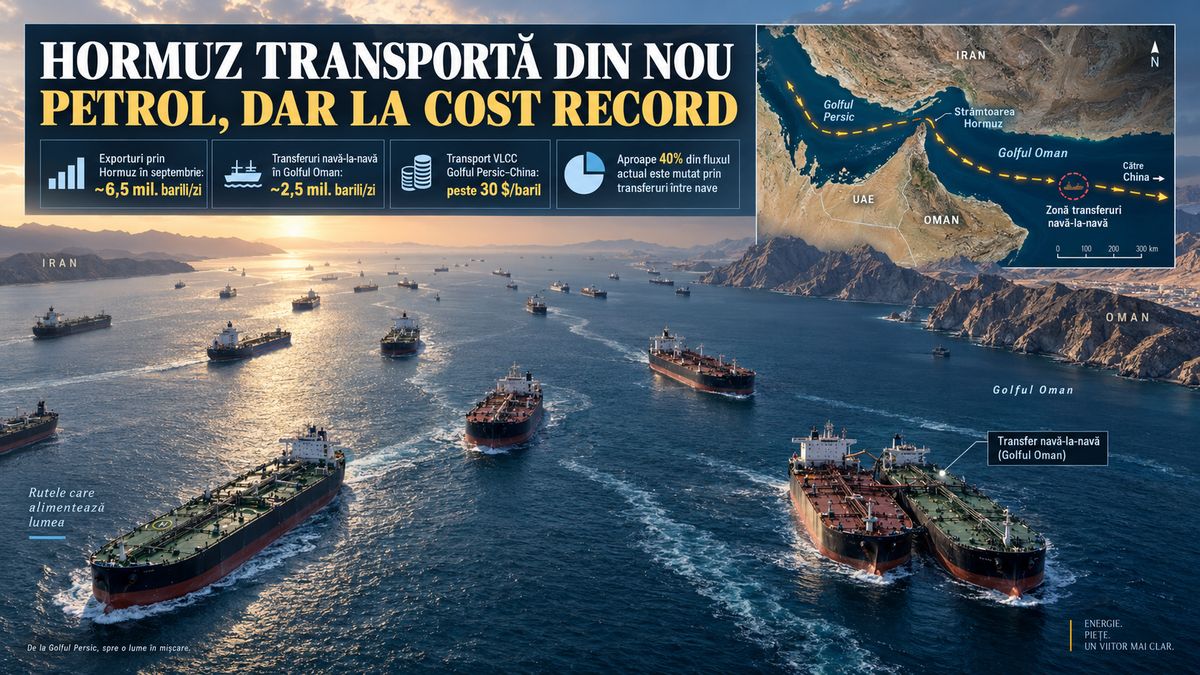
The Strait of Hormuz is once again carrying millions of barrels of oil every day, but the return of these flows has not restored the market to its pre-war normalcy. In September, exports through the strait reached approximately 6.5 million barrels per day, according to Kpler data cited by Reuters, the highest level since the temporary surge following the June truce. Oil is flowing, but through a more complex logistical system that consumes more vessels, more time, and far more money. The contrast with the pre-conflict energy landscape remains stark. In 2025, an average of 19.87 million barrels per day of crude and petroleum products passed through Hormuz. Crude and condensates alone accounted for 14.95 million barrels per day, according to the International Energy Agency. Current oil flows thus indicate a significant recovery from the near-paralysis of the war's early months, but the volume of crude now exiting the strait remains well below pre-conflict levels. Oil Has Returned Faster Than Vessel Traffic The two perspectives on Hormuz in September seem, at first glance, contradictory. On one hand, millions of barrels leave the Gulf daily. On the other hand, the number of vessels transiting the strait remains far below pre-war levels. At the end of August, S&P Global estimated that transits through Hormuz were still more than 80% below pre-conflict levels. Before the war began on February 28, approximately 125–135 commercial vessels transited the strait daily, depending on the tracking methodology. The explanation lies in the radically different way oil shipping now operates. Some tankers transit corridors close to the Omani coast with their public AIS navigation systems turned off, meaning observable traffic underestimates actual movement. At the same time, an increasing share of vessels no longer makes the entire journey between Gulf terminals and Asian refineries. Instead, the market has built a maritime shuttle system. Nearly 40% of Current Flows Pass Through a Tanker "Bridge" Tankers loaded in the Gulf cross Hormuz, reach safer waters in the Gulf of Oman, and transfer their crude to other vessels, which then continue the journey to Asia. The vessel that crossed the high-risk zone can then return to the Gulf for another load. Ship-to-ship transfers, rare in this area before the war, have become a central component of regional oil trade. Kpler estimates that approximately 2.5 million barrels per day will be loaded through such operations in the Gulf of Oman in September, up from 1.4 million barrels per day in August . Relative to the roughly 6.5 million barrels per day currently exiting Hormuz, ship-to-ship transfers account for nearly 40% of current flows . The system allows producers to make more efficient use of tankers willing to transit the conflict zone. Instead of a single vessel spending weeks on a round trip to China, the same vessel can operate as a shuttle between Gulf terminals and the transfer zone in Oman. The result is a higher export capacity than the low number of vessels appearing on public tracking systems would suggest. However, the price of this adaptation is enormous. Shipping a Barrel to China Has Exceeded $30 The benchmark for shipping crude from the Gulf to China on a VLCC—a very large crude carrier capable of transporting around two million barrels—has surged to over $30 per barrel , according to LSEG data cited by Reuters. This is by far the highest level recorded in this series. With crude valued at around $105 per barrel at the time of the Reuters analysis, shipping costs end up representing more than a quarter of the oil's value . Before the war, freight rates typically accounted for only about 2–3% of the barrel's value . A VLCC loaded with approximately two million barrels can thus incur, as an order of magnitude, over $60 million for shipping alone , if the benchmark of over $30 per barrel is applied to the entire cargo. For producers, this difference does not simply vanish in the supply chain. Reuters reports that Gulf exporters have been forced to offer steeper discounts to keep their oil competitive, absorbing a portion of the rising logistical costs. The War Multiplied a Rate That Was Already Extreme The evolution of freight rates shows how violently the economics of oil shipping have changed. On February 27, the day before the war broke out, Argus assessed the cost of shipping a barrel of Basrah Medium crude on the Persian Gulf–China route at $6.82 . Even this level was already exceptional: a six-year high and roughly four times the rate recorded a year earlier. By March 3, the cost had reached $15.32 per barrel , representing over 20% of the FOB value of the transported crude. Now, the benchmark exceeds $30 per barrel. Compared to the $6.82 level on the eve of the war—which was already abnormally high—the cost has multiplied more than 4.4 times . This increase does not only reflect the risk of transiting a conflict zone. Additional ship-to-ship transfers tie up…