Brent Above $114: Houthis Claim Attack on Saudi Pipeline — NRG-IA
Geopolitică & Energie Author: Ioana BuzoaicaBrent holds above $114/bbl after a 6% gain last week, as Houthis claim new strikes on Saudi oil assets, exposing key East-West pipeline vulnerabilities.
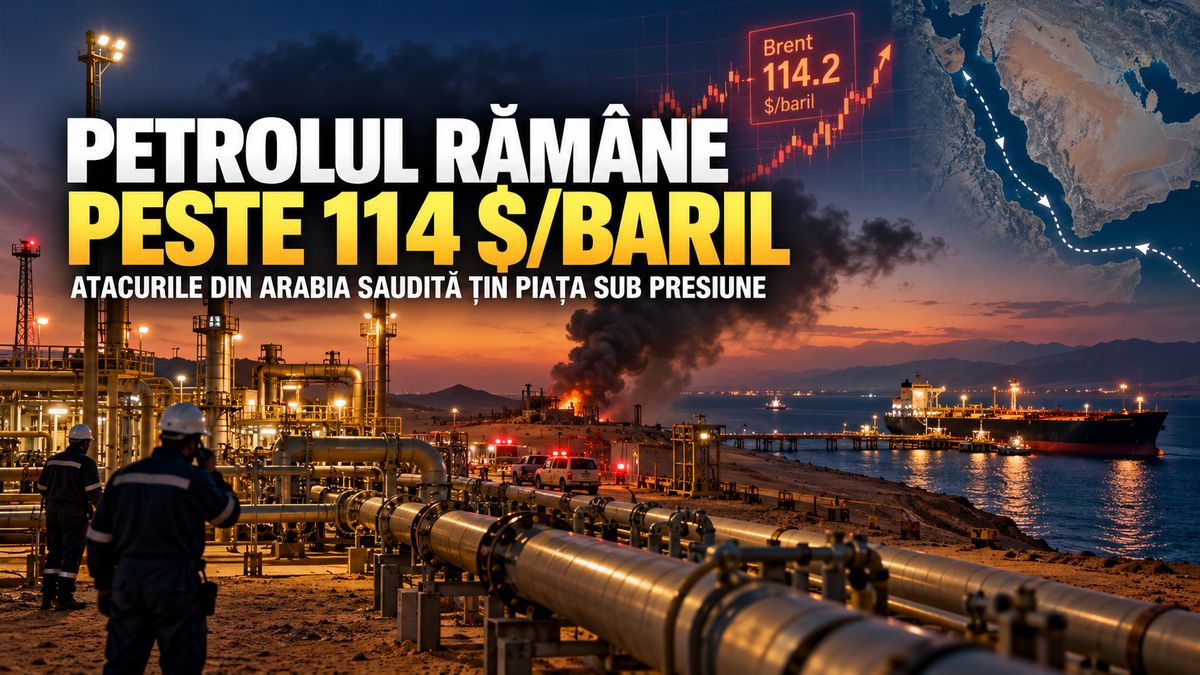
The global oil market remains under pressure from the Middle East conflict after Yemen's Houthi rebels claimed fresh attacks on Monday, October 26, 2026, targeting pumping stations along Saudi Arabia's East–West pipeline—one of the region's critical crude transport assets. Brent crude traded at $114.82 per barrel around 09:59 GMT, down 1.63% from the previous session, but held near six-month highs. The targeted pipeline holds exceptional strategic significance. With a throughput capacity of up to 7 million barrels per day (bpd), it allows Saudi Arabia to move crude from its Eastern Province to Red Sea terminals, bypassing the Strait of Hormuz—a maritime choke point severely impacted by the war with Iran. Roughly 5 million bpd of this pipeline capacity is available for export, with the remainder dedicated to supplying domestic Saudi refineries. According to Reuters, the Houthi rebels stated they attacked both the pipeline's pumping infrastructure and King Khalid International Airport in Riyadh. Saudi authorities did not immediately confirm the attacks on the pipeline. However, the Saudi-led coalition reported intercepting a missile launched toward Riyadh and destroying missile launch sites in Yemen. These developments underscore the intensifying clash in a region where energy infrastructure security has become decisive for global trade. East–West Pipeline Transports Up to 7 Million bpd, Bypassing the Strait of Hormuz The East–West pipeline, also known as Petroline, spans Saudi Arabia from east to west over roughly 1,200 kilometers. The system transports crude oil from the processing facilities around Abqaiq to the port of Yanbu on the Red Sea coast, where it can be loaded onto tankers or directed to domestic refineries. This infrastructure gained heightened strategic relevance following commercial shipping disruptions through the Strait of Hormuz triggered by the war that broke out on February 28, 2026. Under normal conditions, Hormuz is a primary outlet for Persian Gulf crude bound for Asian and European markets. Restricted transit has forced producers onto alternative routes, making pipeline export capacity critical to maintaining crude flows. According to the U.S. Energy Information Administration (EIA), Saudi Arabia has redirected significant crude volumes through East–West toward Yanbu. Prior to the September attacks, the agency estimated that over 5 million bpd were exported via this route. Saudi Aramco reported that the infrastructure holds a total capacity of approximately 7 million bpd, around 2 million of which can be allocated to domestic refining. The scale of these volumes explains the pipeline's international significance. Any substantial operational curtailment could impair Saudi crude export availability, particularly when conventional maritime routes are already constrained. Under such conditions, the market impact extends well beyond the region, rippling out to crude buyers globally. September Strikes Previously Halted Oil Flows, Driving Up Brent Prices The vulnerability of the East–West line was laid bare in September. Saudi Arabia temporarily halted operations as a precautionary measure following a drone attack that Saudi and Iraqi authorities stated had originated in Iraq. The incident underscored the reliance of crude exports on the security of high-capacity overland infrastructure. In its October report, the EIA noted that the pipeline disruption contributed to a sharp rally in crude benchmark prices. On September 15, daily Brent spot prices touched roughly $131/bbl as refiners and traders scrambled to secure alternative supplies for affected Saudi barrels. The latest claimed attacks bring these vulnerabilities back into sharp focus. On Saturday, October 24, Houthi forces claimed strikes on the East–West pipeline, pumping stations, a Saudi Aramco facility in Yanbu, and the Rabigh refinery. On Monday, they announced further attacks on pumping stations and the Riyadh airport. At the time of the Reuters report, Saudi authorities had not confirmed the scope of these actions or any physical damage to energy infrastructure. Distinguishing between claimed attacks and confirmed operational impacts remains key for market analysis. A strike on an oil asset may trigger precautionary shutdowns, safety inspections, or temporary capacity reductions. However, the extent of any actual supply shortfall hinges on physical damage, disruption duration, and the operator's ability to maintain system throughput. Brent Holds Above $114 as Potential Iran Talks Cap Gains At the start of the week, crude prices underwent a pullback following strong gains in preceding sessions. On Monday at 09:59 GMT, Brent futures were down $1.90 at $114.82/bbl, while U.S. West Texas Intermediate (WTI) crude fell $2.08 to $101.19/bbl. The correction followed a week in which Brent gained approximately 6% and WTI advanced 2.3%. Price action reflects two competing market forces: persistent threats to Middle Eastern oil production…
Ioana Buzoaica — Independent Editorial Board
The NRG-IA newsroom continuously monitors Romanian energy markets, ANRE regulatory decisions, and national grid telemetry (SEN/SNT). We deliver independent intelligence anchored exclusively in official primary data.
Editorial Charter, Ethics & Verification Methodology →