IEA Warns of Thinning Global Oil Stocks Ahead of Summer — NRG-IA
Geopolitică & Energie Author: Ioana BuzoaicaGlobal oil stocks are falling at a record pace. The IEA warns of fragile summer reserves, making prices highly sensitive to any shipping or terminal delays.
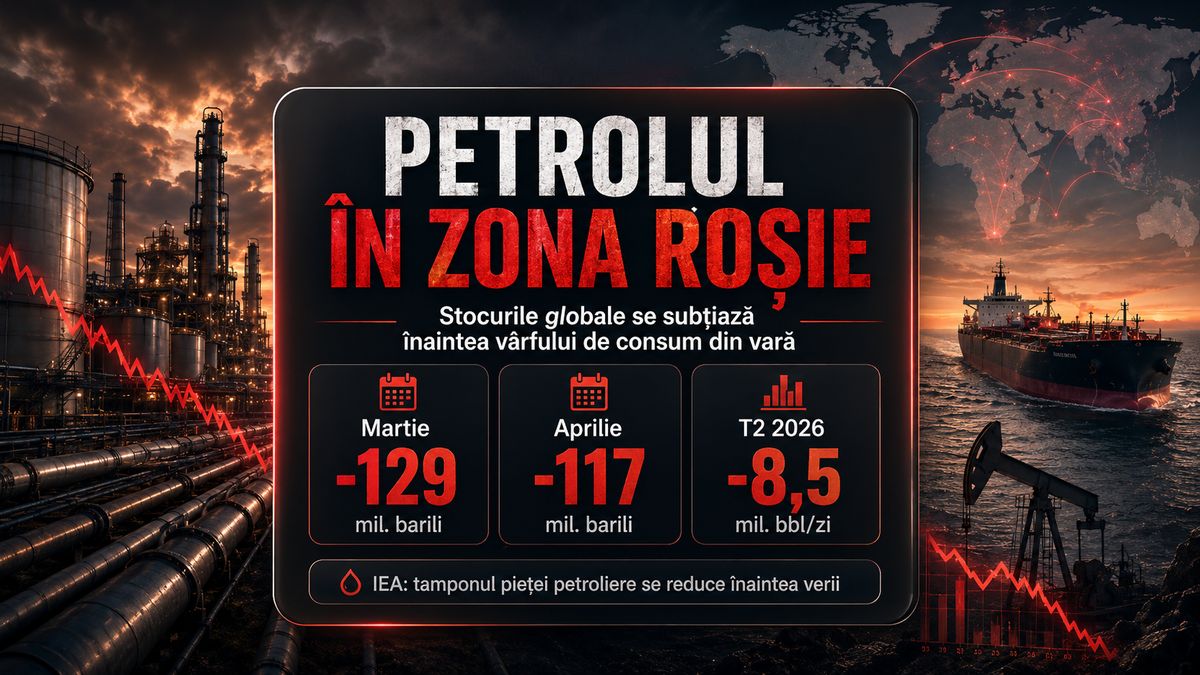
The global oil market is entering a phase where the price per barrel tells only part of the story. The starkest signal comes from inventories: commercial and strategic reserves are being depleted rapidly, just ahead of the seasonal surge in fuel demand in the Northern Hemisphere. The International Energy Agency (IEA) warns that, at the current pace of drawdowns, global stocks could reach critical levels or even historic lows before the summer demand peak. Toril Bosoni, head of the oil markets division at the IEA, stated that the market continues to see inventory drawdowns heading into summer, a pace that could push reserves to critical levels just before the peak consumption period. The IEA directly links this risk to major supply disruptions in the Gulf region and restricted transit through the Strait of Hormuz. Inventories are the oil market's airbag Oil is not traded solely on today's production. The market also looks at the volume of reserves available for the next shock. Inventories act as the oil system's airbag: when a terminal shuts down, a shipping route is partially closed, or a refinery urgently needs crude, reserves absorb the pressure. When this airbag deflates, every local incident becomes more costly. A loading issue in the Gulf of Oman, a delay in Hormuz, or a new wave of seasonal demand no longer impacts a market with a comfortable buffer, but rather one that is rapidly burning through its reserves. IEA data highlights the scale of the pressure. Observed global inventories fell by 129 million barrels in March and another 117 million barrels in April—a total of 246 million barrels in just two months. In April, onshore stocks dropped by 170 million barrels, while OECD onshore inventories fell by 146 million barrels. The IEA describes this drawdown as being fueled by ongoing disruptions to maritime flows through the Strait of Hormuz. Hormuz turns logistics into price risk The Strait of Hormuz remains the epicenter of tension. It is not just a route on a map, but the mechanism through which a major portion of Gulf oil reaches the global market. When transit through Hormuz is restricted, the market loses more than physical barrels—it loses predictability. The IEA notes that production from Gulf countries affected by the blockade was 14.4 million barrels per day (bpd) below pre-war levels, and global oil supply fell by another 1.8 million bpd in April to 95.1 million bpd. For the full year 2026, the IEA projects an average decline in global supply of 3.9 million bpd to 102.2 million bpd, even assuming a gradual resumption of flows through the strait starting in June. This is where inventories become the primary battleground. A market can withstand a disruption if it has sufficient reserves. But when supply losses accumulate and stocks are drawn down at a record pace, pressure quickly shifts to prices, refining margins, fuel costs, and logistics. Reuters reported that the IEA believes a full reopening of the Strait of Hormuz could take six to eight months, even under a swift agreement scenario. This timeframe maintains pressure on maritime flows and dampens the prospects of a rapid market normalization. Strategic reserves buy time, they do not replace lost supply Releases from strategic petroleum reserves serve a stabilizing role. They inject barrels into the market, ease immediate pressure, and allow refineries to keep running. However, they do not alter the structural problem: if the supply deficit persists, reserves merely buy time. The IEA coordinated an emergency release of 400 million barrels in March, and Reuters notes that about half of this volume had not yet reached the market at the time of Bosoni's remarks. The IEA's message is clear: emergency releases are a temporary fix, not a solution for supply losses of this magnitude. This distinction matters for the public. Strategic reserves are not a permanent source of oil; they are a crisis buffer. When heavily drawn upon, they mitigate short-term risk but reduce the protection available for the next shock. EIA confirms the mechanism: falling stocks, supported Brent The US Energy Information Administration (EIA) confirms this market logic. The EIA estimates that global oil inventories will fall by an average of 8.5 million bpd in the second quarter of 2026, pushing Brent prices to an average of around $106/barrel in May and June. The EIA subsequently projects prices to ease toward $89/barrel in the fourth quarter as inventory drawdowns slow and offline production gradually returns. The EIA scenario underscores the market's extreme sensitivity to the Hormuz timeline. A one-month delay in reopening the strait would add over $20/barrel to the short-term baseline forecast. This figure explains why the market reacts so strongly to every headline regarding shipping routes, terminals, and negotiations. In the United States, this pressure is already visible in weekly data. Commercial crude inventories fell by 8 million barrels in the week ending…
Ioana Buzoaica — Independent Editorial Board
The NRG-IA newsroom continuously monitors Romanian energy markets, ANRE regulatory decisions, and national grid telemetry (SEN/SNT). We deliver independent intelligence anchored exclusively in official primary data.
Editorial Charter, Ethics & Verification Methodology →