US Temporarily Eases Iranian Oil Sanctions: Brent Below $77 — NRG-IA
Geopolitică & Energie Author: Ioana BuzoaicaThe US issued a temporary license for Iranian oil. Brent fell to $76.81, but the market is still testing if physical flows will actually normalize.
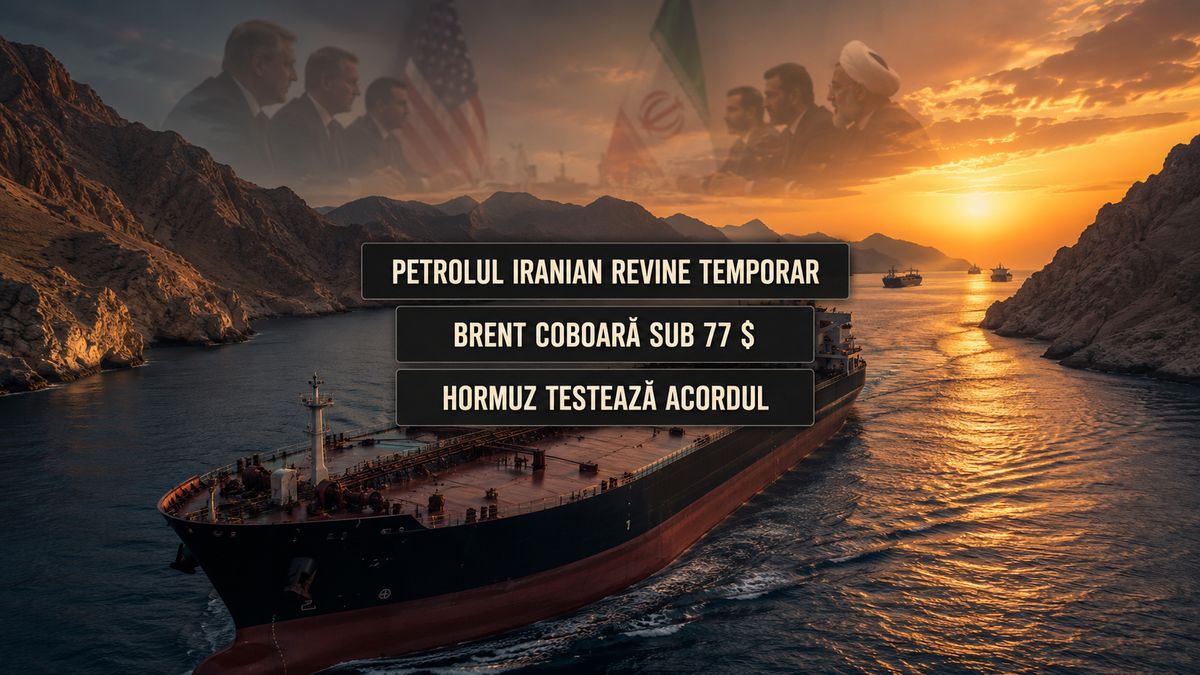
Iranian oil is temporarily returning to US-authorized commercial channels, a move that immediately shifts market signals after months of tension in the Gulf. The Office of Foreign Assets Control (OFAC), the US Department of the Treasury agency that administers sanctions, issued General License X on June 22. This document authorizes, until August 21, 2026, transactions necessary for the production, sale, delivery, and unloading of Iranian-origin crude oil, petroleum products, and petrochemical products. The license is not a permanent lifting of sanctions. It is a time-limited authorization, structured as part of negotiations between Washington and Tehran. This very limitation explains the market's swift yet cautious reaction: while potential supply is expanding, the political and logistical conditions for a full recovery remain highly uncertain. On the morning of June 23, Brent fell by 1.4% to $76.81 per barrel, while WTI dropped to $72.99 per barrel. The decline followed a pullback of over 3% in the previous session, as the market began pricing in the prospects of resuming oil flows through the Strait of Hormuz. What the US license actually permits General License X has a broader scope than simply permitting the purchase of Iranian oil. The document authorizes transactions "ordinarily incident and necessary" to the production, sale, delivery, or unloading of Iranian-origin crude oil, petroleum products, and petrochemicals. This category includes activities essential to the actual functioning of the oil trade: vessel management, crewing, bunkering, piloting, vessel registration and flagging, insurance, classification, salvage, safe mooring, and anchoring. The license even permits imports into the US when necessary to complete the sale, delivery, or unloading of the cargo. A financially significant element is the authorization of US dollar payments to Iran, the Iranian government, or blocked persons for eligible oil, petroleum products, and petrochemical products under the license. For traders, banks, insurers, and vessel operators, this is one of the key mechanisms that can translate a political decision into an actual transaction. The authorization excludes individuals and entities from North Korea, Cuba, sanctioned regions of Ukraine, and Crimea. Furthermore, it does not override prohibitions resulting from other executive orders or US regulations not explicitly covered by the license. Washington links oil to nuclear inspections and Hormuz The US administration presented the measure as part of a negotiated framework with Tehran. According to information published after the license was issued, Iran has committed to allowing access for International Atomic Energy Agency (IAEA) inspectors and supporting free transit through the Strait of Hormuz. The link between oil, the nuclear issue, and maritime transit is essential. Washington is not merely offering a period of trade relief. It is using Iran's access to energy revenues as leverage in negotiations for two issues that directly impact global security: the verification of the nuclear program and the stability of the world's most critical energy transit chokepoint. Prior to the conflict, Hormuz carried approximately one-fifth of global maritime oil and LNG flows. A critical portion of exports from Saudi Arabia, Iraq, the United Arab Emirates, Kuwait, Qatar, and Iran passes through this strait. A de facto closure or blockage of transit does not just affect Iranian oil, but the entire supply architecture of Asia and, indirectly, global energy prices. Two tankers do not mean a return to normal traffic The market reacted to the first physical signs of traffic resumption. Tracking data showed that two crude tankers, carrying nearly 2 million barrels, crossed Hormuz on Monday. Two other supertankers entered the Gulf through the strait, with one indicating the Iraqi port of Basra as its destination. These movements are relevant because markets do not just follow diplomatic statements. They track vessels, cargoes, insurance, crew availability, port scheduling, and the actual pace of deliveries to refineries. However, current traffic levels remain low. Reuters notes that the observed crossings represent only a fraction of the pre-war average of about 125 vessels per day. The market cannot treat two tankers as proof of full normalization, and this discrepancy explains why Brent fell but did not return to the $60–$70 per barrel levels seen at the beginning of the year. The physical return of flows depends on several simultaneous conditions: maritime safety, insurance premiums, vessel availability, the pace of port operations, trader confidence, and the political stability of the truce. A declared reopening can have a rapid effect on financial markets. However, fully restoring physical supply chains takes weeks or months. The market tests the agreement with every day of transit Brent's decline to $76.81 per barrel shows that the market is pricing in a higher probability…
Ioana Buzoaica — Independent Editorial Board
The NRG-IA newsroom continuously monitors Romanian energy markets, ANRE regulatory decisions, and national grid telemetry (SEN/SNT). We deliver independent intelligence anchored exclusively in official primary data.
Editorial Charter, Ethics & Verification Methodology →