Oil could hit $150 if US-Iran truce fails, Rystad warns — NRG-IA
Geopolitică & Energie Author: Aurora AI$150/bbl oil is not the baseline forecast, but a risk scenario of a US-Iran escalation and Hormuz disruptions, impacting Europe via Brent and fuels.
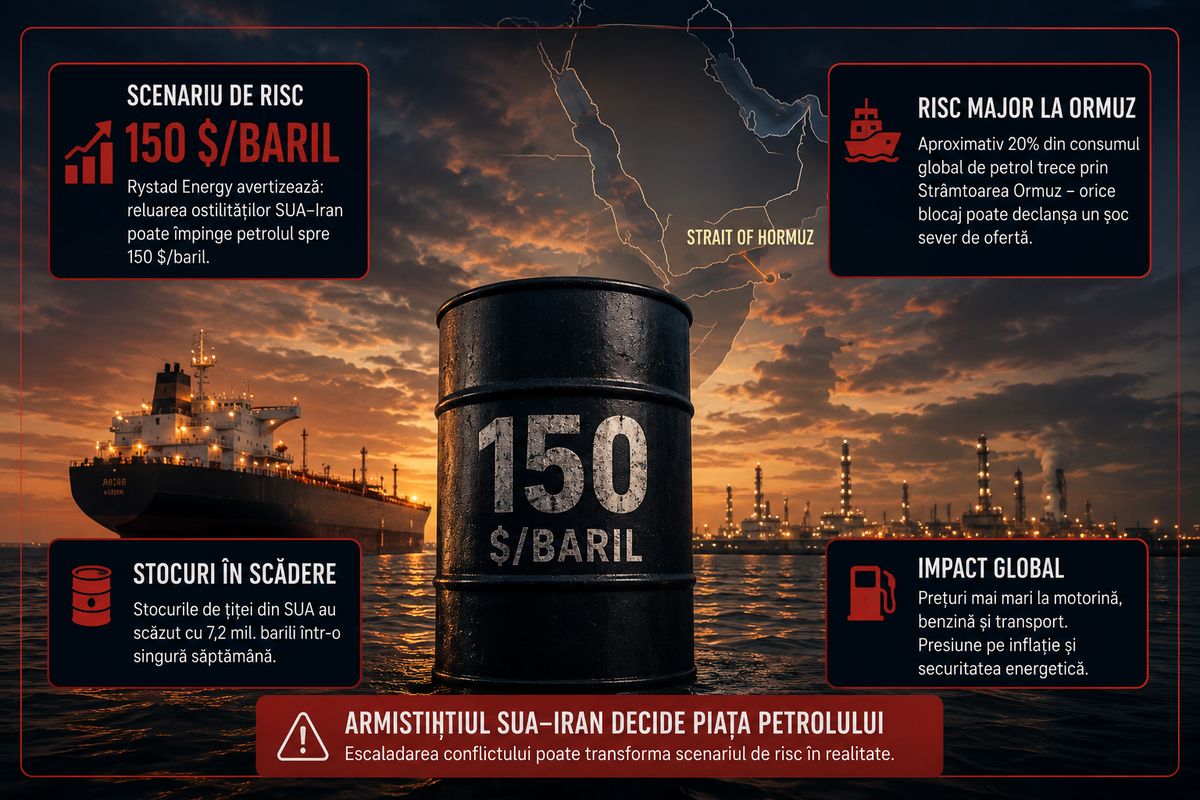
Oil could surge toward $150 per barrel if the US-Iran truce collapses and full-scale hostilities resume, Rystad Energy warns, according to OilPrice and Business Standard. This scenario is tied to a potential worsening of supply bottlenecks in the Middle East, persistent risks surrounding the Strait of Hormuz, and low inventory levels, which have cushioned market shocks so far. While the $150 figure carries editorial weight, it must be read as a conditional scenario. Rystad is not pointing to an inevitable price level, but rather a possible threshold in a severe escalation of the conflict. The distinction is crucial for the market: Brent in the $90–$100 range reflects high tension; Brent heading toward $150 would signal major supply losses, fears of a prolonged blockade, and intense pressure on refined products. The $150 scenario depends on a resumption of hostilities Rystad Energy estimates that a serious resumption of hostilities between the US and Iran could push oil toward $150/bbl. Business Standard cites the firm's analysis, which links this scenario to significant volumes being knocked offline among Gulf producers and the market's inability to quickly offset an additional shock. The critical point is the scale of the renewed conflict. A limited military episode might maintain volatility and a risk premium in oil prices. However, a sustained escalation—featuring attacks on energy infrastructure, damaged vessels, restricted shipping routes, and soaring insurance costs—would fundamentally alter the balance between available supply and demand. Rystad also highlights the current uncertainty. The market does not yet have confirmation that current tensions represent a full return to open conflict. This uncertainty explains price fluctuations: traders react to every military and diplomatic signal, but have not yet fully priced in an extreme scenario. Hormuz concentrates global oil risk The Strait of Hormuz remains the central mechanism of this stress scenario. The EIA notes that in 2024, an average of approximately 20 million barrels per day passed through Hormuz, equivalent to about 20% of global petroleum liquids consumption. In the first half of 2025, flows through the strait averaged approximately 20.9 million barrels per day, representing nearly a quarter of the world's seaborne oil trade. This route lacks sufficient alternatives to quickly absorb a major blockage. Regional pipelines and ports can only divert a fraction of the volumes. The remainder depends on navigation through the strait, tanker security, military decisions by regional actors, and shippers' appetite for risk. The IEA extends the stakes to liquefied natural gas as well. Hormuz is highly relevant for LNG, particularly due to exports from Qatar and the United Arab Emirates. A prolonged crisis would simultaneously hit crude oil, refined products, and LNG, transmitting broader pressure across global energy markets. Inventories cushion the shock, but the buffer is narrowing The market has so far avoided an uncontrolled price spike because it possessed buffers: strategic inventories, flow adjustments, declines in certain imports, limited alternative routes, and cautious trader reactions. In March, the IEA announced the largest coordinated emergency stock release in the agency's history, making 400 million barrels available to the market. This buffer is not infinite. If supply losses persist and flows through Hormuz remain restricted, inventories become part of the problem: each month of deficit reduces the market's capacity to absorb the next shock. In such a context, price reactions are non-linear. An additional lost volume can trigger a disproportionate spike if refiners, shippers, and traders begin competing for available barrels. Recent US data highlights the pressure on inventories. The EIA reported a 7.2 million barrel draw in commercial crude inventories for the week ending June 5, down to 426.5 million barrels. While a single weekly report does not define the global market, it confirms the trend: in a tight market, inventories become a critical price indicator. What could push Brent toward $150 The $150 scenario requires a combination of factors. First is the collapse of the US-Iran truce and a shift to sustained hostilities. Second is a severe restriction of traffic through Hormuz, either via military blockade or operational risks so high that shippers avoid the route or demand much higher insurance premiums. Third is a further reduction in production or exports from Gulf states. Another channel is refining. Expensive crude is passed down through the cost of petroleum products, but pressure intensifies if refineries do not receive the required crude grades or if shipping costs rise. Diesel and jet fuel are typically more sensitive in such episodes due to their global supply chains and high industrial demand. A $150 price tag would reflect a market where actors are no longer just buying oil, but securing supply. Contracts, vessels,…