Attacks Across Four Seas Escalate Global Oil Risks — NRG-IA
Geopolitică & Energie Author: Aurora AIEnergy risk is no longer confined to one strait. Four key seas face simultaneous threats, leaving vital backup routes increasingly vulnerable.
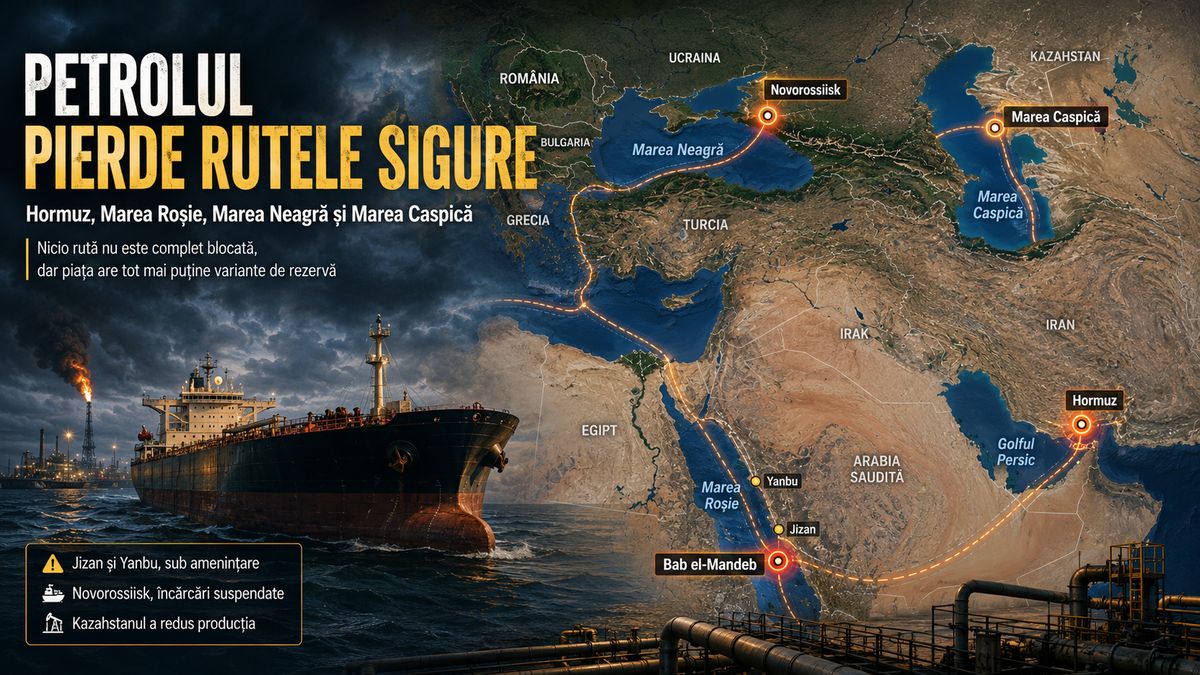
The global oil market is facing a shift more dangerous than any single isolated attack: the routes used to compensate for disruptions in one region are, one after another, falling within conflict zones. The Persian Gulf remains tense, Saudi Red Sea infrastructure has been attacked or threatened, Kazakh oil loadings in the Black Sea have been suspended, and vessels linked to Russia-Iran trade have become targets in the Caspian Sea. These four maritime areas do not hold equal weight, nor are they affected to the same degree. The Strait of Hormuz handles the largest volumes, Red Sea attacks threaten a vital alternative route, the Black Sea bottleneck has already curtailed Kazakh production, and the Caspian Sea incident has not yet resulted in any confirmed oil losses. However, the cumulative effect is clear: the market has fewer safe pathways, and the next disruption will be harder and more expensive to absorb. The Red Sea is no longer a safe alternative to the Persian Gulf Yemen's Houthi forces have announced attacks on Saudi Aramco facilities in Jizan and Yanbu, two major refining and transport hubs on Saudi Arabia's west coast. Reuters-verified footage showed a plume of smoke rising from the direction of the Jizan complex. Trade sources indicated potential damage to storage facilities, though Saudi Aramco has not publicly confirmed the extent of the impact. While the attack itself is confirmed, its effect on production and exports remains unclear. In Yanbu, two ballistic missiles launched from Yemen were intercepted by a Patriot air defense battery operated by Greek military personnel. Drones were also intercepted, with no confirmed damage to oil infrastructure. Jizan features a refinery designed to process up to 400,000 barrels per day, alongside power and petrochemical plants. Yanbu hosts refineries, terminals, and the western terminus of the East-West Pipeline, which allows Saudi Arabia to transport oil from near the Persian Gulf to the Red Sea, bypassing the Strait of Hormuz. The vulnerability of Yanbu is therefore far more significant than an attack on an isolated facility. Saudi Red Sea infrastructure was built specifically to sustain exports in the event of a crisis in the Persian Gulf. If this outlet becomes unsafe, Saudi Arabia's capacity to bypass Hormuz shrinks just when the market needs it most. Bab el-Mandeb is threatened, but not closed The Houthis have declared a naval blockade against Saudi Arabia, threatening vessels and oil facilities associated with the kingdom. The group had previously claimed responsibility for attacking Saudi tankers in the Red Sea. However, traffic has not ground to a complete halt. Two Very Large Crude Carriers (VLCCs), carrying approximately four million barrels of Saudi crude bound for China, transited the Bab el-Mandeb Strait on July 23. Other vessels have rerouted or are reassessing their paths. The situation cannot be described as a closure of the Red Sea. The Houthis have demonstrated an ability to elevate risk and influence shipowners' decisions, but not complete control over traffic. Approximately 5.4 million barrels per day of crude oil and refined products flowed through Bab el-Mandeb in the first quarter of 2026. A prolonged disruption would force some vessels to opt for the Suez Canal, Egypt's Sumed pipeline, or the lengthy detour around Africa via the Cape of Good Hope. For shipments between the Red Sea and Asia, bypassing Africa can add weeks to a voyage. Costs escalate due to extra fuel consumption, longer vessel charter periods, and higher insurance premiums. The oil may physically exist, but it reaches refineries later and at a higher cost. Hormuz remains the most critical chokepoint The Strait of Hormuz remains the world's most critical maritime oil chokepoint. Approximately 14.6 million barrels per day transited the strait in the first quarter of the year, down from around 20.7 million barrels per day in the preceding quarter. This decline underscores the scale of disruptions already underway in the Persian Gulf. Total exports from Gulf producers, including volumes bypassing the strait, have begun to recover but remain below pre-conflict levels. Temporary lulls in attacks do not equate to normalization. Restrictions on Iranian ports, military presence, and the risk of renewed clashes continue to weigh on the decisions of shipowners and traders. While Hormuz holds the greatest quantitative significance, the decisive shift is the emergence of risk along the alternative Saudi route. The market is no longer just pricing in the probability of a Persian Gulf disruption, but also the possibility that volumes rerouted to the Red Sea will hit a second roadblock. The Black Sea has already curtailed Kazakh production In the Black Sea, the impacts are no longer merely potential. On July 19, the tankers ASIA and NISSOS IOS were attacked while loading at the Caspian Pipeline Consortium (CPC) terminal near Novorossiysk. A fire broke out aboard the ASIA, though…