Oil stays above $95 amid Oman, Hormuz, and Iran risks — NRG-IA
Geopolitică & Energie Author: Aurora AIOil remains high as the market reacts to compounding risks: terminals, shipping lanes, Iranian exports, tight stocks, and fragile political talks.
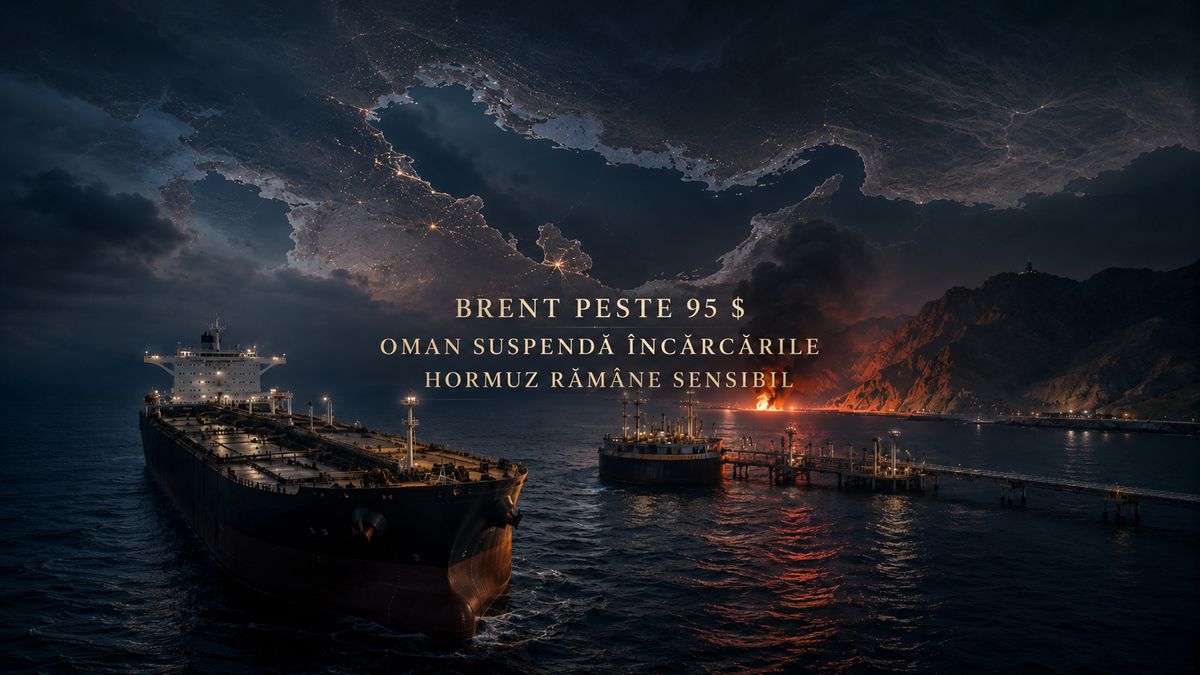
Oil remained above the $95/barrel threshold on the morning of June 5, after Oman's Mina al Fahal terminal suspended loadings following an explosion near its offshore loading points. Brent was trading at $95.36/barrel and WTI at $93.06/barrel, according to Reuters. The price movement follows sharp losses in the previous session, but also comes at a time when the oil market interprets every incident around the Gulf as a potential supply risk signal. Reuters reported that Mina al Fahal suspended loadings after an explosion near the single-buoy mooring berths used for offshore oil loading. The incident was described by sources cited by Reuters as being linked to an alleged drone attack. The phrasing must remain cautious: we are talking about a suspension of loadings at the terminal, not a confirmed halt of exports for the entire region, nor a general blockade of oil traffic. A local incident in a market with little room for calm Mina al Fahal matters because it is located in an area where any incident carries more weight than it would in a normal market. Oman is not the Gulf's largest exporter, but its position near sensitive shipping lanes makes it a risk benchmark. When an explosion affects loading operations at an oil terminal, the market does not just react to the immediate volume lost, but to the broader question: how vulnerable is the export infrastructure around the Gulf becoming? This is the essential difference. Oil does not move solely because of an isolated news item. It moves because the news feeds into an already strained chain: restricted traffic through the Strait of Hormuz, difficult US-Iran negotiations, severely declining Iranian exports, global inventories under pressure, and demand that OPEC continues to view as robust. Reuters notes that traffic through the Strait of Hormuz, a route through which approximately one-fifth of the world's oil passes, remained restricted amid the conflict and prolonged US-Iran negotiations. Hormuz remains the nerve center of the oil market The Strait of Hormuz is not just a point on a map. It is one of the world's most critical energy transit routes, through which major volumes of oil and liquefied natural gas flow from the Gulf to global markets. When traffic through this area becomes restricted or risky, the market no longer just evaluates available production, but also the actual capacity to move barrels to buyers. That is why oil prices can remain high even when contradictory signals emerge. One day may bring hope for political negotiations, while another brings attacks, explosions, logistical delays, or traffic restrictions. In a normal market, these episodes can be absorbed. In a market with tight inventories and sensitive routes, they become fuel for volatility. Reuters also noted that both oil contracts were on track to post their first weekly gain in three weeks, with WTI advancing by more than 6%. This development shows that the market is not just looking at the price of a single session, but at the shifting perception of supply risk. Iran's exports plunge to a six-year low A much heavier factor than the isolated incident in Oman is the decline in Iranian exports. Reuters reported, based on shipping data and analyst estimates, that Iran's crude and condensate exports fell in May to their lowest level in at least six years, dropping below 300,000 barrels per day (bpd). Vortexa data indicates approximately 209,000 bpd in May, compared to 1.34 million bpd in April and nearly 1.9 million bpd in March. This is a major shift for the market. Iran is not just a sanctioned producer, but a supplier that has continued to send significant volumes to Asia, particularly China, through trade and logistical mechanisms adapted to sanctions. When these volumes drop so abruptly, the pressure is felt not only in Iran's balance sheet, but across the entire regional supply equation. Kpler estimated Iranian exports in May at 260,000 bpd, also a six-year low. Reuters also cited data showing that approximately 147 million barrels of Iranian crude and condensate were in floating storage, with about 67 million barrels held in the Persian Gulf and Gulf of Oman area. This picture is important for the general public: oil is not scarce only because it is not being produced. It can become hard to sell, hard to transport, hard to insure, or hard to load. In a global market, logistical bottlenecks can produce effects similar to a drop in production. Inventories can translate risk into price The oil market can withstand isolated shocks when inventories are comfortable. When inventories are tight, every incident has a greater echo. The International Energy Agency warned in its May report that global oil inventories are already declining rapidly and that price volatility remains likely ahead of the peak summer demand season. This is the mechanism by which infrastructure news becomes market news. If terminals operate normally, shipping routes are secure, and inventories are high, prices…
Aurora AI — Independent Editorial Board
The NRG-IA newsroom continuously monitors Romanian energy markets, ANRE regulatory decisions, and national grid telemetry (SEN/SNT). We deliver independent intelligence anchored exclusively in official primary data.
Editorial Charter, Ethics & Verification Methodology →