Oil Rises to $94.39: Hormuz at 8m bpd & New US Sanctions — NRG-IA
Geopolitică & Energie Author: Ioana BuzoaicaThe oil market faces dual pressure: physical constraints in Hormuz persist, while the US prepares tougher sanctions targeting Iran's trade with China.
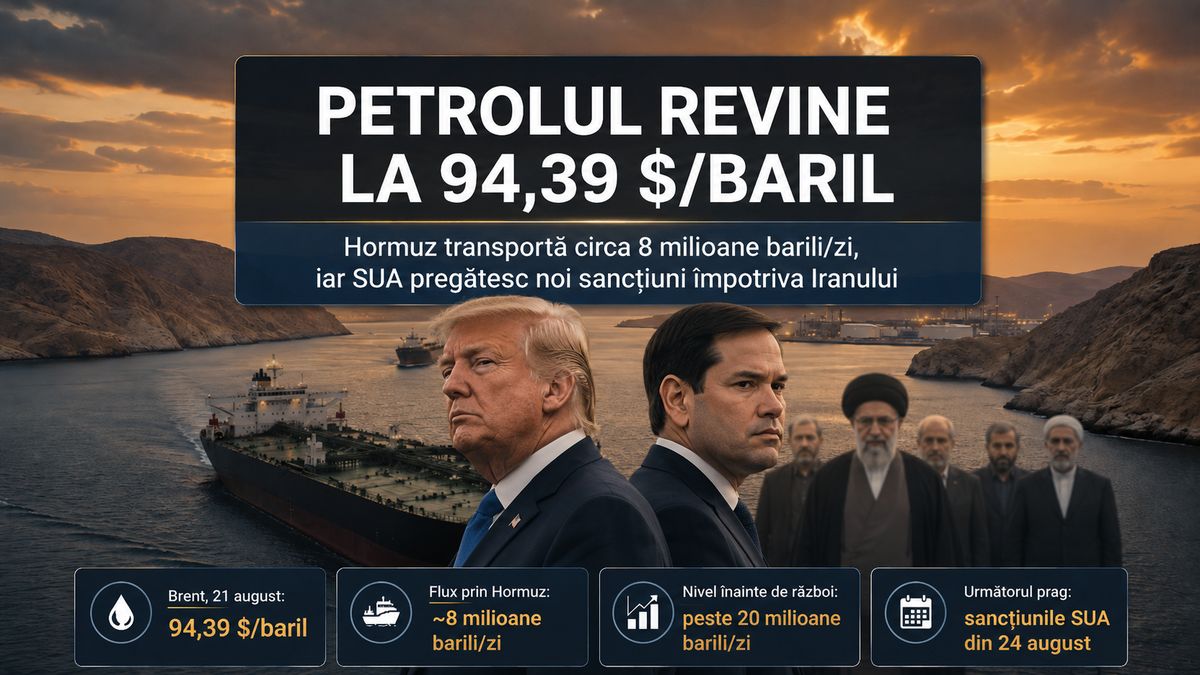
Oil ended the week once again close to $95 per barrel, at a time when geopolitical risk is shifting simultaneously on two fronts: the volume of crude oil managing to cross the Strait of Hormuz remains heavily reduced, and Washington is preparing a new sanctions regime against Iran and the partners who continue to support its trade. Brent closed on Friday, August 21, at $94.39 per barrel , up 0.65% on the day and 6.39% in a single week . WTI reached $87.06 per barrel. Behind this rebound lies a figure that illustrates the scale of the physical disruption. US Energy Secretary Chris Wright estimates that an average of approximately 8 million barrels of oil per day passed through Hormuz over the last seven days, compared to over 20 million barrels per day before the war . The route is not completely closed, but it is operating at a fraction of its pre-conflict oil flow. Physical pressure on transit is now compounding the preparation of a new economic phase of the confrontation. The US administration is set to present details on Monday, August 24, regarding new sanctions against Iran. Treasury Secretary Scott Bessent described them as the toughest sanctions prepared by Washington to date, and President Donald Trump warned of economic consequences for countries or companies that continue to provide commercial support to Iran. Hormuz is operating far below pre-war levels The Strait of Hormuz remains the physical chokepoint where military tension translates directly into risk for global energy supply. Before the war, the route accounted for over 20 million barrels of oil per day, a volume large enough that any sustained disruption would impact global prices. The estimated 8 million barrels per day currently cited by the US administration show that a significant portion of normal flows is no longer crossing the strait at its previous pace. The latest tracking data cited by Reuters indicated that only four commercial cargo vessels transited Hormuz on Thursday, with no VLCC supertankers and no LNG carriers. Vessel counts can fluctuate sharply from day to day and do not directly equate to the volume of oil transported. However, the broader trend is confirmed by the oil flow estimate: the effectively utilized capacity of the Gulf's primary energy gateway remains severely reduced. The consequences extend beyond Iran. Saudi Arabia, Iraq, Kuwait, and other major Gulf producers depend to varying degrees on this route for access to the global market. As long as transit remains restricted, the market must price in not only the volumes actually lost but also the risk of a prolonged or worsening disruption. Washington shifts pressure from infrastructure to trade The new US phase introduces a different risk. While the restriction of flows through Hormuz affects the physical availability of oil, sanctions can simultaneously limit Iran's ability to find buyers, intermediaries, financing, shipping, and services necessary for trade. This effect becomes even more significant as Washington threatens to extend the economic cost to Tehran's trading partners. In this equation, China occupies the central position. Kpler data cited by Reuters shows that, in 2025, China purchased over 80% of seaborne Iranian oil . Restricting this relationship would hit Iran's primary export market, while also forcing Chinese refiners using these volumes to find alternative sources. Beijing has rejected unilateral sanctions and advocates for a diplomatic solution. For the oil market, however, the immediate issue is one of substitution: if less Iranian crude reaches China, buyers must replace it with oil from other nations. China is already receiving significantly less Iranian oil This process is visible in trade data. Chinese imports of Iranian crude are estimated at approximately 534,000 barrels per day in August , compared to an average of about 1.4 million barrels per day in 2025 . In June, volumes were estimated at around 785,000 bpd, and in July at approximately 823,000 bpd. The decline is not just a trade statistic. It is changing the pricing relationship between Iran and its primary customer. Iranian Light crude had previously been offered to Chinese buyers at a discount of around $3 per barrel to Brent. According to trade sources cited by Reuters, some recent offers reached approximately $2 per barrel over Brent . This relative swing of about $5 per barrel indicates a major shift in the availability of these cargoes. In parallel, the volume of Iranian oil in floating storage outside the area affected by the blockade has dropped from approximately 105 million to 80 million barrels . Independent Chinese refiners in Shandong are already seeking more alternatives from Brazil and Iraq. Iran thus finds itself in an unusual situation: sanctioned oil, which traditionally had to be offered at a discount to offset commercial risk, may temporarily become scarce enough for some cargoes to command a premium. Brent at $94 reflects more than just a reaction to…
Ioana Buzoaica — Independent Editorial Board
The NRG-IA newsroom continuously monitors Romanian energy markets, ANRE regulatory decisions, and national grid telemetry (SEN/SNT). We deliver independent intelligence anchored exclusively in official primary data.
Editorial Charter, Ethics & Verification Methodology →